



Prevalence, Awareness, Treatment, and Control of High LDL Cholesterol in New York City, 2004
Supporting Files
Public Domain

-
Apr 15 2010
File Language:
English
Details
-
Journal Article:Preventing Chronic Disease (PCD)
-
Personal Author:
-
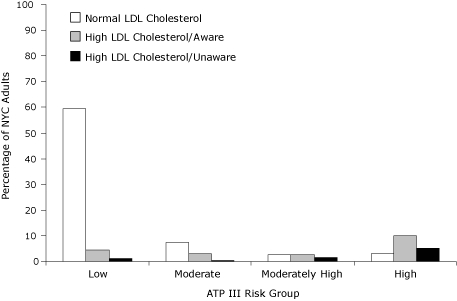
Description:Introduction ; Low-density lipoprotein (LDL) cholesterol is a major contributor to coronary heart disease and the primary target of cholesterol-lowering therapy. Substantial disparities in cholesterol control exist nationally, but it is unclear how these patterns vary locally. ; Methods ; We estimated the prevalence, awareness, treatment, and control of high LDL cholesterol using data from a unique local survey of New York City's diverse population. The New York City Health and Nutrition Examination Survey 2004 was administered to a probability sample of New York City adults. The National Health and Nutrition Examination Survey 2003-2004 was used for comparison. High LDL cholesterol and coronary heart disease risk were defined using National Cholesterol Education Program Adult Treatment Panel III (ATP III) guidelines. ; Results ; Mean LDL cholesterol levels in New York City and nationally were similar. In New York City, 28% of adults had high LDL cholesterol, 71% of whom were aware of their condition. Most aware adults reported modifying their diet or activity level (88%), 64% took medication, and 44% had their condition under control. More aware adults in the low ATP III risk group than those in higher risk groups had controlled LDL cholesterol (71% vs 33%-42%); more whites than blacks and Hispanics had controlled LDL cholesterol (53% vs 31% and 32%, respectively). ; Conclusions ; High prevalence of high LDL cholesterol and inadequate treatment and control contribute to preventable illness and death, especially among those at highest risk. Population approaches — such as making the food environment more heart-healthy — and aggressive clinical management of cholesterol levels are needed.
-
Subjects:
-
Source:Prev Chronic Dis. 7(3).
-
ISSN:1545-1151
-
Document Type:
-
Place as Subject:
-
Location:
-
Volume:7
-
Issue:3
-
Download URL:
-
File Type:
 [PDF - 626.90 KB]
 -
Collection(s):
-
Main Document Checksum:urn:sha-512:580bac3ddba8467e85ee6b49dcc701adda2f91a3746cdc42c46af681884f62d468c15c8e5bdcdbe64bbb1d794e2e8e7e3faec3a4029f45c5616bd3b414111275
Supporting Files


File Language:
English
 Was this page helpful?
 Found an issue?

CDC STACKS serves as an archival repository of CDC-published products including
scientific findings, journal articles, guidelines, recommendations, or other public health information authored or
co-authored by CDC or funded partners.
As a repository, CDC STACKS retains documents in their original published format to ensure public access to scientific information.
As a repository, CDC STACKS retains documents in their original published format to ensure public access to scientific information.
You May Also Like
COLLECTION
Preventing Chronic Disease