



Church-Based Breast Cancer Screening Education: Impact of Two Approaches on Latinas Enrolled in Public and Private Health Insurance Plans
Supporting Files
Public Domain

-
Sep 15 2007
File Language:
English
Details
-
Journal Article:Preventing Chronic Disease (PCD)
-
Personal Author:
-
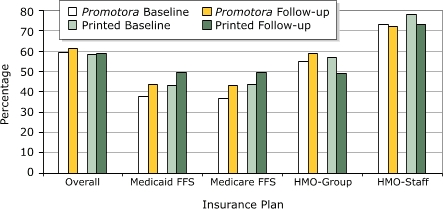
Description:Introduction ; The Tepeyac Project is a church-based health promotion project that was conducted from 1999 through 2005 to increase breast cancer screening rates among Latinas in Colorado. Previous reports evaluated the project among Medicare and Medicaid enrollees in the state. In this report, we evaluate the program among enrollees in the state's five major insurance plans. ; Methods ; We compared the Tepeyac Project's two interventions: the Printed Intervention and the Promotora Intervention. In the first, we mailed culturally tailored education packages to 209 Colorado Catholic churches for their use. In the second, promotoras (peer counselors) in four Catholic churches delivered breast-health education messages personally. We compared biennial mammogram claims from the five insurance plans in the analysis at baseline (1998–1999) and during follow-up (2000–2001) for Latinas who had received the interventions. We used generalized estimating equations (GEE) analysis to adjust rates for confounders. ; Results ; The mammogram rate for Latinas in the Printed Intervention remained the same from baseline to follow-up (58% 2979/5130 vs 58% 3338/5708). In the Promotora Intervention, the rate was 59% (316/536) at baseline and 61% (359/590) at follow-up. Rates increased modestly over time and varied widely by insurance type. After adjusting for age, income, urban versus rural location, disability, and insurance type, we found that women exposed to the Promotora Intervention had a significantly higher increase in biennial mammograms than did women exposed to the Printed Intervention (GEE parameter estimate = .24 ±.11, P = .03). ; Conclusion ; For insured Latinas, personally delivering church-based education through peer counselors appears to be a better breast-health promotion method than mailing printed educational materials to churches.
-
Subjects:
- Aged
- Analysis of Variance
- Breast Neoplasms
- Colorado
- Consumer Participation
- Counseling
- Female
- Hispanic or Latino
- Humans
- Insurance Coverage
- Insurance, Health
- Logistic Models
- Mammography
- Marketing of Health Services
- Mass Screening
- Middle Aged
- Peer Group
- Postal Service
- Program Evaluation
- Religion and Medicine
- Teaching Materials
-
Source:Prev Chronic Dis. 2007; 4(4).
-
ISSN:1545-1151
-
Document Type:
-
Volume:4
-
Issue:4
-
Download URL:
-
File Type:
 [PDF - 528.52 KB]
 -
Collection(s):
-
Main Document Checksum:urn:sha-512:f1139fb4a60a53b0e8c0bbe41d88abdd913bf4e00c3cfbb1387a175a726bd84717dda1c3816101a6c2d2f944f3ebbeb3994d9a3bcdfb14fa2fb7db5647ed4527
Supporting Files


File Language:
English
 Was this page helpful?
 Found an issue?

CDC STACKS serves as an archival repository of CDC-published products including
scientific findings, journal articles, guidelines, recommendations, or other public health information authored or
co-authored by CDC or funded partners.
As a repository, CDC STACKS retains documents in their original published format to ensure public access to scientific information.
As a repository, CDC STACKS retains documents in their original published format to ensure public access to scientific information.
You May Also Like
COLLECTION
Preventing Chronic Disease