



From Program to Policy: Expanding the Role of Community Coalitions
Supporting Files
Public Domain

-
Sep 15 2007
-
Series: Community Case Study
File Language:
English
Details
-
Journal Article:Preventing Chronic Disease (PCD)
-
Personal Author:Hill, Anne ; Guernsey De Zapien, Jill ; Staten, Lisa K ; McClelland, Deborah Jean ; Moore-Monroy, Martha ; Meister, Joel S ; Garza, Rebecca ; Elenes, JoJean ; Steinfelt, Victoria ; Tittelbaugh, Ila ; Whitmer, Evelyn
-
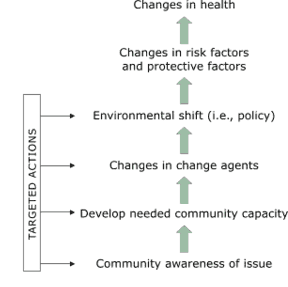
Description:Background ; Diabetes mortality at the United States–Mexico border is twice the national average. Type 2 diabetes mellitus is increasingly diagnosed among children and adolescents. Fragmented services and scarce resources further restrict access to health care. Increased awareness of the incidence of disease and poor health outcomes became a catalyst for creating community-based coalitions and partnerships with the University of Arizona that focused on diabetes. ; Context ; Five partnerships between the communities and the University of Arizona were formed to address these health issues. They began with health promotion as their goal and were challenged to add policy and environmental change to their objectives. Understanding the meaning of policy in the community context is the first step in the transition from program to policy. Policy participation brings different groups together, strengthening ties and building trust among community members and community organizations. ; Methods ; Data on progress and outcomes were collected from multiple sources. We used the Centers for Disease Control and Prevention's Racial and Ethnic Approaches to Community Health (REACH) 2010 Community Change Model as the capacity-building and analytic framework for supporting and documenting the transition of coalitions from program to policy. ; Consequences ; Over 5 years, the coalitions made the transition, in varying degrees, from a programmatic focus to a policy planning and advocacy focus. The coalitions raised community awareness, built community capacity, encouraged a process of "change in change agents," and advocated for community environmental and policy shifts to improve health behaviors. ; Interpretation ; The five coalitions made environmental and policy impacts by engaging in policy advocacy. These outcomes indicate the successful, if not consistently sustained, transition from program to policy. Whether and how these "changes in change agents" are transferable to the larger community over the long term remains to be seen.
-
Subjects:
-
Source:Prev Chronic Dis. 2007; 4(4).
-
Series:
-
ISSN:1545-1151
-
Document Type:
-
Place as Subject:
-
Location:
-
Volume:4
-
Issue:4
-
Download URL:
-
File Type:
 [PDF - 505.28 KB]
 -
Collection(s):
-
Main Document Checksum:urn:sha-512:f7b7dc98e4bf2b53158d860e446386bd9930a38d44a5de702ebb900d9a9e966ac654dce5ddf7947918804096f419a0ed900fd0c3ea7fab3fb603098f4182e628
Supporting Files


File Language:
English
 Was this page helpful?
 Found an issue?


CDC STACKS serves as an archival repository of CDC-published products including
scientific findings, journal articles, guidelines, recommendations, or other public health information authored or
co-authored by CDC or funded partners.
As a repository, CDC STACKS retains documents in their original published format to ensure public access to scientific information.
As a repository, CDC STACKS retains documents in their original published format to ensure public access to scientific information.
You May Also Like
COLLECTION
Preventing Chronic Disease