



The Role of State Public Health Agencies in Addressing Less Prevalent Chronic Conditions
Supporting Files

-
Jun 15 2005
File Language:
English
Details
-
Journal Article:Preventing Chronic Disease (PCD)
-
Personal Author:
-
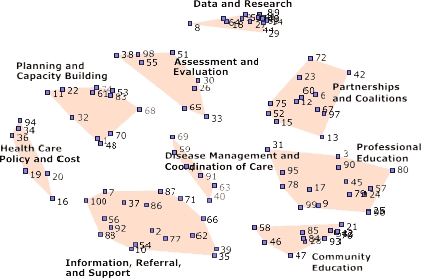
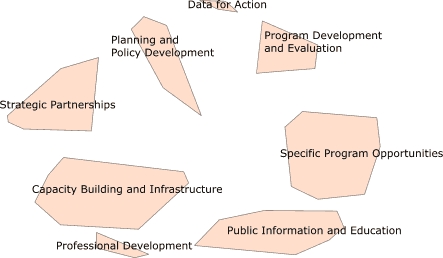
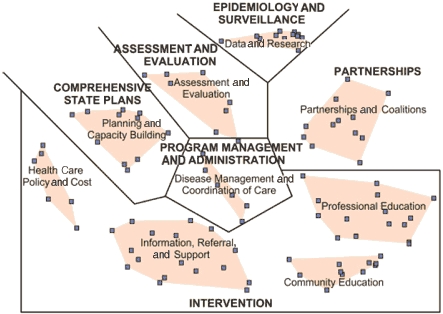
Description:Introduction ; State-based chronic disease programs typically focus on the most prevalent chronic conditions, such as cancer, diabetes, and cardiovascular disease, but interest in less prevalent chronic conditions (LPCCs), such as epilepsy, is growing. In our study, we examined the perceived roles of state health departments in addressing LPCCs and used this information to develop recommendations for state health departments that are considering developing LPCCs programs. We also compared the identified state health department roles for LPCCs with roles related to healthy aging, as well as to the essential elements of existing state-based chronic disease programs, to determine whether future LPCCs programs would have any unique requirements. ; Methods ; Participants used concept-mapping techniques to generate a set of 100 statements on steps that state health departments could take to address LPCCs. The participants sorted and rated each statement according to importance and feasibility. We used a sequence of multivariate statistical analyses to generate a series of maps, or clusters, and rating graphics. We reviewed the findings and produced recommendations for state health departments. We used a similar process to examine roles of state health departments in addressing healthy aging. ; Results ; The participants grouped the LPCCs statements into nine clusters, which they rated as moderately feasible and important. The healthy aging statements were grouped into eight clusters. Clusters for LPCCs and healthy aging were similar. We also compared LPCCs clusters and the essential elements of existing state-based chronic disease programs and found that they were similar. ; Conclusion ; The similarities between LPCCs clusters and essential elements of existing state-based chronic disease programs highlight an important point. State health departments that are considering establishing LPCCs programs should use strategies that have already been used by other public health agencies to develop chronic disease prevention and control programs.
-
Subjects:
-
Source:Prev Chronic Dis. 2005; 2(3).
-
ISSN:1545-1151
-
Document Type:
-
Funding:
-
Place as Subject:
-
Location:
-
Volume:2
-
Issue:3
-
Download URL:
-
File Type:
 [PDF - 330.96 KB]
 -
Collection(s):
-
Main Document Checksum:urn:sha-512:e93bada4bdbe72f6f807eaae73a3309f8dd2d818e41b77aebe2e2dc437712ffdb1703abe9e97843ccf0505b2243ac96482c4924ed4527189fc807c9b45ee0165
Supporting Files


File Language:
English
 Was this page helpful?
 Found an issue?


CDC STACKS serves as an archival repository of CDC-published products including
scientific findings, journal articles, guidelines, recommendations, or other public health information authored or
co-authored by CDC or funded partners.
As a repository, CDC STACKS retains documents in their original published format to ensure public access to scientific information.
As a repository, CDC STACKS retains documents in their original published format to ensure public access to scientific information.
You May Also Like
COLLECTION
Preventing Chronic Disease