



Bringing Health Policy Issues Front and Center in the Community: Expanding the Role of Community Health Coalitions1
Supporting Files
Public Domain

-
Dec 15 2004
File Language:
English
Details
-
Journal Article:Preventing Chronic Disease (PCD)
-
Personal Author:
-
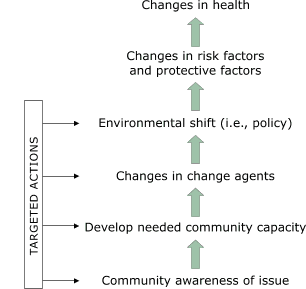
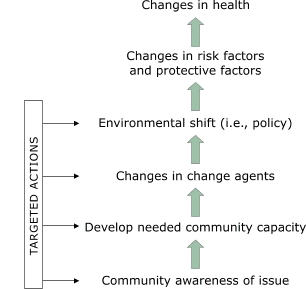
Description:Background ; Systemic, environmental, and socioeconomic conditions create the context in which community members deal with their health concerns. Comprehensive, community-based chronic disease prevention interventions should address community-wide or regional policy issues that influence lifestyle behaviors associated with chronic diseases. ; Context ; In two communities along the Arizona-Mexico border, community coalitions that administered a comprehensive diabetes prevention and control intervention expanded their membership to become policy and advocacy coalitions with broad community representation. These coalitions, or Special Action Groups (SAGs), identified and prioritized policy issues that directly or indirectly affect physical activity or nutrition. ; Methods ; Local schools were one focus of advocacy. The Centers for Disease Control and Prevention's School Health Index was implemented as part of the overall intervention; the SAGs supported schools in advocating for more physical education programs, removal of vending machines, substitution of more healthful options in vending machines, and changes in health education curricula. In the broader community, the SAGs promoted opportunities for walking and bicycling, long-term planning by their cities and counties, and healthy food choices in local grocery stores. ; Consequences ; After three years, SAGs were able to document changes in local policies and practices attributable to their activities. ; Interpretation ; The SAGs contributed to systems changes in their communities and were able to obtain new resources that support protective behaviors. Also, the advocacy process itself provided strong positive reinforcement to all participants in this comprehensive diabetes intervention.
-
Subjects:
-
Source:Prev Chronic Dis. 2005; 2(1).
-
ISSN:1545-1151
-
Document Type:
-
Place as Subject:
-
Location:
-
Volume:2
-
Issue:1
-
Download URL:
-
File Type:
 [PDF - 239.54 KB]
 -
Collection(s):
-
Main Document Checksum:urn:sha-512:40b877c0dd469536f6872dfba9877ffc36d0a9de32b9a15facedc47565d6a39a241543afb138c18f218f6d96247c4789f801b86ae707f107771c3e3399d3cd56
Supporting Files


File Language:
English
 Was this page helpful?
 Found an issue?

CDC STACKS serves as an archival repository of CDC-published products including
scientific findings, journal articles, guidelines, recommendations, or other public health information authored or
co-authored by CDC or funded partners.
As a repository, CDC STACKS retains documents in their original published format to ensure public access to scientific information.
As a repository, CDC STACKS retains documents in their original published format to ensure public access to scientific information.
You May Also Like
COLLECTION
Preventing Chronic Disease