



Inadequate Functional Health Literacy in Spanish as a Barrier to Cervical Cancer Screening Among Immigrant Latinas in New York City
Supporting Files
Public Domain

-
Sep 15 2004
File Language:
English
Details
-
Journal Article:Preventing Chronic Disease (PCD)
-
Personal Author:
-
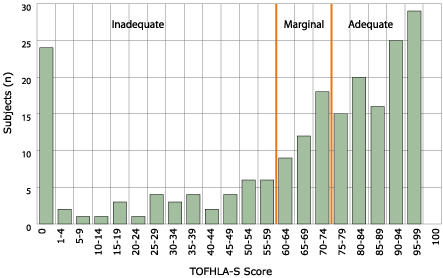
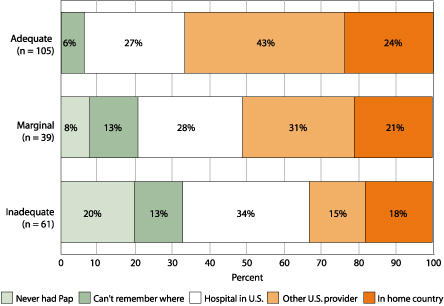
Description:Objective ; The objective of this study was to examine the association between inadequate functional health literacy in Spanish among low-income Latinas aged 40 and older and cervical cancer screening knowledge and behavior. ; Methods ; Spanish-speaking Latinas aged 40–78 of various nationalities (n = 205) participated in a study that included a survey on cervical cancer knowledge and behavior administered in Spanish and the Spanish version of the Test of Functional Health Literacy in Adults. ; Results ; Compared to those with adequate and marginal health literacy, women with inadequate functional health literacy in Spanish were significantly less likely to have ever had a Papanicolaou (Pap) test (odds ratio, 0.12; 95% confidence interval CI, 0.04-0.37) or in the last three years (odds ratio, 0.35; 95% CI, 0.18-0.68) and were significantly more likely to have had their last Pap test at a local public hospital (odds ratio, 2.43; 95% CI, 1.18-4.97). Even when controlling for other factors, women with inadequate health literacy were 16.7 times less likely (adjusted odds ratio, 0.06; 95% CI, 0.01-0.55) to have ever had a Pap test. ; Conclusion ; Almost half of the population we studied will have difficulty interpreting written medical materials, even in Spanish. When developing efforts to reach women who have not been screened, programs and service providers need to be aware that the women most in need of information about screening may be more likely to be unable to read any written materials provided to them, regardless of the language or level of simplicity of the materials. Programs and strategies need to be implemented to increase screening prevalence and to minimize the identified gaps in regular screening for Latinas who have low health literacy.
-
Subjects:
-
Source:Prev Chronic Dis. 2004; 1(4).
-
ISSN:1545-1151
-
Document Type:
-
Place as Subject:
-
Location:
-
Volume:1
-
Issue:4
-
Download URL:
-
File Type:
 [PDF - 368.92 KB]
 -
Collection(s):
-
Main Document Checksum:urn:sha-512:f70070f6cb41c50e0894ac6c2b4e3b74a1eb5d8e4398a60a6e0038c55849b2161ca16a902e5d0d21a3b098f35e3c0446d6f1b8dfbefb2fbd086878bfd0aa8f75
Supporting Files


File Language:
English
 Was this page helpful?
 Found an issue?



CDC STACKS serves as an archival repository of CDC-published products including
scientific findings, journal articles, guidelines, recommendations, or other public health information authored or
co-authored by CDC or funded partners.
As a repository, CDC STACKS retains documents in their original published format to ensure public access to scientific information.
As a repository, CDC STACKS retains documents in their original published format to ensure public access to scientific information.
You May Also Like
COLLECTION
Preventing Chronic Disease