



Health Care Reform and Women’s Insurance Coverage for Breast and Cervical Cancer Screening
Supporting Files

-
2012
File Language:
English
Details
-
Journal Article:Preventing Chronic Disease (PCD)
-
Personal Author:
-
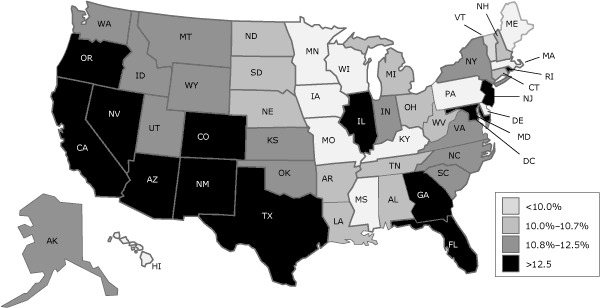
Description:Introduction ; The Patient Protection and Affordable Care Act of 2010 (ACA) will increase insurance coverage for US citizens and for breast and cervical cancer screening through insurance expansions and regulatory changes. The primary objective of this study was to estimate the number of low-income women who would gain health insurance after implementation of the ACA and thus be able to obtain cancer screening. A secondary objective was to estimate the size and characteristics of the uninsured low-income population and the number of women who would still need National Breast and Cervical Cancer Early Detection Program (NBCCEDP) services. ; Methods ; We used the nationally representative 2009 American Community Survey to estimate the determinants of insurance status for women in Massachusetts, assuming full implementation of the ACA. We extrapolated findings to simulate the effects of the ACA on each state. We used individual-level predicted probabilities of being uninsured to generate estimates of the number of women who would gain health insurance after implementation of the ACA and to predict demand for NBCCEDP services. ; Results ; Approximately 6.8 million low-income women would gain health insurance, potentially increasing the annual demand for cancer screenings initially by about 500,000 mammograms and 1.3 million Papanicolaou tests. Despite a 60% decrease in the number of low-income uninsured women, the NBCCEDP would still serve fewer than one-third of the estimated number of women eligible for services. The NBCCEDP-eligible population would comprise a larger number of women with language and literacy-related barriers to care. ; Conclusion ; Implementation of the ACA would increase insurance coverage and access to cancer screening for millions of women, but the NBCCEDP will remain essential for the millions who will remain uninsured.
-
Subjects:
- Adolescent
- Adult
- Aged
- Breast Neoplasms
- Early Detection of Cancer
- Female
- Health Care Reform
- Health Services Accessibility
- Health Services Needs and Demand
- Humans
- Insurance Coverage
- Mammography
- Medically Uninsured
- Middle Aged
- Papanicolaou Test
- Patient Protection and Affordable Care Act
- Poverty
- Uterine Cervical Neoplasms
- Vaginal Smears
-
Source:Prev Chronic Dis. 9.
-
DOI:
-
ISSN:1545-1151
-
Pubmed ID:23098646
-
Pubmed Central ID:PMC3499983
-
Document Type:
-
Funding:
-
Place as Subject:
-
Location:
-
Volume:9
-
Download URL:
-
File Type:
 [PDF - 265.87 KB]
 -
Collection(s):
-
Main Document Checksum:urn:sha-512:12cd42eefe9537e4c1a0189321ae3d2b9bfbf79d8313406c63da6e3407b762cb007ba869ea56e73e2be951c8b15079452dc547c9cf26df353f81f98fc4c4a44e
Supporting Files


File Language:
English
 Was this page helpful?
 Found an issue?


CDC STACKS serves as an archival repository of CDC-published products including
scientific findings, journal articles, guidelines, recommendations, or other public health information authored or
co-authored by CDC or funded partners.
As a repository, CDC STACKS retains documents in their original published format to ensure public access to scientific information.
As a repository, CDC STACKS retains documents in their original published format to ensure public access to scientific information.
You May Also Like
COLLECTION
Preventing Chronic Disease