


Guillain-Barré Syndrome, Influenza Vaccination, and Antecedent Respiratory and Gastrointestinal Infections: A Case-Centered Analysis in the Vaccine Safety Datalink, 2009–2011
Supporting Files
Public Domain

-
Jun 26 2013
-
File Language:
English
Details
-
Alternative Title:PLoS One
-
Personal Author:Greene, Sharon K. ; Rett, Melisa D. ; Vellozzi, Claudia ; Li, Lingling ; Kulldorff, Martin ; Marcy, S. Michael ; Daley, Matthew F. ; Belongia, Edward A. ; Baxter, Roger ; Fireman, Bruce H. ; Jackson, Michael L. ; Omer, Saad B. ; Nordin, James D. ; Jin, Robert ; Weintraub, Eric S. ; Vijayadeva, Vinutha ; Lee, Grace M.
-
Description:Background
Guillain-Barré Syndrome (GBS) can be triggered by gastrointestinal or respiratory infections, including influenza. During the 2009 influenza A (H1N1) pandemic in the United States, monovalent inactivated influenza vaccine (MIV) availability coincided with high rates of wildtype influenza infections. Several prior studies suggested an elevated GBS risk following MIV, but adjustment for antecedent infection was limited.
Methods
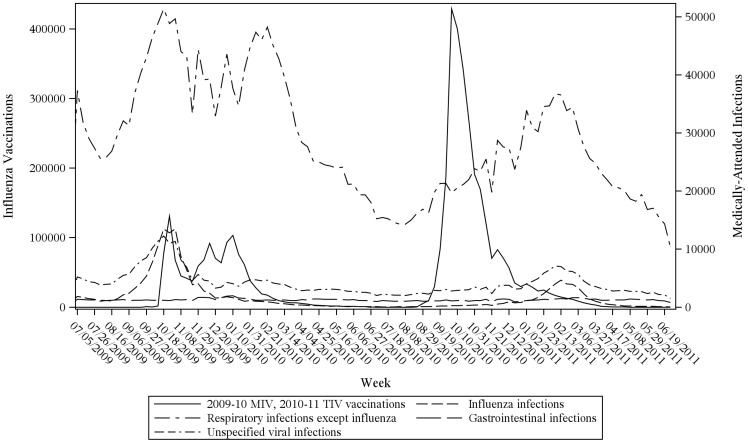
We identified patients enrolled in health plans participating in the Vaccine Safety Datalink and diagnosed with GBS from July 2009 through June 2011. Medical records of GBS cases with 2009–10 MIV, 2010–11 trivalent inactivated influenza vaccine (TIV), and/or a medically-attended respiratory or gastrointestinal infection in the 1 through 141 days prior to GBS diagnosis were reviewed and classified according to Brighton Collaboration criteria for diagnostic certainty. Using a case-centered design, logistic regression models adjusted for patient-level time-varying sources of confounding, including seasonal vaccinations and infections in GBS cases and population-level controls.
Results
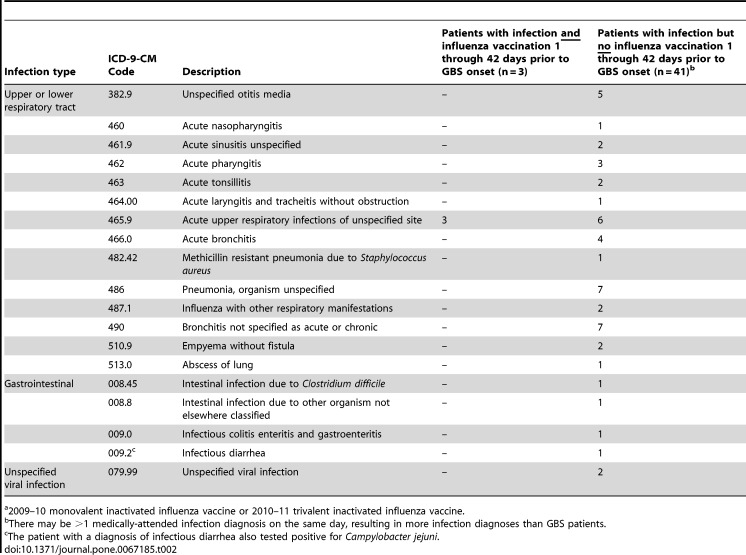
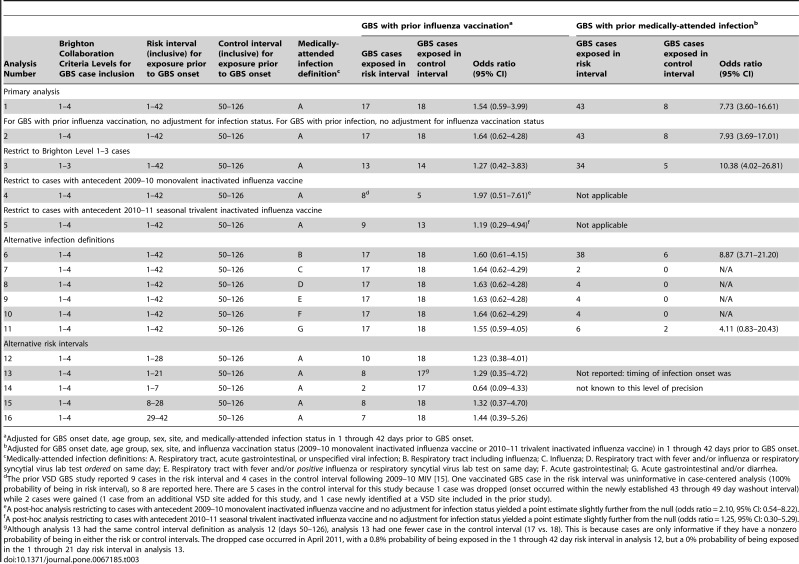
Eighteen confirmed GBS cases received vaccination in the 6 weeks preceding onset, among 1.27 million 2009–10 MIV recipients and 2.80 million 2010–11 TIV recipients. Forty-four confirmed GBS cases had infection in the 6 weeks preceding onset, among 3.77 million patients diagnosed with medically-attended infection. The observed-versus-expected odds that 2009–10 MIV/2010–11 TIV was received in the 6 weeks preceding GBS onset was odds ratio = 1.54, 95% confidence interval (CI), 0.59–3.99; risk difference = 0.93 per million doses, 95% CI, −0.71–5.16. The association between GBS and medically-attended infection was: odds ratio = 7.73, 95% CI, 3.60–16.61; risk difference = 11.62 per million infected patients, 95% CI, 4.49–26.94. These findings were consistent in sensitivity analyses using alternative infection definitions and risk intervals for prior vaccination shorter than 6 weeks.
Conclusions
After adjusting for antecedent infections, we found no evidence for an elevated GBS risk following 2009–10 MIV/2010–11 TIV influenza vaccines. However, the association between GBS and antecedent infection was strongly elevated.
-
Subjects:
-
Source:PLoS One. 2013; 8(6).
-
Document Type:
-
Volume:8
-
Issue:6
-
Collection(s):
-
Main Document Checksum:urn:sha256:73f2becdfad0a66f4ce1575df9463b73d81a0a295cd3999a85f98de4aaf2ef17
-
Download URL:
-
File Type:
 [PDF
- 496.63 KB
]
[PDF
- 496.63 KB
]
Supporting Files


File Language:
English
ON THIS PAGE



CDC STACKS serves as an archival repository of CDC-published products including
scientific findings,
journal articles, guidelines, recommendations, or other public health information authored or
co-authored by CDC or funded partners.
As a repository, CDC STACKS retains documents in their original published format to ensure public access to scientific information.
As a repository, CDC STACKS retains documents in their original published format to ensure public access to scientific information.
You May Also Like
COLLECTION
CDC Public Access