


Aerosol transmission is an important mode of influenza A virus spread
Supporting Files

-
2013
-
File Language:
English
Details
-
Alternative Title:Nat Commun
-
Personal Author:
-
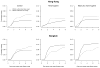
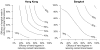
Description:Influenza A viruses are believed to spread between humans through contact, large respiratory droplets and small particle droplet nuclei (aerosols), but the relative importance of each of these modes of transmission is unclear. Volunteer studies suggest that infections via aerosol transmission may have a higher risk of febrile illness. Here we apply a mathematical model to data from randomized controlled trials of hand hygiene and surgical face masks in Hong Kong and Bangkok households. In these particular environments, inferences on the relative importance of modes of transmission are facilitated by information on the timing of secondary infections and apparent differences in clinical presentation of secondary infections resulting from aerosol transmission. We find that aerosol transmission accounts for approximately half of all transmission events. This implies that measures to reduce transmission by contact or large droplets may not be sufficient to control influenza A virus transmission in households.
-
Subjects:
-
Source:Nat Commun. 4:1935
-
Pubmed ID:23736803
-
Pubmed Central ID:PMC3682679
-
Document Type:
-
Funding:
-
Place as Subject:
-
Volume:4
-
Collection(s):
-
Main Document Checksum:urn:sha256:deafcc8e221e90ab32f228416351aa288762d8cf4c063077a5a7417a30a5c80e
-
Download URL:
-
File Type:
 [PDF
- 486.83 KB
]
[PDF
- 486.83 KB
]
Supporting Files


File Language:
English
ON THIS PAGE



CDC STACKS serves as an archival repository of CDC-published products including
scientific findings,
journal articles, guidelines, recommendations, or other public health information authored or
co-authored by CDC or funded partners.
As a repository, CDC STACKS retains documents in their original published format to ensure public access to scientific information.
As a repository, CDC STACKS retains documents in their original published format to ensure public access to scientific information.
You May Also Like
COLLECTION
CDC Public Access