



Relationship between chlorhexidine gluconate concentration and microbial colonization of patients’ skin
Supporting Files

-
5 28 2024
-
Available in CDC Stacks on 2025-11-28T00:00:00Z
File Language:
English
Details
-
Alternative Title:Infect Control Hosp Epidemiol
-
Personal Author:Rhee, Yoona ; Simms, Andrew T.
 ;
Schoeny, Michael
;
Baker, Arthur W.
;
Baker, Meghan A.
;
Gohil, Shruti
;
Rhee, Chanu
;
Talati, Naasha J.
;
Warren, David K.
;
Welbel, Sharon
;
Lolans, Karen
;
Bell, Pamela B.
;
Fukuda, Christine
;
Hayden, Mary K.
;
Lin, Michael Y.
;
Schoeny, Michael
;
Baker, Arthur W.
;
Baker, Meghan A.
;
Gohil, Shruti
;
Rhee, Chanu
;
Talati, Naasha J.
;
Warren, David K.
;
Welbel, Sharon
;
Lolans, Karen
;
Bell, Pamela B.
;
Fukuda, Christine
;
Hayden, Mary K.
;
Lin, Michael Y.
-
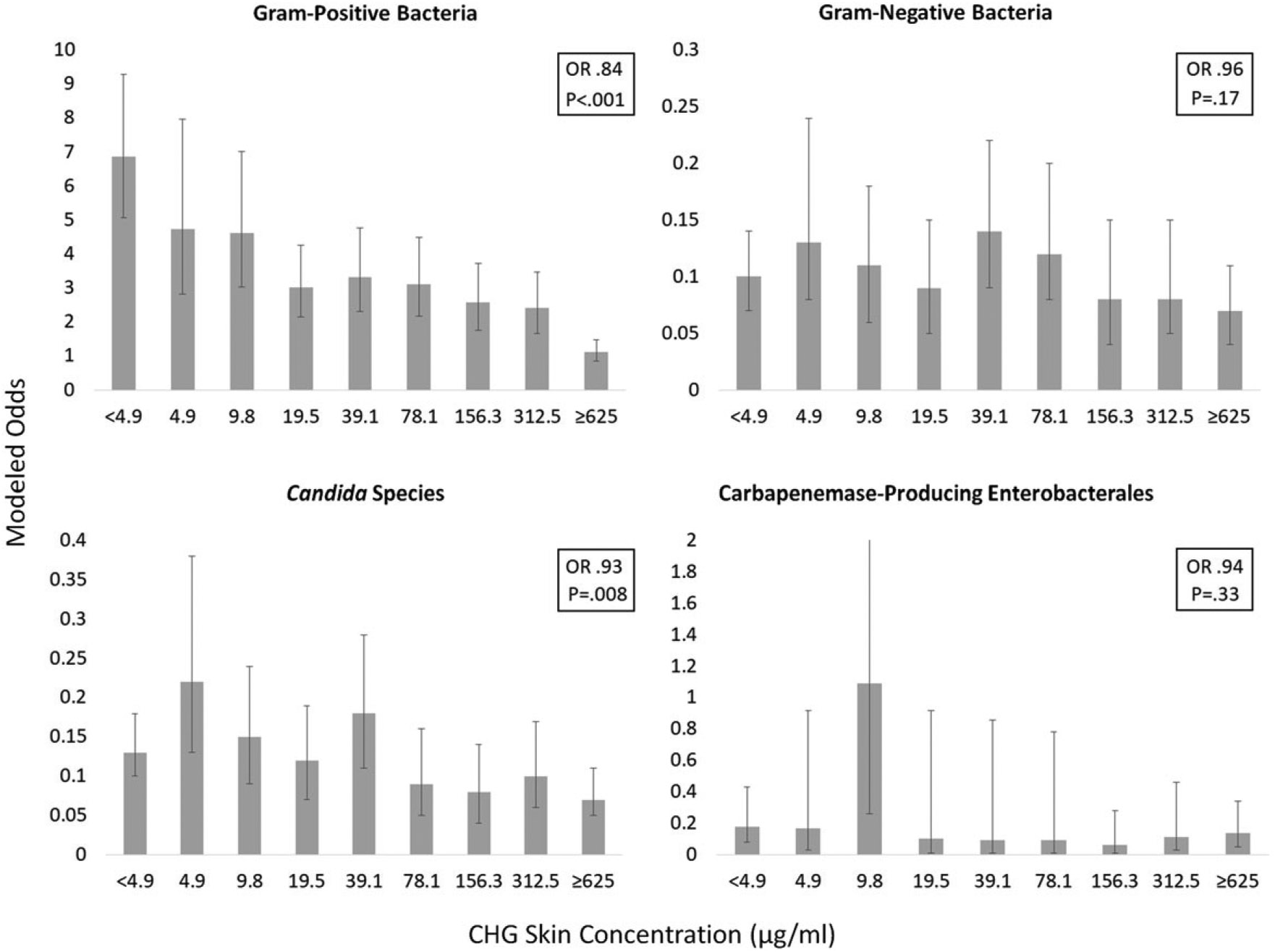
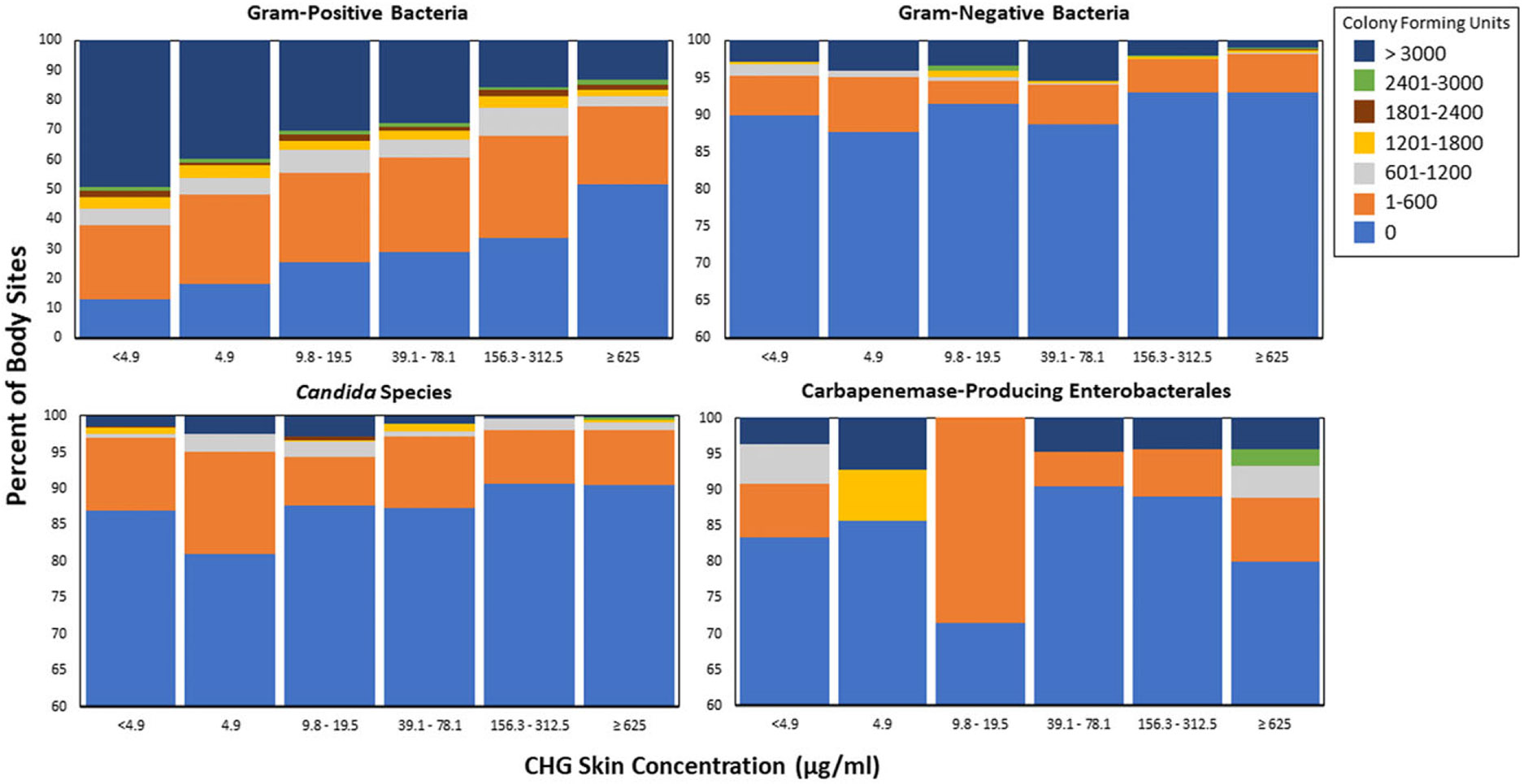
Description:Objective: ; To characterize the relationship between chlorhexidine gluconate (CHG) skin concentration and skin microbial colonization. ; Design: ; Serial cross-sectional study. ; Setting/participants: ; Adult patients in medical intensive care units (ICUs) from 7 hospitals; from 1 hospital, additional patients colonized with carbapenemase-producing Enterobacterales (CPE) from both ICU and non-ICU settings. All hospitals performed routine CHG bathing in the ICU. ; Methods: ; Skin swab samples were collected from adjacent areas of the neck, axilla, and inguinal region for microbial culture and CHG skin concentration measurement using a semiquantitative colorimetric assay. We used linear mixed effects multilevel models to analyze the relationship between CHG concentration and microbial detection. We explored threshold effects using additional models. ; Results: ; We collected samples from 736 of 759 (97%) eligible ICU patients and 68 patients colonized with CPE. On skin, gram-positive bacteria were cultured most frequently (93% of patients), followed by Candida species (26%) and gram-negative bacteria (20%). The adjusted odds of microbial recovery for every twofold increase in CHG skin concentration were 0.84 (95% CI, 0.80–0.87; P < .001) for gram-positive bacteria, 0.93 (95% CI, 0.89–0.98; P = .008) for Candida species, 0.96 (95% CI, 0.91–1.02; P = .17) for gram-negative bacteria, and 0.94 (95% CI, 0.84–1.06; P = .33) for CPE. A threshold CHG skin concentration for reduced microbial detection was not observed. ; Conclusions: ; On a cross-sectional basis, higher CHG skin concentrations were associated with less detection of gram-positive bacteria and Candida species on the skin, but not gram-negative bacteria, including CPE. For infection prevention, targeting higher CHG skin concentrations may improve control of certain pathogens.
-
Source:Infect Control Hosp Epidemiol. :1-6
-
Pubmed ID:38804007
-
Pubmed Central ID:PMC11705612
-
Document Type:
-
Funding:
-
Download URL:
-
File Type:
 [PDF - 428.25 KB]
 -
Collection(s):
-
Main Document Checksum:urn:sha-512:381a620bf8c8b74ed9cf9db4f32d044a2215ab23a199ed511a690e5bb6d1c16bcea59e7e1a3156c2eebacddb7069891406ad9353df7cd2d0959e2a13a1ac93c7
Supporting Files


File Language:
English
 Was this page helpful?
 Found an issue?

CDC STACKS serves as an archival repository of CDC-published products including
scientific findings, journal articles, guidelines, recommendations, or other public health information authored or
co-authored by CDC or funded partners.
As a repository, CDC STACKS retains documents in their original published format to ensure public access to scientific information.
As a repository, CDC STACKS retains documents in their original published format to ensure public access to scientific information.