



Social Vulnerability, Intervention Utilization, and Outcomes in US Adults Hospitalized With Influenza
Supporting Files

-
11 04 2024
-
Available in CDC Stacks on 2025-01-06T00:00:00Z
File Language:
English
Details
-
Alternative Title:JAMA Netw Open
-
Personal Author:Adams, Katherine ; Yousey-Hindes, Kimberly ; Bozio, Catherine H. ; Jain, Seema ; Kirley, Pam Daily ; Armistead, Isaac ; Alden, Nisha B. ; Openo, Kyle P. ; Witt, Lucy S. ; Monroe, Maya L. ; Kim, Sue ; Falkowski, Anna ; Lynfield, Ruth ; McMahon, Melissa ; Hoffman, Marisa R. ; Shaw, Yomei P. ; Spina, Nancy L. ; Rowe, Adam ; Felsen, Christina B. ; Licherdell, Erin ; Lung, Krista ; Shiltz, Eli ; Thomas, Ann ; Talbot, H. Keipp ; Schaffner, William ; Crossland, Melanie T. ; Olsen, Kristen P. ; Chang, Larry W. ; Cummings, Charisse N. ; Tenforde, Mark W. ; Garg, Shikha ; Hadler, James L. ; O’Halloran, Alissa
-
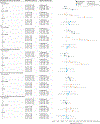
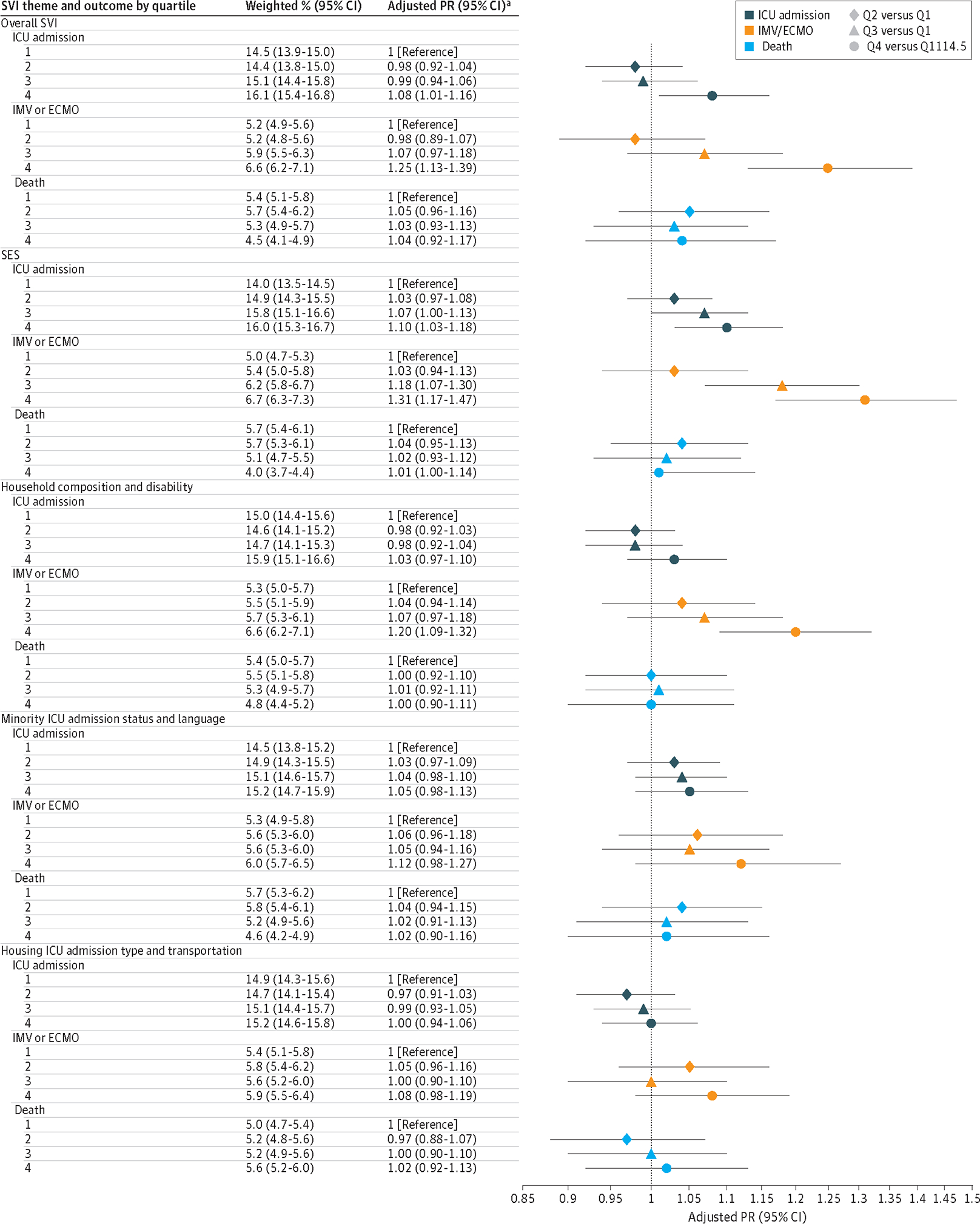
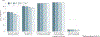
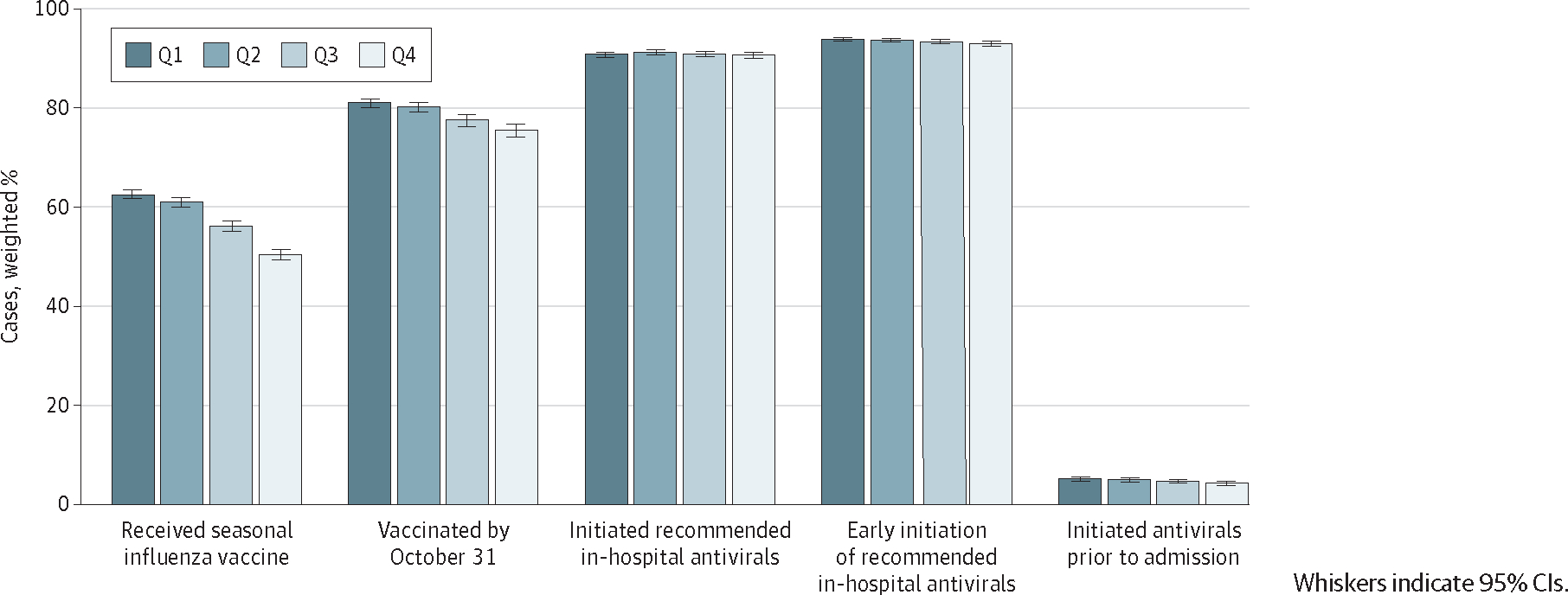
Description:IMPORTANCE ; Seasonal influenza is associated with substantial disease burden. The relationship between census tract–based social vulnerability and clinical outcomes among patients with influenza remains unknown. ; OBJECTIVE ; To characterize associations between social vulnerability and outcomes among patients hospitalized with influenza and to evaluate seasonal influenza vaccine and influenza antiviral utilization patterns across levels of social vulnerability. ; DESIGN, SETTING, AND PARTICIPANTS ; This retrospective repeated cross-sectional study was conducted among adults with laboratory-confirmed influenza-associated hospitalizations from the 2014 to 2015 through the 2018 to 2019 influenza seasons. Data were from a population-based surveillance network of counties within 13 states. Data analysis was conducted in December 2023. ; EXPOSURE ; Census tract–based social vulnerability. ; MAIN OUTCOMES AND MEASURES ; Associations between census tract–based social vulnerability and influenza outcomes (intensive care unit admission, invasive mechanical ventilation and/or extracorporeal membrane oxygenation support, and 30-day mortality) were estimated using modified Poisson regression as adjusted prevalence ratios. Seasonal influenza vaccine and influenza antiviral utilization were also characterized across levels of social vulnerability. ; RESULTS ; Among 57 964 sampled cases, the median (IQR) age was 71 (58–82) years; 55.5% (95% CI, 51.5%–56.0%) were female; 5.2% (5.0%–5.4%) were Asian or Pacific Islander, 18.3% (95% CI, 18.0%–18.6%) were Black or African American, and 64.6% (95% CI, 64.2%–65.0%) were White; and 6.6% (95% CI, 6.4%–68%) were Hispanic or Latino and 74.7% (95% CI, 74.3%–75.0%) were non-Hispanic or Latino. High social vulnerability was associated with higher prevalence of invasive mechanical ventilation and/or extracorporeal membrane oxygenation support (931 of 13 563 unweighted cases; adjusted prevalence ratio aPR, 1.25 95% CI, 1.13–1.39), primarily due to socioeconomic status (790 of 11 255; aPR, 1.31 95% CI, 1.17–1.47) and household composition and disability (773 of 11 256; aPR, 1.20 95% CI, 1.09–1.32). Vaccination status, presence of underlying medical conditions, and respiratory symptoms partially mediated all significant associations. As social vulnerability increased, the proportion of patients receiving seasonal influenza vaccination declined (−19.4% relative change across quartiles; P < .001) as did the proportion vaccinated by October 31 (−6.8%; P < .001). No differences based on social vulnerability were found in in-hospital antiviral receipt, but early in-hospital antiviral initiation (−1.0%; P = .01) and prehospital antiviral receipt (−17.3%; P < .001) declined as social vulnerability increased. ; CONCLUSIONS AND RELEVANCE ; In this cross-sectional study, social vulnerability was associated with a modestly increased prevalence of invasive mechanical ventilation and/or extracorporeal membrane oxygenation support among patients hospitalized with influenza. Contributing factors may have included worsened baseline respiratory health and reduced receipt of influenza prevention and prehospital or early in-hospital treatment interventions among persons residing in low socioeconomic areas.
-
Subjects:
-
Source:JAMA Netw Open. 7(11):e2448003
-
Pubmed ID:39602116
-
Pubmed Central ID:PMC11702903
-
Document Type:
-
Funding:
-
Volume:7
-
Issue:11
-
Download URL:
-
File Type:
 [PDF - 672.47 KB]
 -
Collection(s):
-
Main Document Checksum:urn:sha-512:a77b0174390d964e4e89367d1ce48ee2ca895b781d437b7665e084c680b277d3fa78b13dfb926ab3208a439e55012a5d002378cf283277d11af204cc9649f15e
Supporting Files


File Language:
English
 Was this page helpful?
 Found an issue?

CDC STACKS serves as an archival repository of CDC-published products including
scientific findings, journal articles, guidelines, recommendations, or other public health information authored or
co-authored by CDC or funded partners.
As a repository, CDC STACKS retains documents in their original published format to ensure public access to scientific information.
As a repository, CDC STACKS retains documents in their original published format to ensure public access to scientific information.
You May Also Like
COLLECTION
CDC Public Access