



Manhattan Vision Screening and Follow-up Study (NYC-SIGHT): a nested cross-sectional assessment of falls risk within a cluster randomised trial
Supporting Files

-
11 22 2024
-
Available in CDC Stacks on 2025-01-06T00:00:00Z
File Language:
English
Details
-
Alternative Title:Br J Ophthalmol
-
Personal Author:Hark, Lisa A
 ;
Wang, Yujia
;
Gorroochurn, Prakash
;
Simon, Phyllis R
;
Maruri, Stefania C
;
Henriquez, Desiree R
;
Diamond, Daniel F
;
Horowitz, Jason D
;
Park, Lisa
;
Wang, Qing
;
Auran, James D
;
Carrion, Jailine
;
Friedman, David S
;
Liebmann, Jeffrey L
;
Cioffi, George A
;
Harizman, Noga
;
Wang, Yujia
;
Gorroochurn, Prakash
;
Simon, Phyllis R
;
Maruri, Stefania C
;
Henriquez, Desiree R
;
Diamond, Daniel F
;
Horowitz, Jason D
;
Park, Lisa
;
Wang, Qing
;
Auran, James D
;
Carrion, Jailine
;
Friedman, David S
;
Liebmann, Jeffrey L
;
Cioffi, George A
;
Harizman, Noga
-
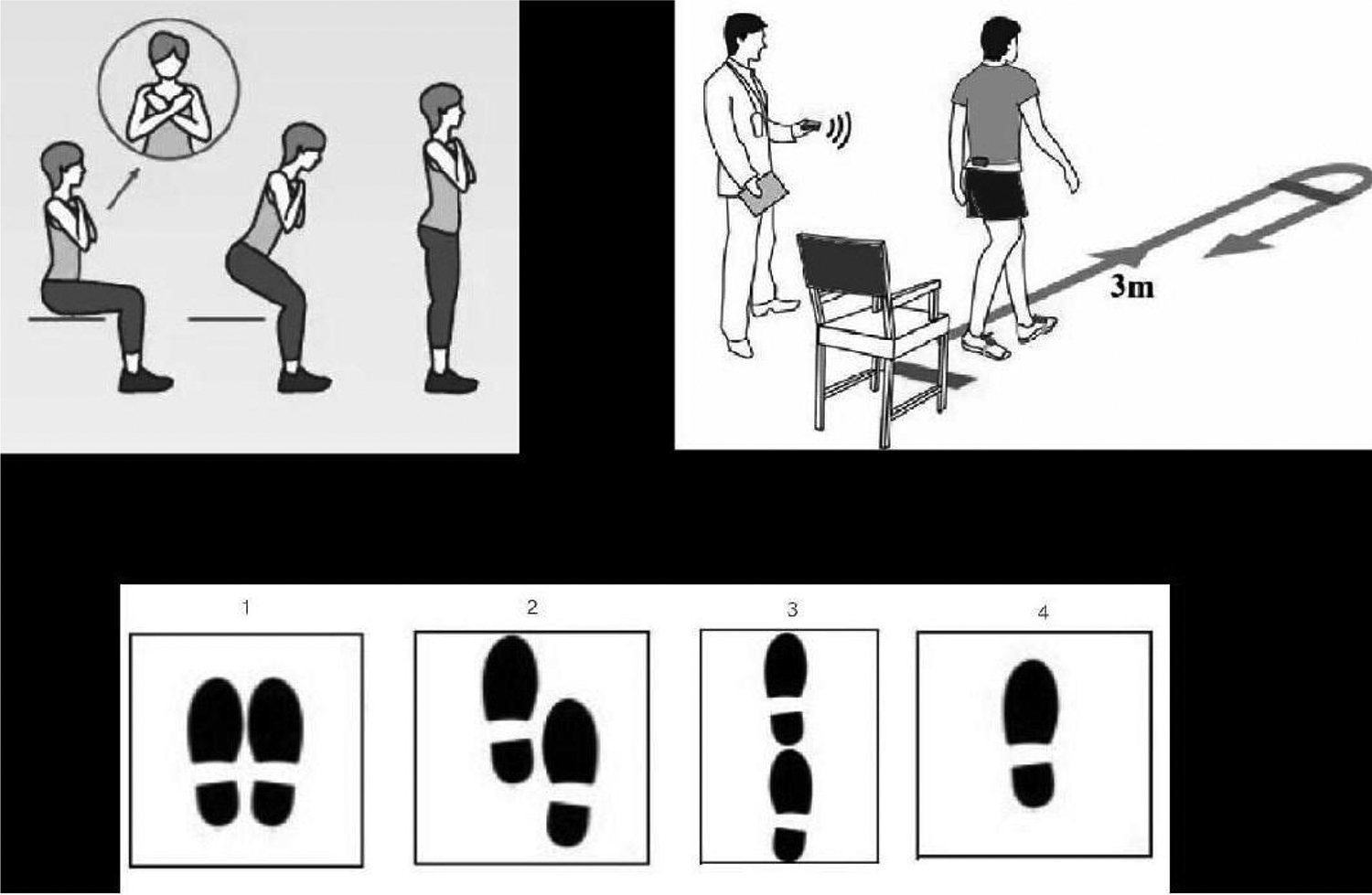
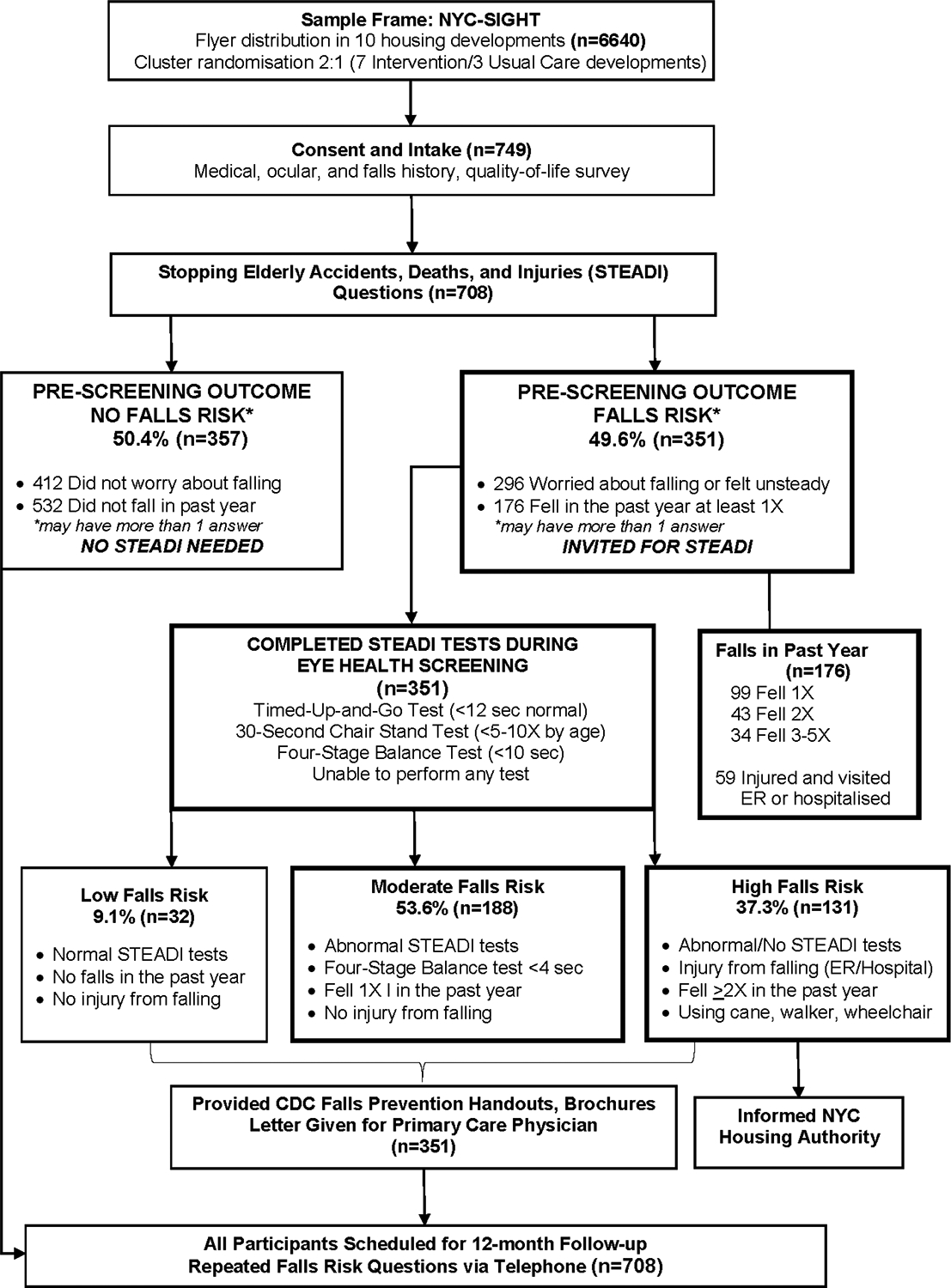
Description:Background ; To investigate the feasibility of using the Stopping Elderly Accidents, Deaths and Injuries (STEADI) Falls Risk Tool Kit during community-based eye health screenings to assess falls risk of participants enrolled in the Manhattan Vision Screening and Follow-Up Study (NYC-SIGHT). ; Methods ; Cross-sectional analysis of data from a 5-year prospective, duster-randomised clinical trial conducted in affordable housing developments in New York City in adults age 40 years and older. Prescreening questions determined whether participants were at risk of falling. STEADI tests classified participants at low, moderate or high risk of falling. Multivariate logistic regression determined odds of falls risk of all enrolled participants. ; Results ; 708 participants completed the eye health screening; 351 (49.6%) performed STEADI tests; mean age: 71.0 years (SD±11.3); 72.1 % female; 53.6% Black, non-Hispanic, 37.6% Hispanic/Latino. Level of falls risk: 32 (9.1%) low, 188 (53.6%) moderate and 131 (37.3%) high. Individuals age >80 (OR 5.921,95% Cl (2.383 to 14.708), p=0.000), had blurry vision (OR 1.978,95% Cl (1.186 to 3.300), p=0.009), high blood pressure (OR 2.131,95% Cl (1.252 to 3.628), p=0.005), arthritis (OR 2.29876,95% Cl (1.362 to 3.875), p=0.002) or foot problems (OR 5.239,95% Cl (2.947 to 9.314), p=0.000) had significantly higher odds of falling, emergency department visits or hospitalisation due to falling. ; Conclusion ; This study detected a significant amount of falls risk in an underserved population. The STEADI Falls Risk screening questions were easy for eye care providers to ask, were highly predictive of falls risk and may be adequate for referral to occupational health and/or physical therapy.
-
Subjects:
-
Source:Br J Ophthalmol. 108(12):1761-1768
-
Pubmed ID:38609163
-
Pubmed Central ID:PMC11701788
-
Document Type:
-
Funding:
-
Volume:108
-
Issue:12
-
Download URL:
-
File Type:
 [PDF - 640.73 KB]
 -
Collection(s):
-
Main Document Checksum:urn:sha-512:bc31f2641d0742125e7db3eb956f16a45577a4e4d2f8b05962b59efd8e51df3591446c35b54ccbe930190e5ae3a2fb7da93ac9b58836f393e12b946d05052d9d
Supporting Files


File Language:
English
 Was this page helpful?
 Found an issue?

CDC STACKS serves as an archival repository of CDC-published products including
scientific findings, journal articles, guidelines, recommendations, or other public health information authored or
co-authored by CDC or funded partners.
As a repository, CDC STACKS retains documents in their original published format to ensure public access to scientific information.
As a repository, CDC STACKS retains documents in their original published format to ensure public access to scientific information.
You May Also Like
COLLECTION
CDC Public Access