


Safety Surveillance of Varicella Vaccines in the Vaccine Adverse Event Reporting System, United States, 2006–2020
Supporting Files

-
10 21 2022
-
File Language:
English
Details
-
Alternative Title:J Infect Dis
-
Personal Author:
-
Description:Background.
The Vaccine Adverse Event Reporting System (VAERS) is the United States national passive vaccine safety surveillance system. We updated the data on the safety of single-antigen varicella vaccine (VAR) and assessed the safety of combination measles, mumps, rubella, and varicella vaccine (MMRV) licensed in the United States using VAERS data.
Methods.
US VAERS reports received after administration of VAR and MMRV during 2006–2020 were identified. Reports were analyzed by vaccine type, age, seriousness, most common adverse events (AEs), and concomitant vaccines. We reviewed medical records of selected reports of AEs of special interest and conducted empirical Bayesian data mining to identify disproportionally reported AEs.
Results.
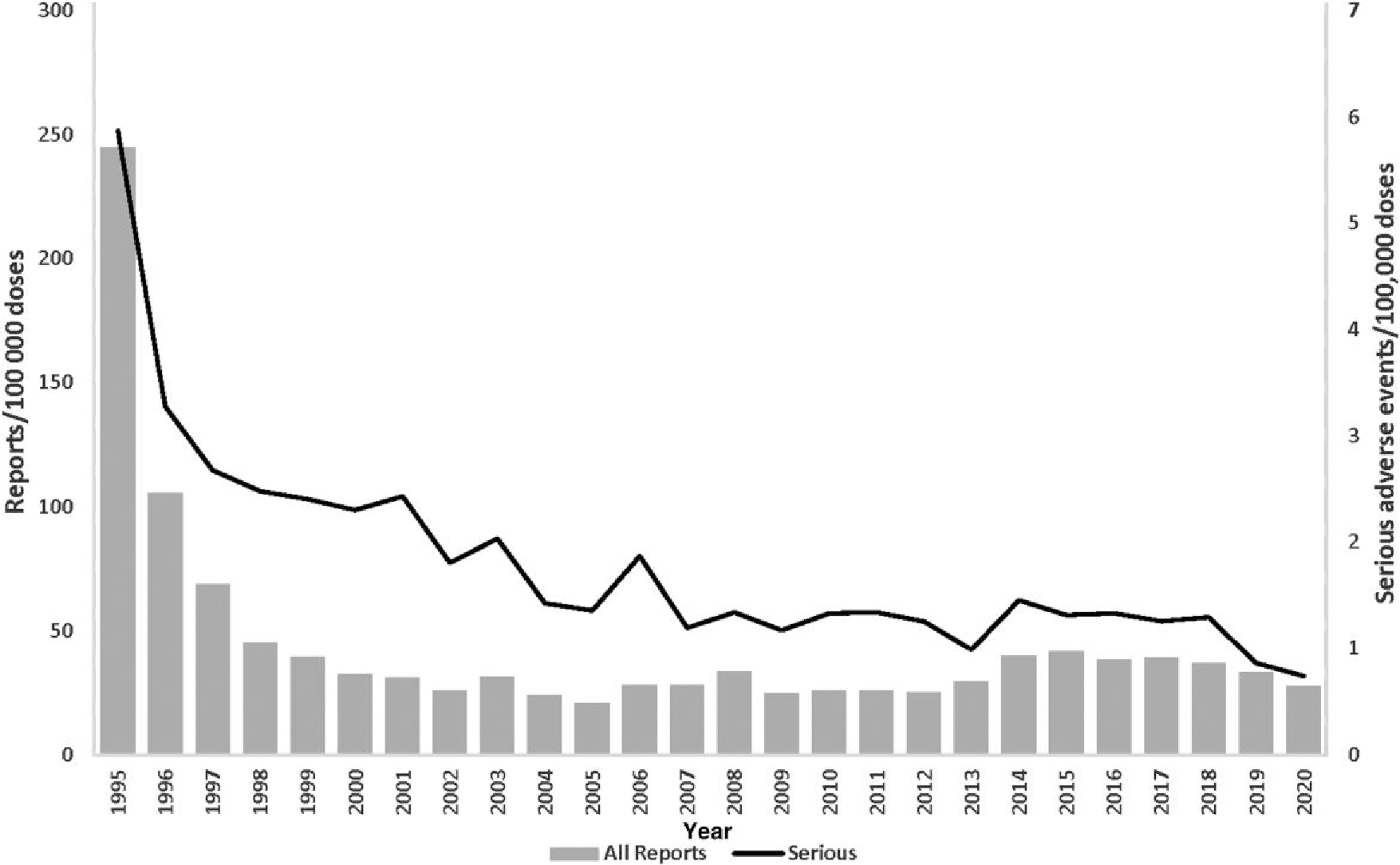
During 2006–2020, approximately 132.8 million VAR doses were distributed; 40 684 reports were received in VAERS (30.6/100 000 doses distributed), with 4.1% classified as serious (1.3/100 000 doses distributed). Approximately 35.5 million MMRV doses were distributed; 13 325 reports were received (37.6/100 000 doses distributed) with 3.3% classified as serious (1.3/100 000 doses distributed). The most common adverse health events after both VAR and MMRV were injection site reactions (31% and 27%), rash (28% and 20%), and fever (12% and 14%), respectively. Vaccination errors accounted for 23% of reports after VAR administration and 41% after MMRV administration, but ≥95% of them did not describe an adverse health event. AEs associated with evidence of vaccine strain varicella-zoster virus (vVZV) infection included meningitis, encephalitis, herpes zoster, and 6 deaths (all in immunocompromised persons with contraindications for vaccination). No new or unexpected AE was disproportionally reported.
Conclusions.
No new or unexpected safety findings were detected for VAR and MMRV given as recommended, reinforcing the favorable safety profiles of these vaccines. Providers should obtain specimens for viral testing and strain-typing for serious AEs if they consider vVZV as the possible causative agent.
-
Subjects:
-
Keywords:
-
Source:J Infect Dis. 226(Suppl 4):S431-S440
-
Pubmed ID:36265846
-
Pubmed Central ID:PMC11692937
-
Document Type:
-
Funding:
-
Volume:226
-
Collection(s):
-
Main Document Checksum:urn:sha-512:55f8bd2da307b242580d4cb1f202fd356134f0bd9cdde22bfaa461c0cff9e6498e20004f45c59420313c2deb533b4d4b20537a423ef7e53a96e6ba0edfe78abf
-
Download URL:
-
File Type:
 [PDF
- 251.52 KB
]
[PDF
- 251.52 KB
]
Supporting Files


File Language:
English
ON THIS PAGE

CDC STACKS serves as an archival repository of CDC-published products including
scientific findings,
journal articles, guidelines, recommendations, or other public health information authored or
co-authored by CDC or funded partners.
As a repository, CDC STACKS retains documents in their original published format to ensure public access to scientific information.
As a repository, CDC STACKS retains documents in their original published format to ensure public access to scientific information.
You May Also Like
COLLECTION
CDC Public Access