



Racial and ethnic differences in infant survival for hydrocephaly—Texas, 1999–2017
Supporting Files

-
1 2024 ; 1-2024
-
Available in CDC Stacks on January 01, 2025, 12:00 AM

File Language:
English
Details
-
Alternative Title:Birth Defects Res
-
Personal Author:
-
Description:Background:
Congenital hydrocephaly, an abnormal accumulation of fluid within the ventricular spaces at birth, can cause disability or death if untreated. Limited information is available about survival of infants born with hydrocephaly in Texas. Therefore, the purpose of the study was to calculate survival estimates among infants born with hydrocephaly without spina bifida in Texas.
Methods:
A cohort of live-born infants delivered during 1999–2017 with congenital hydrocephaly without spina bifida was identified from the Texas Birth Defects Registry. Deaths within 1 year of delivery were identified using vital and medical records. One-year infant survival estimates were generated for multiple descriptive characteristics using the Kaplan–Meier method. Crude hazard ratios (HRs) for one-year survival among infants with congenital hydrocephaly by maternal and infant characteristics and adjusted HRs for maternal race and ethnicity were estimated using Cox proportional hazard models.
Results:
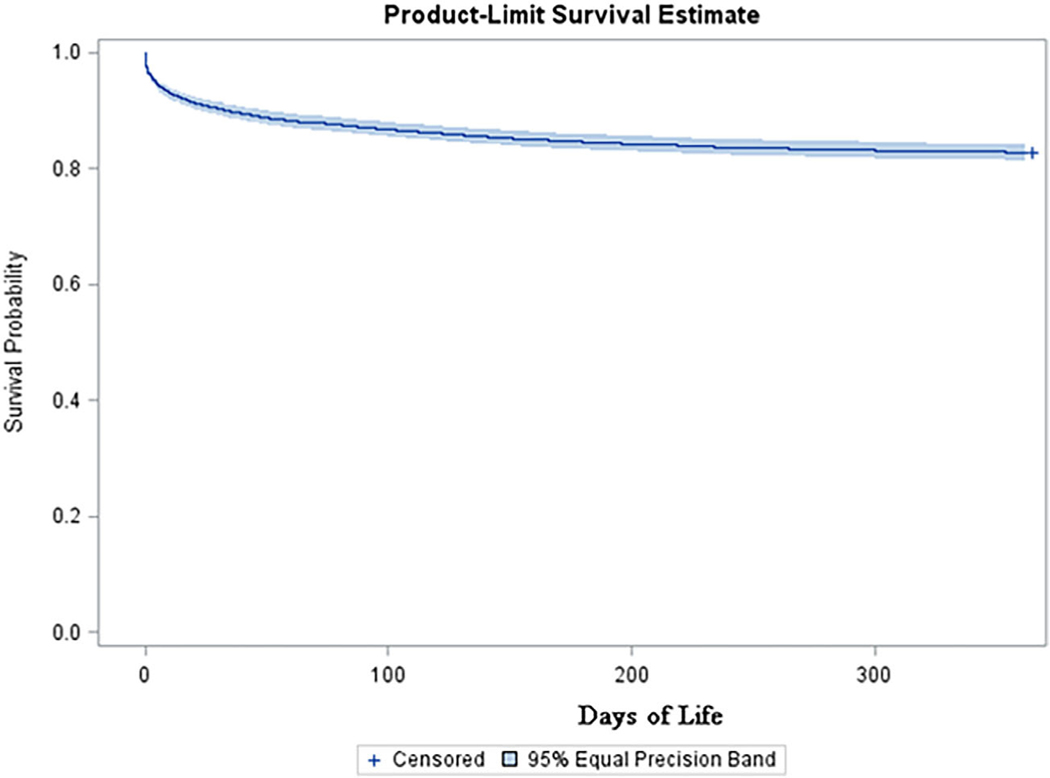
Among 5709 infants born with congenital hydrocephaly without spina bifida, 4681 (82%) survived the first year. The following characteristics were associated with infant survival: maternal race and ethnicity, clinical classification (e.g., chromosomal or syndromic), preterm birth, birth weight, birth year, and maternal education. In the multivariable Cox proportional hazards model, differences in survival were observed by maternal race and ethnicity after adjustment for other maternal and infant characteristics. Infants of non-Hispanic Black (HR: 1.28, 95% CI: 1.04–1.58) and Hispanic (HR: 1.31, 95% CI: 1.12–1.54) women had increased risk for mortality, compared with infants of non-Hispanic White women.
Conclusions:
This study showed infant survival among a Texas cohort differed by maternal race and ethnicity, clinical classification, gestational age, birth weight, birth year, and maternal education in infants with congenital hydrocephaly without spina bifida. Findings confirm that mortality continues to be common among infants with hydrocephaly without spina bifida. Additional research is needed to identify other risk factors of mortality risk. -
Subjects:
-
Keywords:
-
Source:Birth Defects Res. 116(1):e2285
-
Pubmed ID:38111285
-
Pubmed Central ID:PMC10872561
-
Document Type:
-
Funding:
-
Volume:116
-
Issue:1
-
Download URL:
-
File Type:
 [PDF - 250.08 KB]
 -
Collection(s):
-
Main Document Checksum:urn:sha-512:74c8c1b78e9f29bd255af84d3947718168c3e47aa04ee796aecfc3773404dee5f1c0b3d53bd942d100e24106bfa007d59c9cc36f23ff2b5897603f9a0c317c96
Supporting Files


File Language:
English
 Was this page helpful?
 Found an issue?

CDC STACKS serves as an archival repository of CDC-published products including
scientific findings, journal articles, guidelines, recommendations, or other public health information authored or
co-authored by CDC or funded partners.
As a repository, CDC STACKS retains documents in their original published format to ensure public access to scientific information.
As a repository, CDC STACKS retains documents in their original published format to ensure public access to scientific information.
You May Also Like
COLLECTION
CDC Public Access