



Physical Intimate Partner Violence and Increased Partner Aggression During Pregnancy During the COVID-19 Pandemic: Results From the Pregnancy Risk Assessment Monitoring System
Supporting Files

-
9 28 2024 ; Jan-Feb 2025
-
Available in CDC Stacks on January 01, 2025, 12:00 AM

File Language:
English
Details
-
Alternative Title:Public Health Rep
-
Personal Author:
-
Description:Objectives:
Public health emergencies can elevate the risk for intimate partner violence (IPV). Our objectives were 2-fold: first, to assess the prevalence of physical IPV and increased aggression from a husband or partner that occurred during pregnancy and was perceived to be due to the COVID-19 pandemic; second, to examine associations between these experiences and (1) COVID-19–related stressors and (2) postpartum outcomes.
Methods:
We used data from the Pregnancy Risk Assessment Monitoring System that were collected in 29 US jurisdictions among individuals with a live birth in 2020. We estimated the prevalence of violence during pregnancy by demographic characteristics and COVID-19–related stressors. We calculated adjusted prevalence ratios (APRs) to examine associations of physical IPV or increased aggression with COVID-19–related stressors, postpartum outcomes, and infant birth outcomes.
Results:
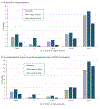
Among 14 154 respondents, 1.6% reported physical IPV during pregnancy, and 3.1% reported increased aggression by a husband or partner due to the COVID-19 pandemic. Respondents experiencing any economic, housing, or childcare COVID-19–related stressors reported approximately twice the prevalence of both types of violence as compared with those without COVID-19–related stressors. Physical IPV and increased aggression were associated with a higher prevalence of postpartum depressive symptoms (APRs, 1.73 and 2.28, respectively) and postpartum cigarette smoking (APRs, 1.74 and 2.19). Physical IPV was associated with a lower prevalence of attending postpartum care visits (APR, 1.84).
Conclusions:
Our findings support the need for ongoing efforts to prevent IPV during pregnancy and to ensure the availability of resources during public health emergencies. -
Subjects:
-
Keywords:
-
Source:Public Health Rep. 140(1 Suppl):20S-31S
-
Pubmed ID:39342451
-
Pubmed Central ID:PMC11556449
-
Document Type:
-
Funding:
-
Volume:140
-
Download URL:
-
File Type:
 [PDF - 654.21 KB]
 -
Collection(s):
-
Main Document Checksum:urn:sha-512:4b936d6b0be098fd30b508f218096a36e81258be6b4704c7dcd0074c9bf4448505939e5a0b8b0e7a9ce950c075291b7a6eab4cd76caa4677aae8c47c0187b98f
Supporting Files


File Language:
English
 Was this page helpful?
 Found an issue?


CDC STACKS serves as an archival repository of CDC-published products including
scientific findings, journal articles, guidelines, recommendations, or other public health information authored or
co-authored by CDC or funded partners.
As a repository, CDC STACKS retains documents in their original published format to ensure public access to scientific information.
As a repository, CDC STACKS retains documents in their original published format to ensure public access to scientific information.
You May Also Like
COLLECTION
CDC Public Access