



The Association Between Sexual Violence and Suicidal Ideation Among Transgender Women and the Role of Gender-Affirming Healthcare Providers in Seven Urban Areas in the United States, 2019 to 2020
Supporting Files

-
6 06 2024
-
Available in CDC Stacks on December 06, 2025, 12:00 AM

File Language:
English
Details
-
Alternative Title:J Interpers Violence
-
Personal Author:
-
Corporate Authors:
-
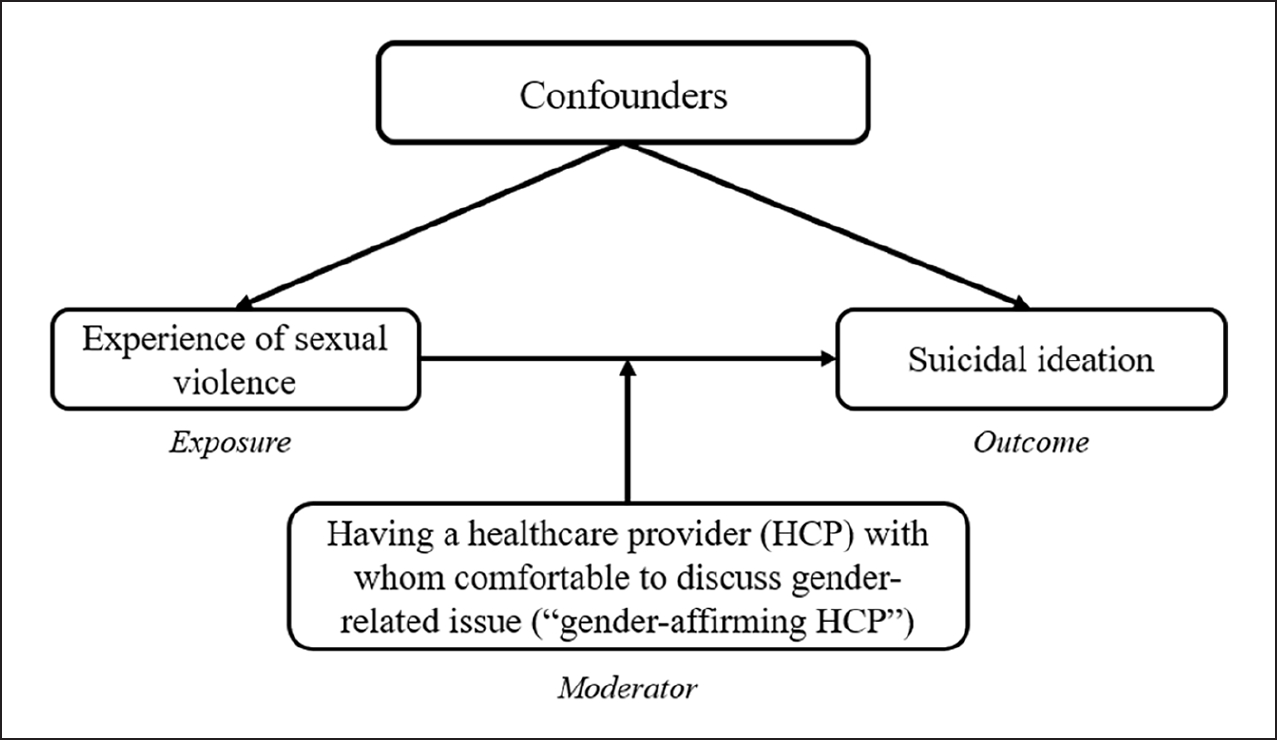
Description:Transgender women are disproportionately affected by sexual violence and corresponding mental health sequelae; however, many do not access healthcare due to experiences with transphobia. This analysis evaluated the association between sexual violence and suicidal ideation and the moderating effect of having a healthcare provider (HCP) with whom transgender women were comfortable discussing gender-related issues ("gender-affirming HCP"). We analyzed cross-sectional data from the Centers for Disease Control and Prevention's National HIV Behavioral Surveillance among Transgender Women (NHBS-Trans). Transgender women were recruited using respondent-driven sampling from seven urban areas from 2019 to 2020 and participated in an HIV biobehavioral survey. This analysis was restricted to transgender women who visited a HCP in the past 12 months ("healthcare-seeking transgender women" HSTW) (| = 1,489). Log-linked Poisson regression models provided adjusted prevalence ratios (aPRs) and 95% confidence intervals (CIs) to estimate the association between sexual violence and suicidal ideation in the past 12 months. The interaction between sexual violence and having a gender-affirming HCP was statistically significant (|-value = .034). Among 1,489 HSTW, 225 (15.1%) experienced sexual violence and 261 (17.5%) reported suicidal ideation; 1,203 (80.8%) reported having a gender-affirming HCP. Sexual violence was associated with suicidal ideation (aPR = 2.65, 95% CI 2.08, 3.38); the association was notably higher among those who did | have a gender-affirming HCP (aPR = 3.61, 2.17, 6.02) than among those who did (aPR = 1.87, 1.48, 2.37). Eliminating transphobia and promoting trauma- and violence-informed approaches in healthcare are necessary for sexual violence and suicide prevention among HSTW.
-
Keywords:
-
Source:J Interpers Violence. :8862605241257592
-
Pubmed ID:38842225
-
Pubmed Central ID:PMC11621224
-
Document Type:
-
Funding:
-
Download URL:
-
File Type:
 [PDF - 467.37 KB]
 -
Collection(s):
-
Main Document Checksum:urn:sha-512:2b68e75126f4e4fb1c6ab5c1dd1e617a0d2be79527067176db76f05eeaa0f59e0eb3d3267ade4f0602243c09087e501c76b5b376bb2aa90c0eab427d2ecafb11
Supporting Files


File Language:
English
 Was this page helpful?
 Found an issue?

CDC STACKS serves as an archival repository of CDC-published products including
scientific findings, journal articles, guidelines, recommendations, or other public health information authored or
co-authored by CDC or funded partners.
As a repository, CDC STACKS retains documents in their original published format to ensure public access to scientific information.
As a repository, CDC STACKS retains documents in their original published format to ensure public access to scientific information.
You May Also Like
COLLECTION
CDC Public Access