



Preventing Adverse Childhood Experiences in a Sample of Largely Indigenous Children
Supporting Files

-
9 01 2024 ; 9-01-
-
Available in CDC Stacks on 2025-09-01T00:00:00Z
File Language:
English
Details
-
Alternative Title:Pediatrics
-
Personal Author:
-
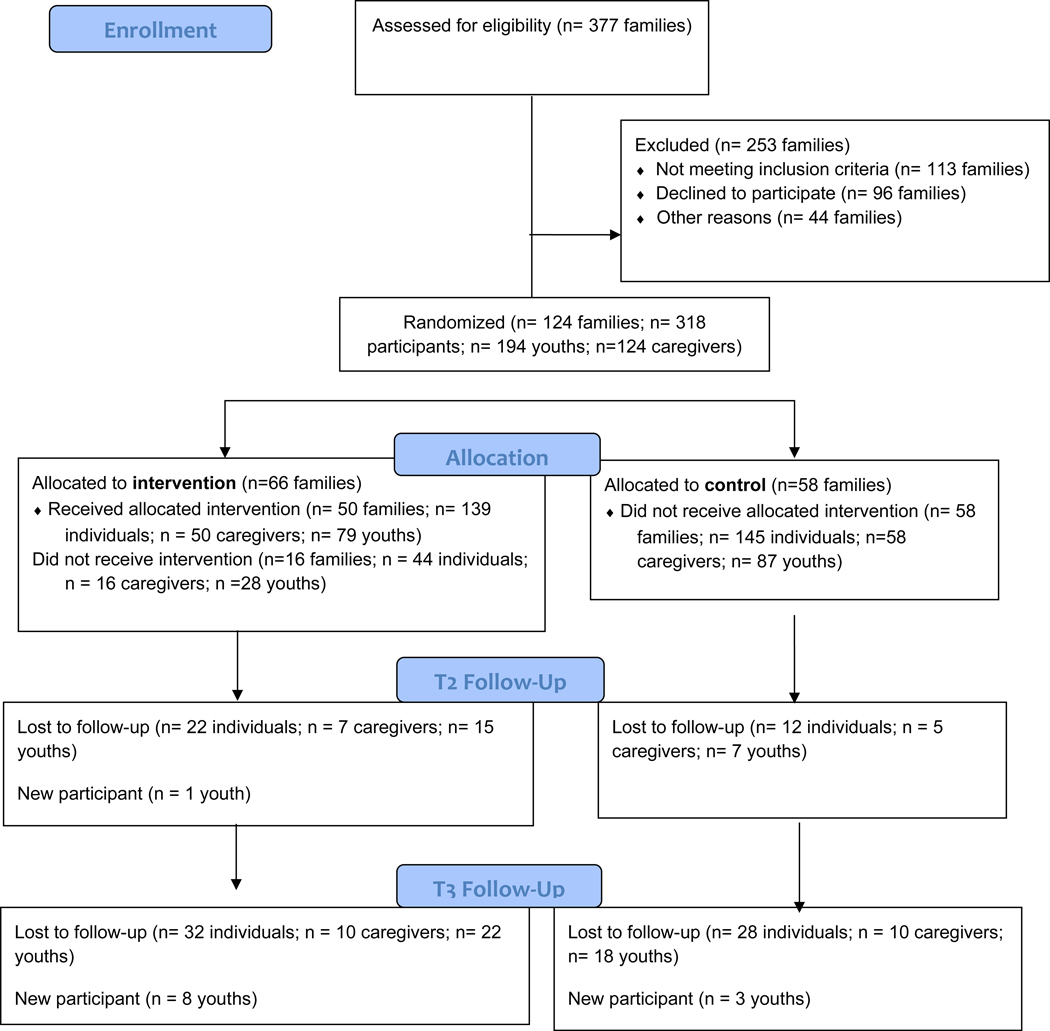
Description:Objectives: ; The purpose of this study was to develop, pilot, and evaluate a culturally grounded, family-based program to prevent adverse childhood experiences (ACEs) among low-income and/or Indigenous children ages 10 to 14. The Tiwahe Wicagwicayapi program (TWP) is a 7-session program that teaches skills to prevent ACEs and is rooted in Lakota culture, language, and history. ; Methods: ; 124 families (124 caregivers 96% Indigenous; 90% reported yearly income less than $40,000 with 194 children ages 10 to 14 93% Indigenous) were randomly assigned to the treatment (N = 66 families and 183 individuals) or waitlist (N = 58 families and 145 individuals) control groups. Caregivers and children completed a baseline, immediate post-test, and 6-month follow-up survey. ; Results: ; Treatment effects were detected indicating, compared to control participants, reductions in incidence of child ACEs (IRR = .64), bullying victimization (OR = .53), depression (d = –.20), and externalizing behaviors (d = –.23), and increased parent-child communication (g = .27) and child help seeking behaviors (d = .28). For caregivers, effects indicated the program prevented intimate partner violence victimization (IRR = .36) and perpetration (IRR = .45), harsh parenting (g = –.35), and depression (d = –.24), and increased emotion regulation (d = .37), social support (d = .33), and cultural connection (d = .34). ; Conclusions: ; The TWP holds great promise in preventing ACEs among low-income, Indigenous children, showing potential promise for widespread public health impact. Future rigorous research on the TWP is warranted.
-
Subjects:
-
Source:Pediatrics. 154(3)
-
Pubmed ID:39136077
-
Pubmed Central ID:PMC11616712
-
Document Type:
-
Funding:
-
Volume:154
-
Issue:3
-
Download URL:
-
File Type:
 [PDF - 980.04 KB]
 -
Collection(s):
-
Main Document Checksum:urn:sha-512:c445b7bb98151734a47a0b48256485abcd7b5144c74ed8acdf8b884ee6515d409c0698e68f967d388c4aadaf16c3efb4cbf050a8464a05f2a0ed3b8ecec92a3a
Supporting Files


File Language:
English
 Was this page helpful?
 Found an issue?

CDC STACKS serves as an archival repository of CDC-published products including
scientific findings, journal articles, guidelines, recommendations, or other public health information authored or
co-authored by CDC or funded partners.
As a repository, CDC STACKS retains documents in their original published format to ensure public access to scientific information.
As a repository, CDC STACKS retains documents in their original published format to ensure public access to scientific information.
You May Also Like
COLLECTION
CDC Public Access