


Decentralizing Access to Antiretroviral Therapy for Children Living with HIV in Swaziland
Supporting Files

-
8 2016
-
File Language:
English
Details
-
Alternative Title:Pediatr Infect Dis J
-
Personal Author:
-
Description:Background:
In 2007, Swaziland initiated a hub-and-spoke model for decentralizing antiretroviral therapy (ART) access for HIV-infected children (<15 years old). Decentralization was facilitated through (1) down referral of stable children on ART from overburdened central facilities (hubs) to primary healthcare clinics (spokes) and (2) pediatric ART initiation at spokes (spoke initiation).
Methods:
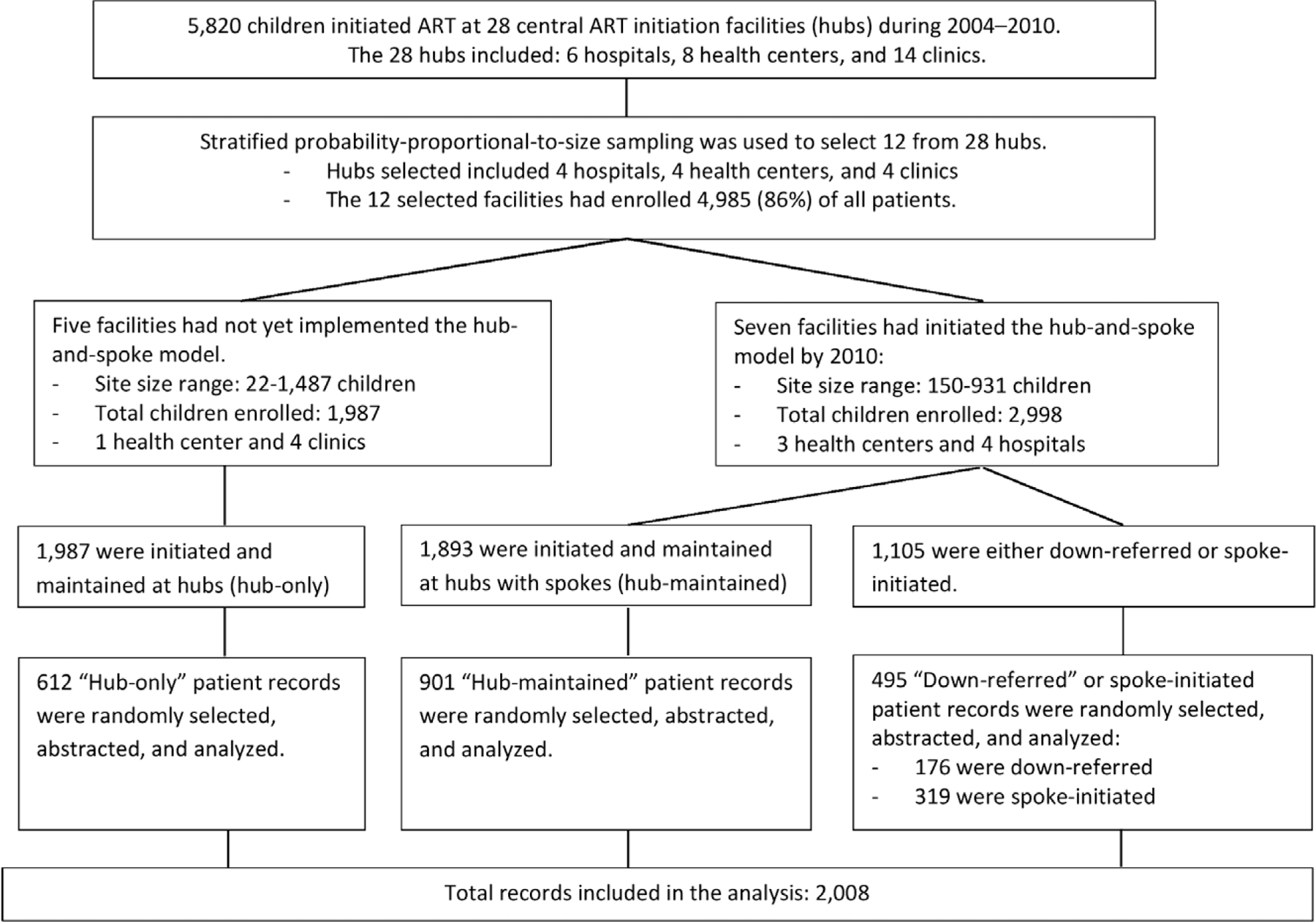
We conducted a nationally representative retrospective cohort study among children starting ART during 2004–2010 to assess effect of down referral and spoke initiation on rates of loss to follow-up (LTFU), death and attrition (death or LTFU). Twelve of 28 pediatric ART hubs were randomly selected using probability-proportional-to-size sampling. Seven selected facilities had initiated hub-and-spoke decentralization by study start; at these facilities, 901 of 1893 hub-initiated and maintained (hub-maintained) children and 495 of 1105 down-referred or spoke-initiated children were randomly selected for record abstraction. At the 5 hub-only facilities, 612 of 1987 children were randomly selected. Multivariable proportional hazards regression was used to estimate adjusted hazard ratios (AHR) for effect of down referral (a time-varying covariate) and spoke initiation on outcomes.
Results:
Among 2008 children at ART initiation, median age was 5.0 years, median CD4% 12.0%, median CD4 count 358 cells/µL and median weight-for-age Z score −1.91. Controlling for known confounders, down referral was strongly protective against LTFU (AHR: 0.40; 95% confidence interval: 0.20–0.79) and attrition (AHR: 0.46; 95% confidence interval: 0.26–0.83) but not mortality. Compared with hub-only children or hub-maintained children, spoke-initiated children had similar outcomes.
Conclusions:
Decentralization of pediatric ART through down referral and spoke initiation within a hub-and-spoke system should be continued and might improve program outcomes.
-
Subjects:
-
Keywords:
-
Source:Pediatr Infect Dis J. 35(8):886-893
-
Pubmed ID:26849157
-
Pubmed Central ID:PMC11552438
-
Document Type:
-
Funding:
-
Volume:35
-
Issue:8
-
Collection(s):
-
Main Document Checksum:urn:sha-512:9736525b83f94496bb3198bbbb086cf52d732a8d39125763dff8b946c3d16574d4020233bd2c0fabbdfa9b40387a6ec96e1c09fce563e683cc345b1408bb1974
-
Download URL:
-
File Type:
 [PDF
- 646.22 KB
]
[PDF
- 646.22 KB
]
Supporting Files


File Language:
English
ON THIS PAGE

CDC STACKS serves as an archival repository of CDC-published products including
scientific findings,
journal articles, guidelines, recommendations, or other public health information authored or
co-authored by CDC or funded partners.
As a repository, CDC STACKS retains documents in their original published format to ensure public access to scientific information.
As a repository, CDC STACKS retains documents in their original published format to ensure public access to scientific information.
You May Also Like
COLLECTION
CDC Public Access