



How Rural is All of Us? Comparing Characteristics of Rural Participants in the NIH All of Us Research Program to Other National Data Sources
Supporting Files

-
9 2024 ; 9-2024
-
Available in CDC Stacks on 2025-09-01T00:00:00Z
File Language:
English
Details
-
Alternative Title:J Rural Health
-
Personal Author:
-
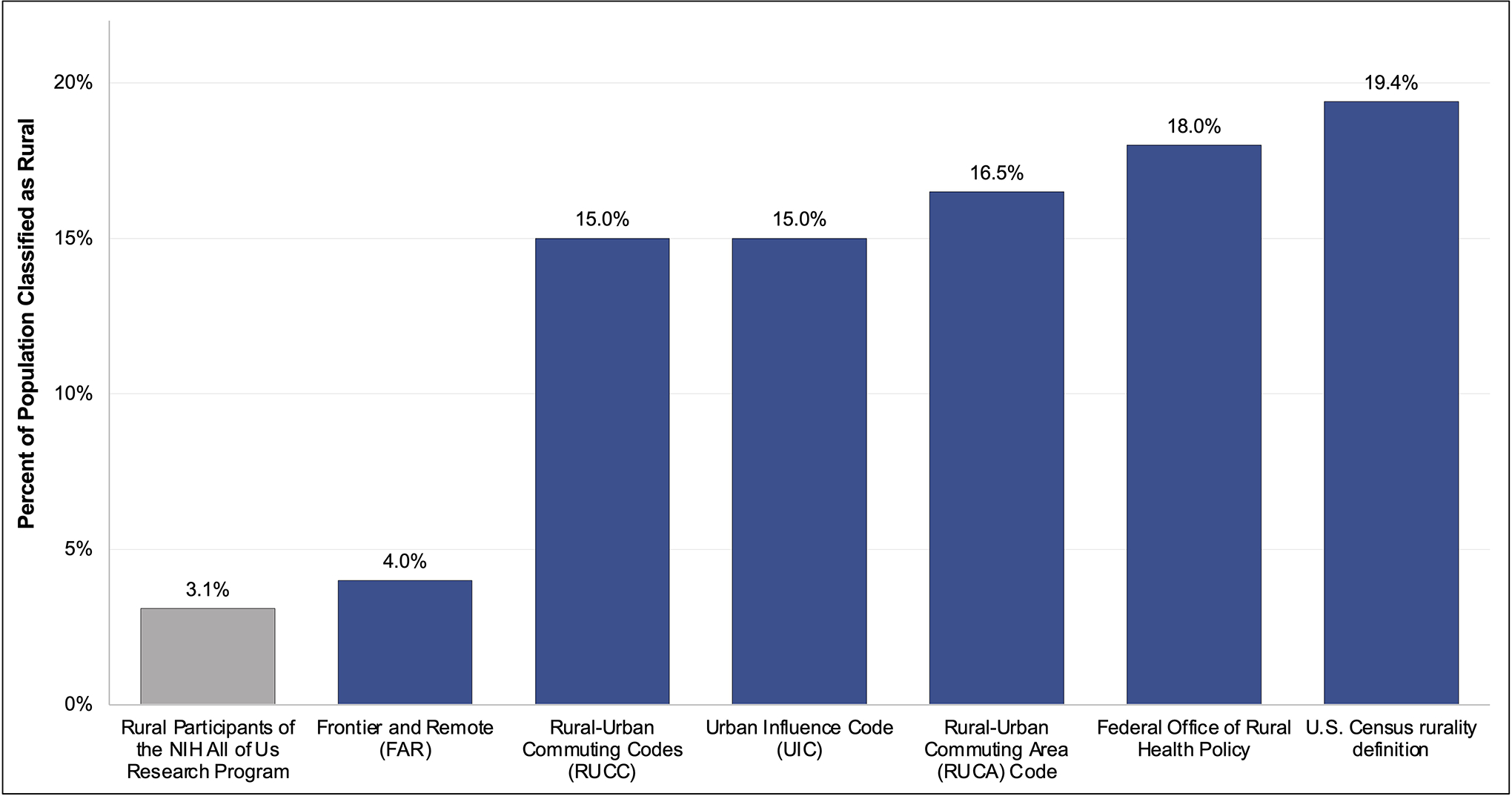
Description:Purpose: ; The National Institute of Health’s All of Us Research Program represents a national effort to develop a database to advance health research, especially among individuals historically underrepresented in research, including rural populations. The purpose of this study was to describe the rural populations identified in the All of Us Research Program using the only rurality indicator currently available in the dataset. ; Methods: ; Currently, the the All of Us Research Program provides a proxy measure of rurality that identifies participants who self-reported delaying care due to far travel distances associated with living in rural areas. Using the All of Us Controlled Tier Dataset v6, we compared sociodemographic and health characteristics of All of Us rural participants identified via this proxy to rural US residents from nationally representative data sources using chi-squared tests. ; Results: ; 3.1% of 160,880 All of Us participants were rural, compared to 15–20% of US residents based on commonly accepted rural definitions. Proportionally more rural All of Us participants reported fair or poor health status, history of cancer, and history of heart disease (p<0.01). ; Conclusions: ; The All of Us measure may capture a subset of underserved participants who live in rural areas and experience healthcare access barriers due to distance. Researchers who use this proxy measure to characterize rurality should interpret their findings with caution due to differences in population and health characteristics using the All of Us definition or rural compared to other commonly used rural definitions.
-
Subjects:
-
Keywords:
-
Source:J Rural Health. 40(4):745-751
-
Pubmed ID:38683037
-
Pubmed Central ID:PMC11502281
-
Document Type:
-
Funding:K23MD013899/National Institute on Minority Health and Health Disparities of the National Institutes of Health/ ; 1 OT2 OD026551/National Institutes of Health, Office of the Director: Regional Medical Centers/ ; 5 U2C OD023196/Data and Research Center/ ; OT2 OD025315/OD/NIH HHSUnited States/ ; OT2 OD026551/OD/NIH HHSUnited States/ ; OT2 OD026552/OD/NIH HHSUnited States/ ; OT2 OD025337/OD/NIH HHSUnited States/ ; OT2 OD025277/OD/NIH HHSUnited States/ ; OT2 OD026555/OD/NIH HHSUnited States/ ; 1 OT2 OD026553/National Institutes of Health, Office of the Director: Regional Medical Centers/ ; OT2 OD026554/OD/NIH HHSUnited States/ ; U24 OD023163/OD/NIH HHSUnited States/ ; OT2 OD023206/OD/NIH HHSUnited States/ ; 1 OT2 OD025276/Community Partners/ ; OT2 OD026556/OD/NIH HHSUnited States/ ; 1 U24 OD023121/Biobank/ ; U24 OD023176/OD/NIH HHSUnited States/ ; OT2 OD026548/OD/NIH HHSUnited States/ ; U2C OD023196/OD/NIH HHSUnited States/ ; 3 OT2 OD023206/Communications and Engagement/ ; U24 OD023121/OD/NIH HHSUnited States/ ; 1 OT2 OD026548/National Institutes of Health, Office of the Director: Regional Medical Centers/ ; IAA #: AOD 16037/National Institutes of Health, Office of the Director: Regional Medical Centers/ ; OT2 OD026549/OD/NIH HHSUnited States/ ; 1 OT2 OD 026552/National Institutes of Health, Office of the Director: Regional Medical Centers/ ; 1 U24 OD023163/Participant Technology Systems Center/ ; 1 OT2 OD026557/National Institutes of Health, Office of the Director: Regional Medical Centers/ ; OT2 OD026550/OD/NIH HHSUnited States/ ; American Association of Colleges of Nursing (AACN)/ ; 3 OT2 OD025315/Community Partners/ ; U24 OD023176/CD/ODCDC CDC HHSUnited States/ ; OT2 OD026553/OD/NIH HHSUnited States/ ; OT2 OD023205/OD/NIH HHSUnited States/ ; K23 MD013899/MD/NIMHD NIH HHSUnited States/ ; 3 OT2 OD023205/Communications and Engagement/ ; OT2 OD025276/OD/NIH HHSUnited States/ ; 1 OT2 OD026556/National Institutes of Health, Office of the Director: Regional Medical Centers/ ; 1 OT2 OD025277/Community Partners/ ; 1 OT2 OD025337/Community Partners/ ; 1 OT2 OD026554/National Institutes of Health, Office of the Director: Regional Medical Centers/ ; OT2 OD026557/OD/NIH HHSUnited States/ ; 1 OT2 OD026550/National Institutes of Health, Office of the Director: Regional Medical Centers/ ; 263201600085U/Federally Qualified Health Centers/ ; 1 OT2 OD026549/National Institutes of Health, Office of the Director: Regional Medical Centers/ ; National Institutes of Health (NIH)/ ; 1 OT2 OD026555/National Institutes of Health, Office of the Director: Regional Medical Centers/
-
Volume:40
-
Issue:4
-
Download URL:
-
File Type:
 [PDF - 436.96 KB]
 -
Collection(s):
-
Main Document Checksum:urn:sha-512:ee6f5669259cb46b41db1022b2ef6babff93ec86dc429ef99d41a4afa469b56361e04d8f17f96bedca99b1d93c8344daf72215a18365dcf57ba15949f0198c36
Supporting Files


File Language:
English
 Was this page helpful?
 Found an issue?


CDC STACKS serves as an archival repository of CDC-published products including
scientific findings, journal articles, guidelines, recommendations, or other public health information authored or
co-authored by CDC or funded partners.
As a repository, CDC STACKS retains documents in their original published format to ensure public access to scientific information.
As a repository, CDC STACKS retains documents in their original published format to ensure public access to scientific information.
You May Also Like
COLLECTION
CDC Public Access