



Emergence of zoonotic sporotrichosis in Brazil: a genomic epidemiology study
Supporting Files

-
3 2024 ; 3-2024
-
Available in CDC Stacks on 2025-03-01T00:00:00Z
File Language:
English
Details
-
Alternative Title:Lancet Microbe
-
Personal Author:dos Santos, Amanda Ribeiro ; Misas, Elizabeth ; Min, Brian ; Le, Ngoc ; Bagal, Ujwal R ; Parnell, Lindsay A ; Sexton, D Joseph ; Lockhart, Shawn R ; de Souza Carvalho Melhem, Marcia ; Takahashi, Juliana Possatto Fernandes ; Oliboni, Gabriel Manzi ; Bonfieti, Lucas Xavier ; Cappellano, Paola ; Sampaio, Jorge Luiz Mello ; Araujo, Lisandra Siufi ; Filho, Hilton L Alves ; Venturini, James ; Chiller, Tom M ; Litvintseva, Anastasia P ; Chow, Nancy A
-
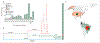
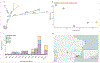
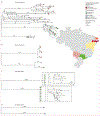
Description:Background ; Zoonotic sporotrichosis is a neglected fungal disease, whereby outbreaks are primarily driven by Sporothrix brasiliensis and linked to cat-to-human transmission. To understand the emergence and spread of sporotrichosis in Brazil, the epicentre of the current epidemic in South America, we aimed to conduct whole-genome sequencing (WGS) to describe the genomic epidemiology. ; Methods ; In this genomic epidemiology study, we included Sporothrix spp isolates from sporotrichosis cases from Brazil, Colombia, and the USA. We conducted WGS using Illumina NovaSeq on isolates collected by three laboratories in Brazil from humans and cats with sporotrichosis between 2013 and 2022. All isolates that were confirmed to be Sporothrix genus by internal transcribed spacer or beta-tubulin PCR sequencing were included in this study. We downloaded eight Sporothrix genome sequences from the National Center for Biotechnology Information (six from Brazil, two from Colombia). Three Sporothrix spp genome sequences from the USA were generated by the US Centers for Disease Control and Prevention as part of this study. We did phylogenetic analyses and correlated geographical and temporal case distribution with genotypic features of Sporothrix spp isolates. ; Findings ; 72 Sporothrix spp isolates from 55 human and 17 animal sporotrichosis cases were included: 67 (93%) were from Brazil, two (3%) from Colombia, and three (4%) from the USA. Cases spanned from 1999 to 2022. Most (61 85%) isolates were S brasiliensis, and all were reported from Brazil. Ten (14%) were Sporothrix schenckii and were reported from Brazil, USA, and Colombia. For S schenckii isolates, two distinct clades were observed wherein isolates clustered by geography. For S brasiliensis isolates, five clades separated by more than 100 000 single-nucleotide polymorphisms were observed. Among the five S brasiliensis clades, clades A and C contained isolates from both human and cat cases, and clade A contained isolates from six different states in Brazil. Compared with S brasiliensis isolates, larger genetic diversity was observed among S schenckii isolates from animal and human cases within a clade. ; Interpretation ; Our results suggest that the ongoing epidemic driven by S brasiliensis in Brazil represents several, independent emergence events followed by animal-to-animal and animal-to human transmission within and between Brazilian states. These results describe how S brasiliensis can emerge and spread within a country. ; Funding ; Coordenação de Aperfeiçoamento de Pessoal de Nível Superior, Brazil; the São Paulo Research Foundation; Productivity in Research fellowships by the National Council for Scientific and Technological Development, and Ministry of Science and Technology of Brazil.
-
Subjects:
-
Source:Lancet Microbe. 5(3):e282-e290
-
Pubmed ID:38432234
-
Pubmed Central ID:PMC11487493
-
Document Type:
-
Funding:
-
Volume:5
-
Issue:3
-
Download URL:
-
File Type:
 [PDF - 748.26 KB]
 -
Collection(s):
-
Main Document Checksum:urn:sha-512:0b90d279dc2a2f217828a7bcd7376005329ddfbc73fff32d441db3e3358650dd5c30d6fb09b4ea3cc1f50bfe65335bccdada27a10657ab8a71bd479a42149d43
Supporting Files


File Language:
English
 Was this page helpful?
 Found an issue?




CDC STACKS serves as an archival repository of CDC-published products including
scientific findings, journal articles, guidelines, recommendations, or other public health information authored or
co-authored by CDC or funded partners.
As a repository, CDC STACKS retains documents in their original published format to ensure public access to scientific information.
As a repository, CDC STACKS retains documents in their original published format to ensure public access to scientific information.
You May Also Like
COLLECTION
CDC Public Access