



Interventions to Mitigate the Impact of COVID-19 Among People Experiencing Sheltered Homelessness: Chicago, Illinois, March 1, 2020–May 11, 2023
Supporting Files

-
10-2024
-
Available in CDC Stacks on 2025-02-01T00:00:00Z
File Language:
English
Details
-
Alternative Title:Am J Public Health
-
Personal Author:Tietje, Lauren
 ;
Ghinai, Isaac
;
Cooper, Antea
;
Tung, Elizabeth L.
;
Borah, Brian
;
Funk, Michelle
;
Ramachandran, Divya
;
Gerber, Ben
;
Man, Bernice
;
Singer, Rebecca
;
Bell, Elizabeth
;
Moss, Angela
;
Weidemiller, Andrew
;
Chaudhry, Mehreen
;
Lendacki, Frances
;
Bernard, Rachel
;
Gretsch, Stephanie
;
English, Kayla
;
Huggett, Thomas D.
;
Tornabene, Mary
;
Cool, Caroline
;
Detmer, Wayne M.
;
Schroeter, Mary Kate
;
Mayer, Stockton
;
Davis, Elizabeth
;
Boegner, Josh
;
Glenn, Erik Elias
;
Phillips, Gregory
;
Falck, Suzanne
;
Barranco, Lindsay
;
Toews, Karrie-Ann
;
Ghinai, Isaac
;
Cooper, Antea
;
Tung, Elizabeth L.
;
Borah, Brian
;
Funk, Michelle
;
Ramachandran, Divya
;
Gerber, Ben
;
Man, Bernice
;
Singer, Rebecca
;
Bell, Elizabeth
;
Moss, Angela
;
Weidemiller, Andrew
;
Chaudhry, Mehreen
;
Lendacki, Frances
;
Bernard, Rachel
;
Gretsch, Stephanie
;
English, Kayla
;
Huggett, Thomas D.
;
Tornabene, Mary
;
Cool, Caroline
;
Detmer, Wayne M.
;
Schroeter, Mary Kate
;
Mayer, Stockton
;
Davis, Elizabeth
;
Boegner, Josh
;
Glenn, Erik Elias
;
Phillips, Gregory
;
Falck, Suzanne
;
Barranco, Lindsay
;
Toews, Karrie-Ann
-
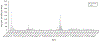
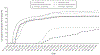
Description:Objectives. ; To compare the incidence, case-hospitalization rates, and vaccination rates of COVID-19 between people experiencing sheltered homelessness (PESH) and the broader community in Chicago, Illinois, and describe the impact of a whole community approach to disease mitigation during the public health emergency. ; Methods. ; Incidence of COVID-19 among PESH was compared with community-wide incidence using case-based surveillance data from March 1, 2020, to May 11, 2023. Seven-day rolling means of COVID-19 incidence were assessed for the overall study period and for each of 6 distinct waves of COVID-19 transmission. ; Results. ; A total of 774009 cases of COVID-19 were detected: 2579 among PESH and 771 430 in the broader community. Incidence and hospitalization rates per 100 000 in PESH were more than 5 times higher (99.84 vs 13.94 and 16.88 vs 2.14) than the community at large in wave 1 (March 1, 2020–October 3, 2020). This difference decreased through wave 3 (March 7, 2021–June 26, 2021), with PESH having a lower incidence rate per 100 000 than the wider community (8.02 vs 13.03). Incidence and hospitalization of PESH rose again to rates higher than the broader community in waves 4 through 6 but never returned to wave 1 levels. Throughout the study period, COVID-19 incidence among PESH was 2.88 times higher than that of the community (70.90 vs 24.65), and hospitalization was 4.56 times higher among PESH (7.51 vs 1.65). ; Conclusions. ; Our findings suggest that whole-community approaches can minimize disparities in severe acute respiratory syndrome coronavirus 2 (SARS-CoV-2) transmission between vulnerable populations and the broader community, and reinforce the benefits of a shared approach that include multiple partners when addressing public health emergencies in special populations.
-
Subjects:
-
Source:Am J Public Health. 114(Suppl 7):S590-S598
-
Pubmed ID:39197136
-
Pubmed Central ID:PMC11424243
-
Document Type:
-
Funding:
-
Volume:114
-
Download URL:
-
File Type:
 [PDF - 340.85 KB]
 -
Collection(s):
-
Main Document Checksum:urn:sha-512:50f40feb395e7f9eeda01db678666c8e480d5f0c6be4249e2aef25d4a9a0c8c25dbb84d3333a588f2206eaa311608790921e92501eebdbf2e4944c25efe5f08f
Supporting Files


File Language:
English
 Was this page helpful?
 Found an issue?



CDC STACKS serves as an archival repository of CDC-published products including
scientific findings, journal articles, guidelines, recommendations, or other public health information authored or
co-authored by CDC or funded partners.
As a repository, CDC STACKS retains documents in their original published format to ensure public access to scientific information.
As a repository, CDC STACKS retains documents in their original published format to ensure public access to scientific information.
You May Also Like
COLLECTION
CDC Public Access