



Eye Care in Federally Qualified Health Centers
Supporting Files

-
10 2024 ; 10-2024
-
Available in CDC Stacks on 2025-10-01T00:00:00Z
File Language:
English
Details
-
Alternative Title:Ophthalmology
-
Personal Author:
-
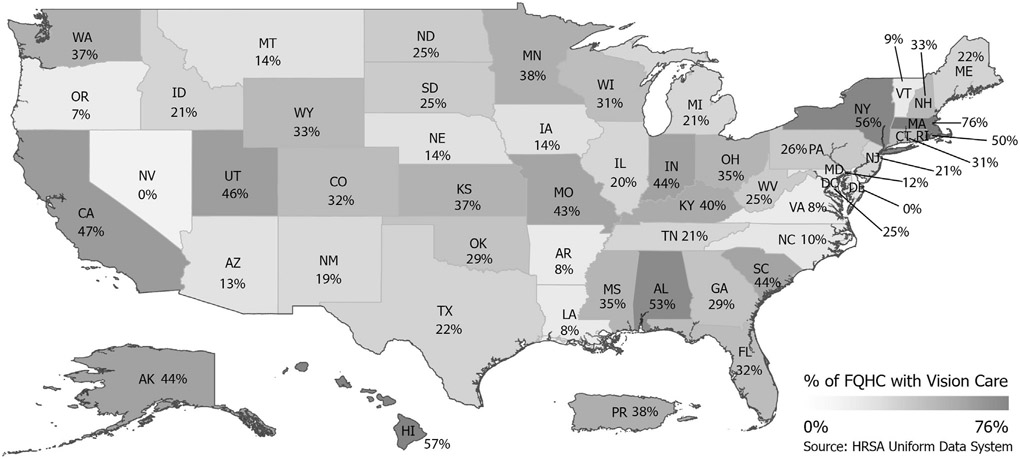
Description:Purpose: ; To assess changes in vision care availability at Federally Qualified Health Centers (FQHCs) between 2017 and 2021 and whether neighborhood-level demographic social risk factors (SRFs) associated with eye care services provided by FQHCs. ; Design: ; Secondary data analysis of the Health Resources and Services Administration (HRSA) data and 2017–2021 American Community Survey (ACS). ; Participants: ; Federally Qualified Health Centers. ; Methods: ; Patient and neighborhood characteristics for SRFs were summarized. Differences in FQHCs providing and not providing vision care were compared via Wilcoxon-Mann–Whitney tests for continuous measures and chi-square tests for categorical measures. Logistic regression models were used to test the associations between neighborhood measures and FQHCs providing vision care, adjusted for patient characteristics. ; Main Outcome Measures: ; Odds ratios (ORs) with 95% confidence intervals (CIs) for neighborhood-level predictors of FQHCs providing vision care services. ; Results: ; Overall, 28.5% of FQHCs (n = 375/1318) provided vision care in 2017 versus 32% (n = 435/1362) in 2021 with some increases and decreases in both the number of FQHCs and those with and without vision services. Only 2.6% of people who accessed FQHC services received eye care in 2021. Among the 435 FQHCs that provided vision care in 2021, 27.1% (n = 118) had added vision services between 2017 and 2021, 71.5% (n = 311) had been offering vision services since at least 2017, and 1.4% (n = 6) were newly established. FQHCs providing vision care in 2021 were more likely to be in neighborhoods with a higher percentage of Hispanic/Latino individuals (OR, 1.08, 95% CI, 1.02–1.14, P = 0.0094), Medicaid-insured individuals (OR, 1.08, 95% CI, 1.02–1.14, P = 0.0120), and no car households (OR, 1.07, 95% CI, 1.01–1.13, P = 0.0142). However, FQHCs with vision care, compared to FQHCs without vision care, served a lower percentage of Hispanic/Latino individuals (27.2% vs. 33.9%, P = 0.0007), Medicaid-insured patients (42.8% vs. 46.8%, P < 0.0001), and patients living at or below 100% of the federal poverty line (61.3% vs. 66.3%, P < 0.0001). ; Conclusions: ; Vision care services are available at a few FQHCs, localized to a few states. Expanding eye care access at FQHCs would meet patients where they seek care to mitigate vision loss to underserved communities. ; Financial Disclosure(s): ; Proprietary or commercial disclosure may be found after the references.
-
Subjects:
-
Keywords:
-
Source:Ophthalmology. 131(10):1225-1233
-
Pubmed ID:38697267
-
Pubmed Central ID:PMC11416322
-
Document Type:
-
Funding:P30 EY001792/EY/NEI NIH HHSUnited States/ ; R01 EY031033/EY/NEI NIH HHSUnited States/ ; R01 EY031337/EY/NEI NIH HHSUnited States/ ; K12 GM111725/GM/NIGMS NIH HHSUnited States/ ; R01 EB032328/EB/NIBIB NIH HHSUnited States/ ; K23 EY030530/EY/NEI NIH HHSUnited States/ ; P30 EY007003/EY/NEI NIH HHSUnited States/ ; UL1 TR002240/TR/NCATS NIH HHSUnited States/ ; U01 DP006442/DP/NCCDPHP CDC HHSUnited States/
-
Volume:131
-
Issue:10
-
Download URL:
-
File Type:
 [PDF - 276.39 KB]
 -
Collection(s):
-
Main Document Checksum:urn:sha-512:f18631e7956cf6863a475a3b6474ebf1ecf3b1baf114fb42ebf399542092d6f95a651ef9346c38166df5306d812b63c842c069e327cf75c2ed9f424cc3e13e6d
Supporting Files


File Language:
English
 Was this page helpful?
 Found an issue?

CDC STACKS serves as an archival repository of CDC-published products including
scientific findings, journal articles, guidelines, recommendations, or other public health information authored or
co-authored by CDC or funded partners.
As a repository, CDC STACKS retains documents in their original published format to ensure public access to scientific information.
As a repository, CDC STACKS retains documents in their original published format to ensure public access to scientific information.
You May Also Like
COLLECTION
CDC Public Access