



Construction of residential histories to estimate long-term environmental exposures in the California Teachers Study cohort
Supporting Files

-
11 2024 ; 11-2024
-
Available in CDC Stacks on 2024-12-06T00:00:00Z
File Language:
English
Details
-
Alternative Title:J Expo Sci Environ Epidemiol
-
Personal Author:
-
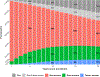
Description:Environmental epidemiologic studies using geospatial data often estimate exposure at a participant's residence upon enrollment, but mobility during the exposure period can lead to misclassification. We aimed to mitigate this issue by constructing residential histories for participants in the California Teachers Study through follow-up (1995-2018). Address records have been collected from the US Postal Service, LexisNexis, Experian, and California Cancer Registry. We identified records of the same address based on geo-coordinate distance (≤250 m) and street name similarity. We consolidated addresses, prioritizing those confirmed by participants during follow-up questionnaires, and estimating the duration lived at each address using dates associated with records (e.g., date-first-seen). During 23 years of follow-up, about half of participants moved (48%, including 14% out-of-state). We observed greater mobility among younger women, Hispanic/Latino women, and those in metropolitan and lower socioeconomic status areas. The cumulative proportion of in-state movers remaining eligible for analysis was 21%, 32%, and 41% at 5, 10, and 20 years post enrollment, respectively. Using self-reported information collected 10 years after enrollment, we correctly identified 94% of movers and 95% of non-movers as having moved or not moved from their enrollment address. This dataset provides a foundation for estimating long-term environmental exposures in diverse epidemiologic studies in this cohort. IMPACT: Our efforts in constructing residential histories for California Teachers Study participants through follow-up (1995-2018) benefit future environmental epidemiologic studies. Address availability during the exposure period can mitigate misclassification due to residential changes, especially when evaluating long-term exposures and chronic health outcomes. This can reduce differential misclassification among more mobile subgroups, including younger women and those from lower socioeconomic and urban areas. Our approach to consolidating addresses from multiple sources showed high accuracy in comparison to self-reported residential information. The residential dataset produced from this analysis provides a valuable tool for future studies, ultimately enhancing our understanding of environmental health impacts.
-
Subjects:
-
Keywords:
-
Source:J Expo Sci Environ Epidemiol. 34(6):1028-1034
-
Pubmed ID:38448681
-
Pubmed Central ID:PMC11377857
-
Document Type:
-
Funding:HHSN261201800009C/CA/NCI NIH HHSUnited States/ ; NU58DP006344/DP/NCCDPHP CDC HHSUnited States/ ; HHSN261201800015I/CA/NCI NIH HHSUnited States/ ; P42 ES033719/ES/NIEHS NIH HHSUnited States/ ; T32 ES007322/ES/NIEHS NIH HHSUnited States/ ; F31 ES035306/ES/NIEHS NIH HHSUnited States/ ; ZIA CP010125/ImNIH/Intramural NIH HHSUnited States/ ; HHSN261201800032I/CA/NCI NIH HHSUnited States/ ; P30 CA033572/CA/NCI NIH HHSUnited States/ ; HHSN261201800015C/CA/NCI NIH HHSUnited States/ ; U01 CA199277/CA/NCI NIH HHSUnited States/ ; UM1 CA164917/CA/NCI NIH HHSUnited States/ ; R01 CA170394/CA/NCI NIH HHSUnited States/ ; HHSN261201800032C/CA/NCI NIH HHSUnited States/ ; P30 CA023100/CA/NCI NIH HHSUnited States/ ; R01 CA077398/CA/NCI NIH HHSUnited States/ ; HHSN261201800009I/CA/NCI NIH HHSUnited States/ ; P30 ES009089/ES/NIEHS NIH HHSUnited States/
-
Volume:34
-
Issue:6
-
Download URL:
-
File Type:
 [PDF - 562.50 KB]
 -
Collection(s):
-
Main Document Checksum:urn:sha-512:7e32c9ae9c8c813e6589a6450910998775bc852538310be7bb2bd1af6c6e7cbe4fc9d9caa2512ae9c188d5c74ebf69df78f4813964c8c54bd8d26754c36adbb1
Supporting Files


File Language:
English
 Was this page helpful?
 Found an issue?


CDC STACKS serves as an archival repository of CDC-published products including
scientific findings, journal articles, guidelines, recommendations, or other public health information authored or
co-authored by CDC or funded partners.
As a repository, CDC STACKS retains documents in their original published format to ensure public access to scientific information.
As a repository, CDC STACKS retains documents in their original published format to ensure public access to scientific information.
You May Also Like
COLLECTION
CDC Public Access