



Campylobacter jejuni Multilocus Sequence Types in Humans, Northwest England, 2003–2004
Supporting Files
Public Domain

-
Oct 2006
Details
-
Alternative Title:Emerg Infect Dis
-
Personal Author:
-
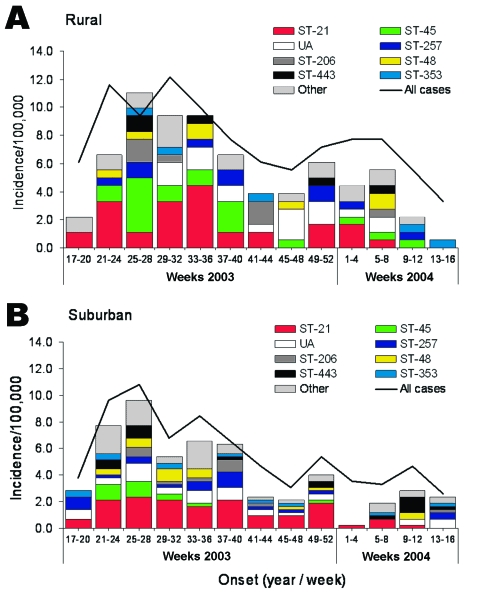
Description:Detailed understanding of the epidemiology of Campylobacter is increasingly facilitated through use of universal and reproducible techniques for accurate strain differentiation and subtyping. Multilocus sequence typing (MLST) enables discriminatory subtyping and grouping of isolate types into genetically related clonal complexes; it also has the advantage of ease of application and repeatability. Recent studies suggest that a measure of host association may be distinguishable with this system. We describe the first continuous population-based survey to investigate the potential of MLST to resolve questions of campylobacteriosis epidemiology. We demonstrate the ability of MLST to identify variations in the epidemiology of campylobacteriosis between distinct populations and describe the distribution of key subtypes of interest.
-
Subjects:
-
Source:Emerg Infect Dis. 12(10):1500-1507.
-
Document Type:
-
Volume:12
-
Issue:10
-
Download URL:
-
File Type:
 [PDF - 284.26 KB]
 -
Collection(s):
-
Main Document Checksum:urn:sha256:d4ef94d6491b52db4d756e3954a45babc14fe107e3380c35658ddfa6f22f9512
Supporting Files


 Was this page helpful?
 Found an issue?


CDC STACKS serves as an archival repository of CDC-published products including
scientific findings, journal articles, guidelines, recommendations, or other public health information authored or
co-authored by CDC or funded partners.
As a repository, CDC STACKS retains documents in their original published format to ensure public access to scientific information.
As a repository, CDC STACKS retains documents in their original published format to ensure public access to scientific information.
You May Also Like
COLLECTION
Emerging Infectious Diseases