



Electrophysiological correlates of thalamocortical function in acute severe traumatic brain injury
Supporting Files

-
7 2022
-
File Language:
English
Details
-
Alternative Title:Cortex
-
Personal Author:
-
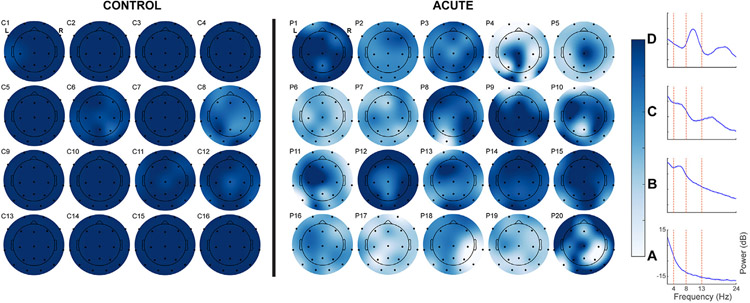
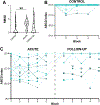
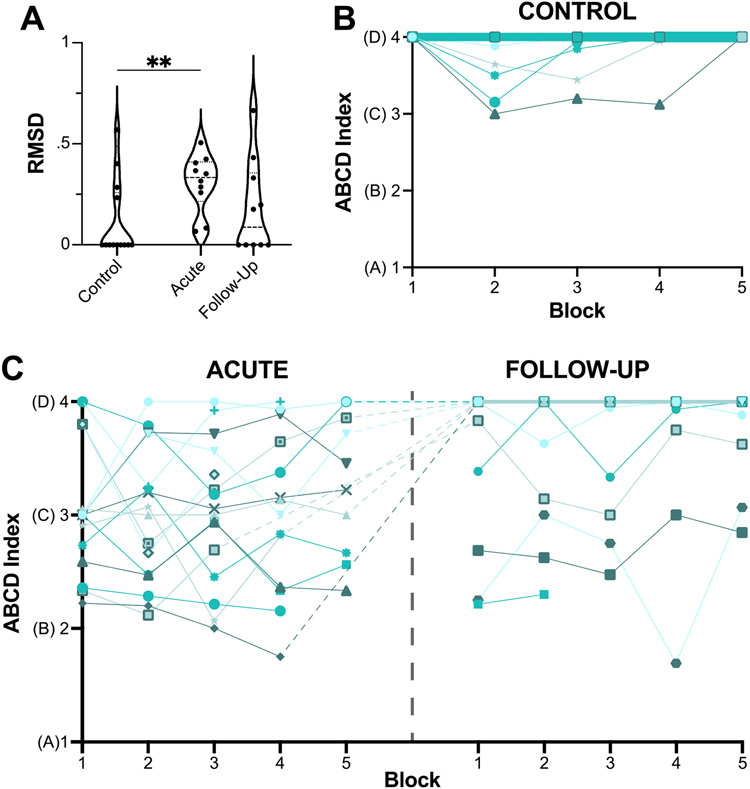
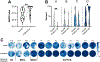
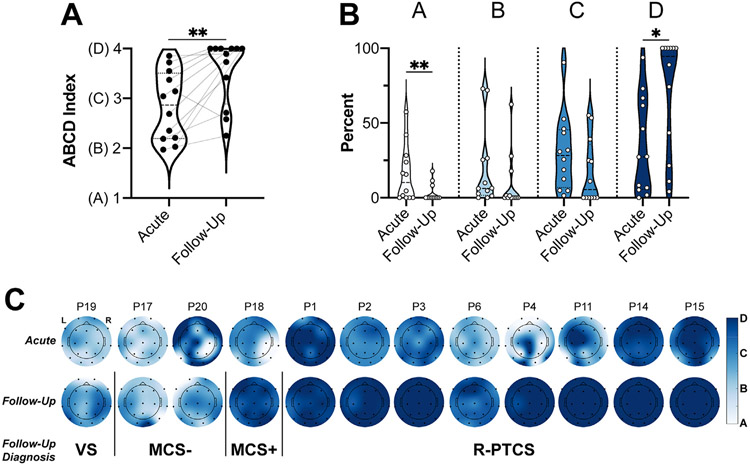
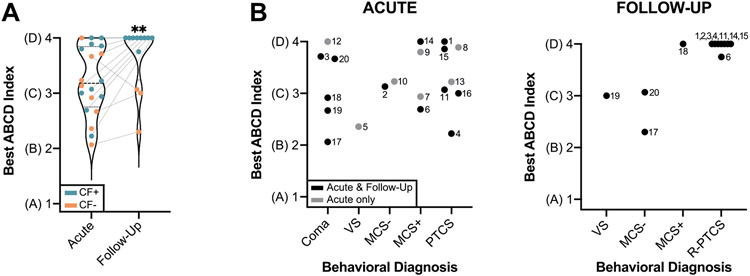
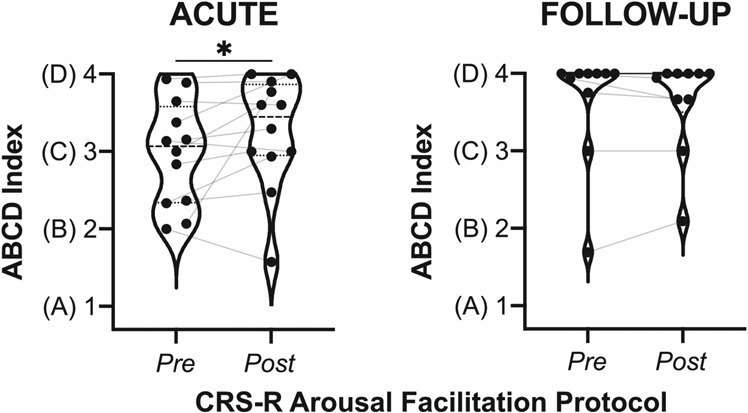
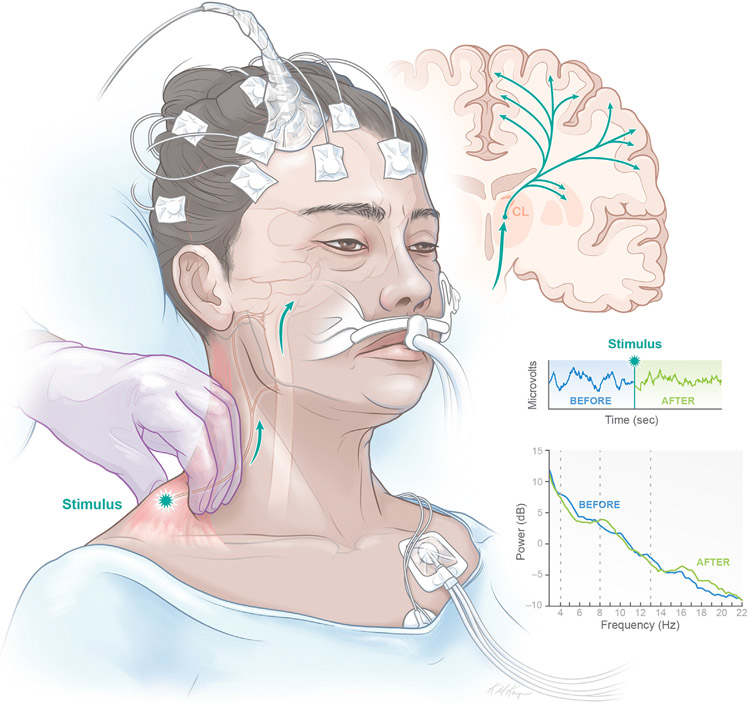
Description:Tools assaying the neural networks that modulate consciousness may facilitate tracking of recovery after acute severe brain injury. The ABCD framework classifies resting-state EEG into categories reflecting levels of thalamocortical network function that correlate with outcome in post-cardiac arrest coma. In this longitudinal cohort study, we applied the ABCD framework to 20 patients with acute severe traumatic brain injury requiring intensive care (12 of whom were also studied at ≥6-months post-injury) and 16 healthy controls. We tested four hypotheses: 1) EEG ABCD classifications are spatially heterogeneous and temporally variable; 2) ABCD classifications improve longitudinally, commensurate with the degree of behavioral recovery; 3) ABCD classifications correlate with behavioral level of consciousness; and 4) the Coma Recovery Scale-Revised arousal facilitation protocol yields improved ABCD classifications. Channel-level EEG power spectra were classified based on spectral peaks within pre-defined frequency bands: 'A' = no peaks above delta (<4 Hz) range (complete thalamocortical disruption); 'B' = theta (4-8 Hz) peak (severe thalamocortical disruption); 'C' = theta and beta (13-24 Hz) peaks (moderate thalamocortical disruption); or 'D' = alpha (8-13 Hz) and beta peaks (normal thalamocortical function). Acutely, 95% of patients demonstrated 'D' signals in at least one channel but exhibited within-session temporal variability and spatial heterogeneity in the proportion of different channel-level ABCD classifications. By contrast, healthy participants and patients at follow-up consistently demonstrated signals corresponding to intact thalamocortical network function. Patients demonstrated longitudinal improvement in ABCD classifications (p < .05) and ABCD classification distinguished patients with and without command-following in the subacute-to-chronic phase of recovery (p < .01). In patients studied acutely, ABCD classifications improved after the Coma Recovery Scale-Revised arousal facilitation protocol (p < .05) but did not correspond with behavioral level of consciousness. These findings support the use of the ABCD framework to characterize channel-level EEG dynamics and track fluctuations in functional thalamocortical network integrity in spatial detail.
-
Subjects:
-
Keywords:
-
Source:Cortex. 152:136-152
-
Pubmed ID:35569326
-
Pubmed Central ID:PMC9759728
-
Document Type:
-
Funding:
-
Volume:152
-
Collection(s):
-
Main Document Checksum:urn:sha-512:29388d3f3f928d41f26d229310b72a5520aa2d8c5cf981d1d2c3370feeab132d6a78df3136f7167f2301b85c6d73e31cba8bfd548116a113f2489912f1829052
-
Download URL:
-
File Type:
 [PDF
- 1.19 MB
]
[PDF
- 1.19 MB
]
Supporting Files


File Language:
English
 Was this page helpful?
 Found an issue?


CDC STACKS serves as an archival repository of CDC-published products including
scientific findings,
journal articles, guidelines, recommendations, or other public health information authored or
co-authored by CDC or funded partners.
As a repository, CDC STACKS retains documents in their original published format to ensure public access to scientific information.
As a repository, CDC STACKS retains documents in their original published format to ensure public access to scientific information.
You May Also Like
COLLECTION
CDC Public Access