



Precarious Employment and Mental Health in the United States: Results from the Medical Expenditure Panel Survey (MEPS), 2008–2021
Supporting Files

-
9 2024 ; 9-2024
-
Available in CDC Stacks on 2024-09-03T00:00:00Z
File Language:
English
Details
-
Alternative Title:Prev Med
-
Personal Author:
-
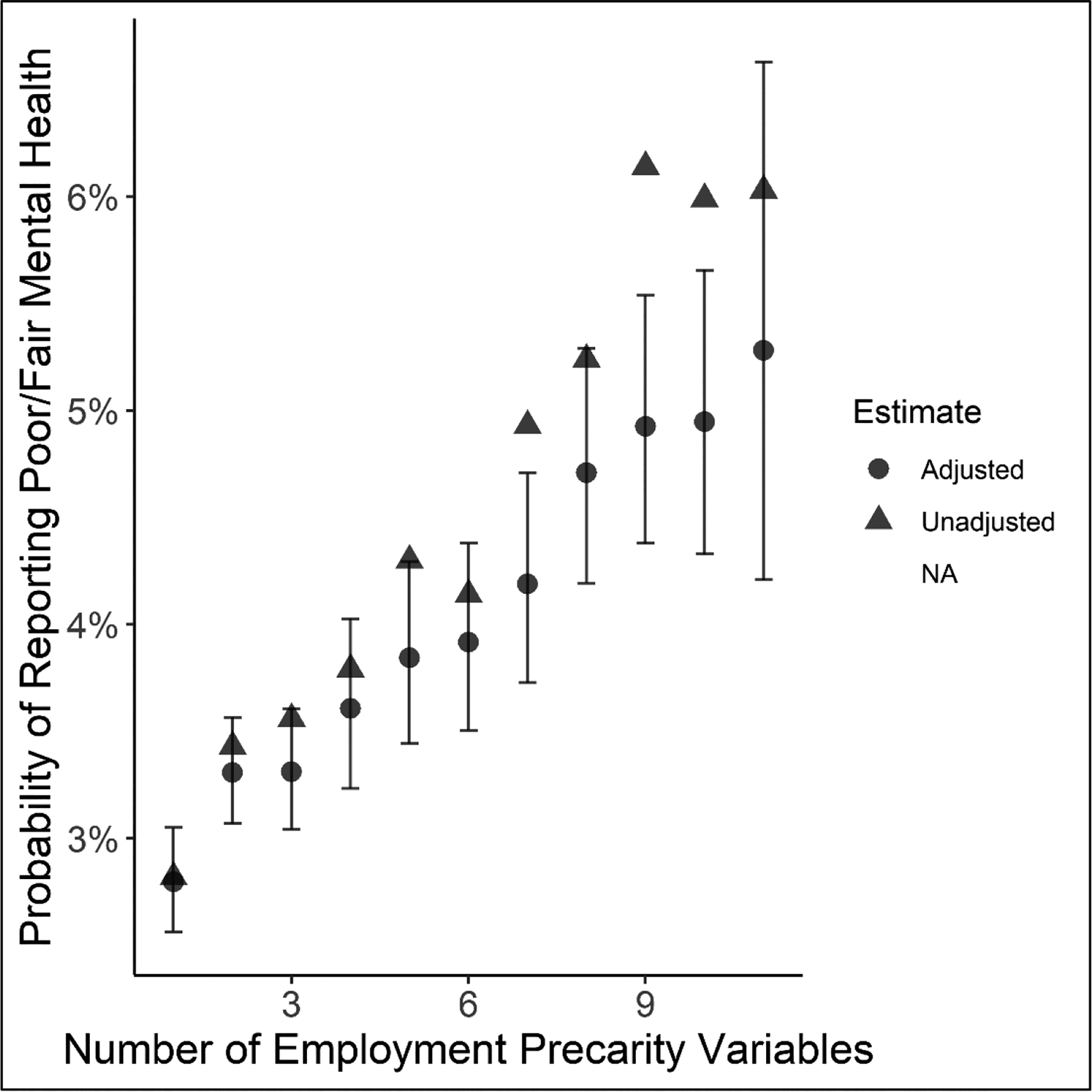
Description:Objectives: ; To measure associations between employment precarity and mental health among United States (US) workers. ; Methods: ; This study used data from the US Medical Expenditure Panel Survey for 2008–2021. Multivariable generalized estimating equations were used to measure associations between employment precarity (operationalized as a multi-dimensional exposure) and self-rated mental health after adjusting for relevant confounders. Marginal effects analysis was used to assess potential dose-response relationships between precarity and mental health. ; Results: ; Our sample (n = 57,529) was representative of more than 106 million US workers employed throughout 2008–2021. Compared to those with low levels of employment precarity, those with medium and high levels of precarity had an increased odds of reporting poor/fair mental health (aOR = 1.21; 95% CI = 1.11, 1.32 and 1.51; 95% CI = 1.36, 1.68, respectively). Marginal effects analysis indicated that increasing levels of precarity were associated with an increased probability of reporting poor/fair mental health. ; Conclusions: ; Increasing levels of employment precarity were associated with poor/fair self-rated mental health, findings potentially indicative of a dose-response relationship between the two. These nationally representative findings suggest employment precarity is an important social determinant of mental health. Future research could investigate how best to mitigate the negative effects of precarity on workers’ lives and well-being, particularly regarding mental health.
-
Subjects:
-
Keywords:
-
Source:Prev Med. 186:108090
-
Pubmed ID:39098343
-
Pubmed Central ID:PMC11370106
-
Document Type:
-
Funding:
-
Volume:186
-
Download URL:
-
File Type:
 [PDF - 514.95 KB]
 -
Collection(s):
-
Main Document Checksum:urn:sha-512:93b6109eb8a5db20fbd5cd87656b19292ca3dec390538aad44842e38b5e3c05410849fcec0d2a6576c1ad1a02173d2d86caad163bf29f86b1a915bf7fef6c805
Supporting Files


File Language:
English
 Was this page helpful?
 Found an issue?

CDC STACKS serves as an archival repository of CDC-published products including
scientific findings, journal articles, guidelines, recommendations, or other public health information authored or
co-authored by CDC or funded partners.
As a repository, CDC STACKS retains documents in their original published format to ensure public access to scientific information.
As a repository, CDC STACKS retains documents in their original published format to ensure public access to scientific information.
You May Also Like
COLLECTION
CDC Public Access