



Child Age at Time of First Maternal Concern and Time to Services among Children with Autism Spectrum Disorder
Supporting Files

-
2024 ; Jul-Aug 2024
-
Available in CDC Stacks on 2024-08-16T00:00:00Z
File Language:
English
Details
-
Alternative Title:J Dev Behav Pediatr
-
Personal Author:Van Dyke, Julia ; Rosenberg, Steven A. ; Crume, Tessa ; Reyes, Nuri ; Alexander, Aimee Anido ; Barger, Brian ; Fitzgerald, Robert ; Hightshoe, Kristina ; Moody, Eric J. ; Pazol, Karen ; Rosenberg, Cordelia R. ; Rubenstein, Eric ; Wiggins, Lisa ; DiGuiseppi, Carolyn
-
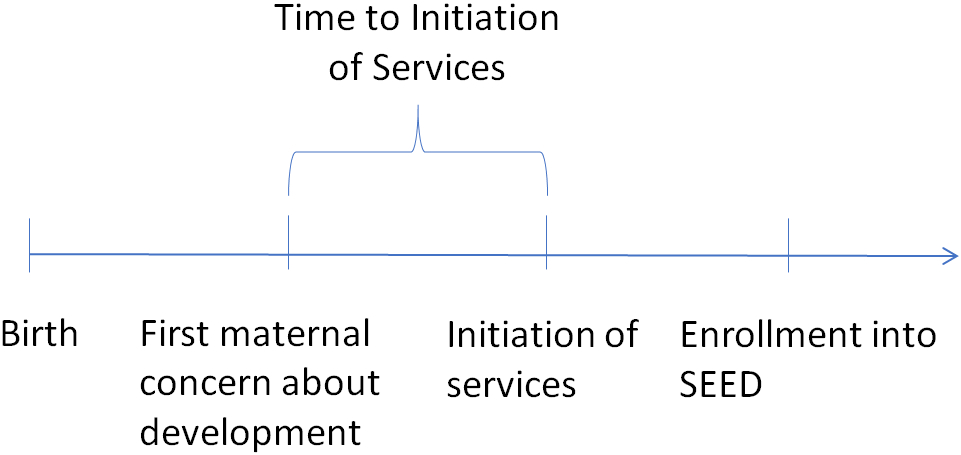
Description:Objective ; Early treatment of autism spectrum disorder (ASD) can improve developmental outcomes. Children with ASD from minority families often receive services later. We explored factors related to child’s age at time of mother’s first concerns about child’s development and subsequent time to service initiation among children with ASD. ; Methods ; Analysis included 759 preschool-age children classified with ASD based on comprehensive evaluations. Factors associated with retrospectively-reported child age at time of first maternal concern and subsequent time to service initiation were investigated using multiple linear regression and Cox proportional-hazards. ; Results ; Earlier maternal concern was associated with multiparity, ≥1 child chronic condition, externalizing behaviors, and younger gestational age, but not race/ethnicity. Time to service initiation was longer for children of non-Latino Black or other than Black or White race and higher developmental level, and shorter for children with ≥1 chronic condition and older child age at first maternal concern. ; Conclusion ; Parity, gestational age, and child health and behavior were associated with child age at first maternal concern. Knowledge of child development in multiparous mothers may allow them to recognize potential concerns earlier, suggesting that first time parents may benefit from enhanced education about normal development. Race/ethnicity was not associated with child’s age when mothers recognized potential developmental problems, hence it is unlikely that awareness of ASD symptoms causes racial/ethnic disparities in initiation of services. Delays in time to service initiation among children from racial/ethnic minority groups highlight the need to improve their access to services as soon as developmental concerns are recognized.
-
Subjects:
-
Keywords:
-
Source:J Dev Behav Pediatr. 45(4):e293-e301
-
Pubmed ID:38896561
-
Pubmed Central ID:PMC11326974
-
Document Type:
-
Funding:U01 DD000746/DD/NCBDD CDC HHSUnited States/ ; U01DD000901/CC/CDC HHSUnited States/ ; U10 DD000901/DD/NCBDD CDC HHSUnited States/ ; U01DD000748/CC/CDC HHSUnited States/ ; U01 DD000749/DD/NCBDD CDC HHSUnited States/ ; U01DD000750/CC/CDC HHSUnited States/ ; U01 DD000748/DD/NCBDD CDC HHSUnited States/ ; U01DD000752/CC/CDC HHSUnited States/ ; U01DD000746/CC/CDC HHSUnited States/ ; U01DD000749/CC/CDC HHSUnited States/ ; U01 DD000752/DD/NCBDD CDC HHSUnited States/ ; U01 DD000750/DD/NCBDD CDC HHSUnited States/
-
Volume:45
-
Issue:4
-
Download URL:
-
File Type:
 [PDF - 155.49 KB]
 -
Collection(s):
-
Main Document Checksum:urn:sha-512:e36573d2e47dfcac5149c6494c3c1d761395c656dc1ccb8425a871a9d0413d5d197c25b497a10d22fb7213391d1a04feb04f00dff50b7274f450379071f85c77
Supporting Files


File Language:
English
 Was this page helpful?
 Found an issue?

CDC STACKS serves as an archival repository of CDC-published products including
scientific findings, journal articles, guidelines, recommendations, or other public health information authored or
co-authored by CDC or funded partners.
As a repository, CDC STACKS retains documents in their original published format to ensure public access to scientific information.
As a repository, CDC STACKS retains documents in their original published format to ensure public access to scientific information.
You May Also Like
COLLECTION
CDC Public Access