



Population-Based Study of Rare Epilepsy Incidence in a US Urban Population
Supporting Files

-
8 2024 ; 8-2024
-
Available in CDC Stacks on August 10, 2024, 12:00 AM

File Language:
English
Details
-
Alternative Title:Epilepsia
-
Personal Author:
-
Description:Objective.
This study was undertaken to estimate incidence of rare epilepsies and compare with literature.
Methods.
We used electronic health record text search to identify children with 28 rare epilepsies in New York City (2010–2014). We estimated cumulative incidence and compared with literature.
Results.
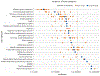
Eight of 28 rare epilepsies had 5 or more prior estimates, and our measurements were within the published range for all. The most common were infantile spasms syndrome (1 in 2,920 live births), Lennox-Gastaut syndrome (1 in 9,690), and seizures associated with tuberous sclerosis complex (1 in 14,300). Sixteen of 28 had fewer than 5 prior estimates, and of these, we provided additional estimates for early infantile developmental and epileptic encephalopathy (1 in 32,700), epilepsy with myoclonic atonic seizures (1 in 34,100), Sturge-Weber syndrome plus seizures/epilepsy (1 in 40,900), epilepsy in infancy with migrating focal seizures (1 in 54,500), Aicardi syndrome plus seizures/epilepsy (1 in 71,600), hypothalamic hamartoma with seizures (1 in 225,000), and Rasmussen syndrome (1 in 450,000). Five of 28 had no prior estimates, and of these, we provided a new estimate for developmental/epileptic encephalopathy with spike-and-wave activation in sleep and/or continuous spikes and waves during sleep (1 in 34,100). Data was limited for the remaining 12 rare epilepsies that were all genetic epilepsies, including PCDH19, CDKL5, Alpers disease, SCN8A, KCNQ2, SCN2A, GLUT1 deficiency, Phelan-McDermid syndrome, MERRF, dup15q syndrome, ring chromosome 14, and ring chromosome 20.
Significance.
We estimated the incidence of rare epilepsies using population-based EHR data and literature review. More research is needed to better estimate the incidence of genetic epilepsies with nonspecific clinical features. Electronic health records may be a valuable data source for studying rare epilepsies and other rare diseases, particularly as genetic testing becomes more widely adopted. -
Subjects:
-
Keywords:
-
Source:Epilepsia. 65(8):2341-2353
-
Pubmed ID:38795333
-
Pubmed Central ID:PMC11315636
-
Document Type:
-
Funding:
-
Volume:65
-
Issue:8
-
Download URL:
-
File Type:
 [PDF - 631.23 KB]
 -
Collection(s):
-
Main Document Checksum:urn:sha-512:bc6d3b2878242eeaec2dddee76404fde304beff96b655c687f1f9fe00d7bb97fc80dfd31b8cc266101b01a9146caa83b353c8bcb57aa625662f77947275db9bb
Supporting Files


File Language:
English
 Was this page helpful?
 Found an issue?



CDC STACKS serves as an archival repository of CDC-published products including
scientific findings, journal articles, guidelines, recommendations, or other public health information authored or
co-authored by CDC or funded partners.
As a repository, CDC STACKS retains documents in their original published format to ensure public access to scientific information.
As a repository, CDC STACKS retains documents in their original published format to ensure public access to scientific information.
You May Also Like
COLLECTION
CDC Public Access