



Density of host-seeking Ixodes scapularis nymphs by region, state, and county in the contiguous United States generated through national tick surveillance
Supporting Files

-
2024/05/01
-
Available in CDC Stacks on 2024-07-30T00:00:00Z
File Language:
English
Details
-
Alternative Title:Ticks Tick Borne Dis
-
Personal Author:
-
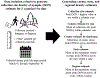
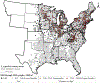
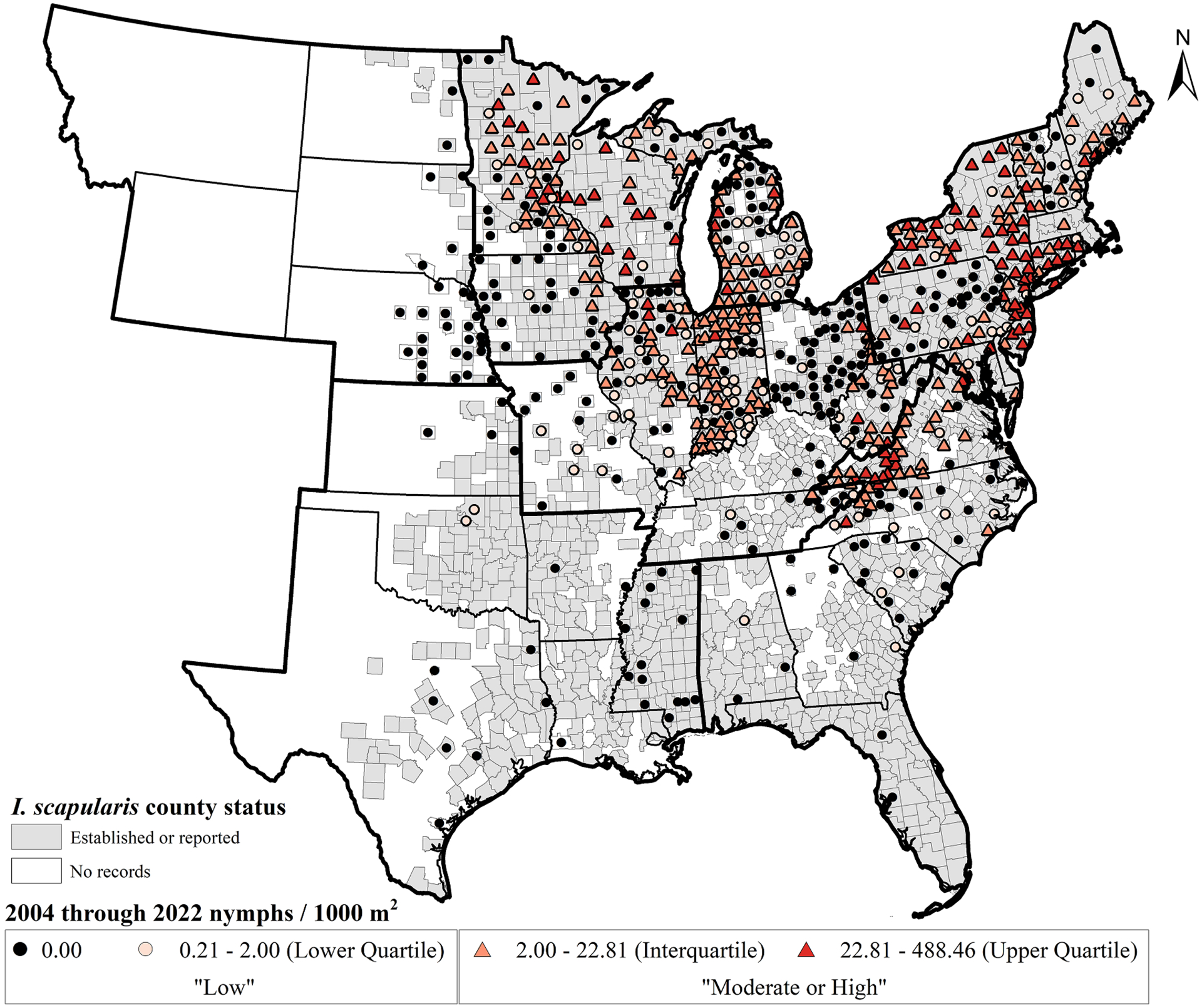
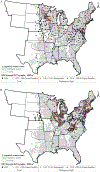
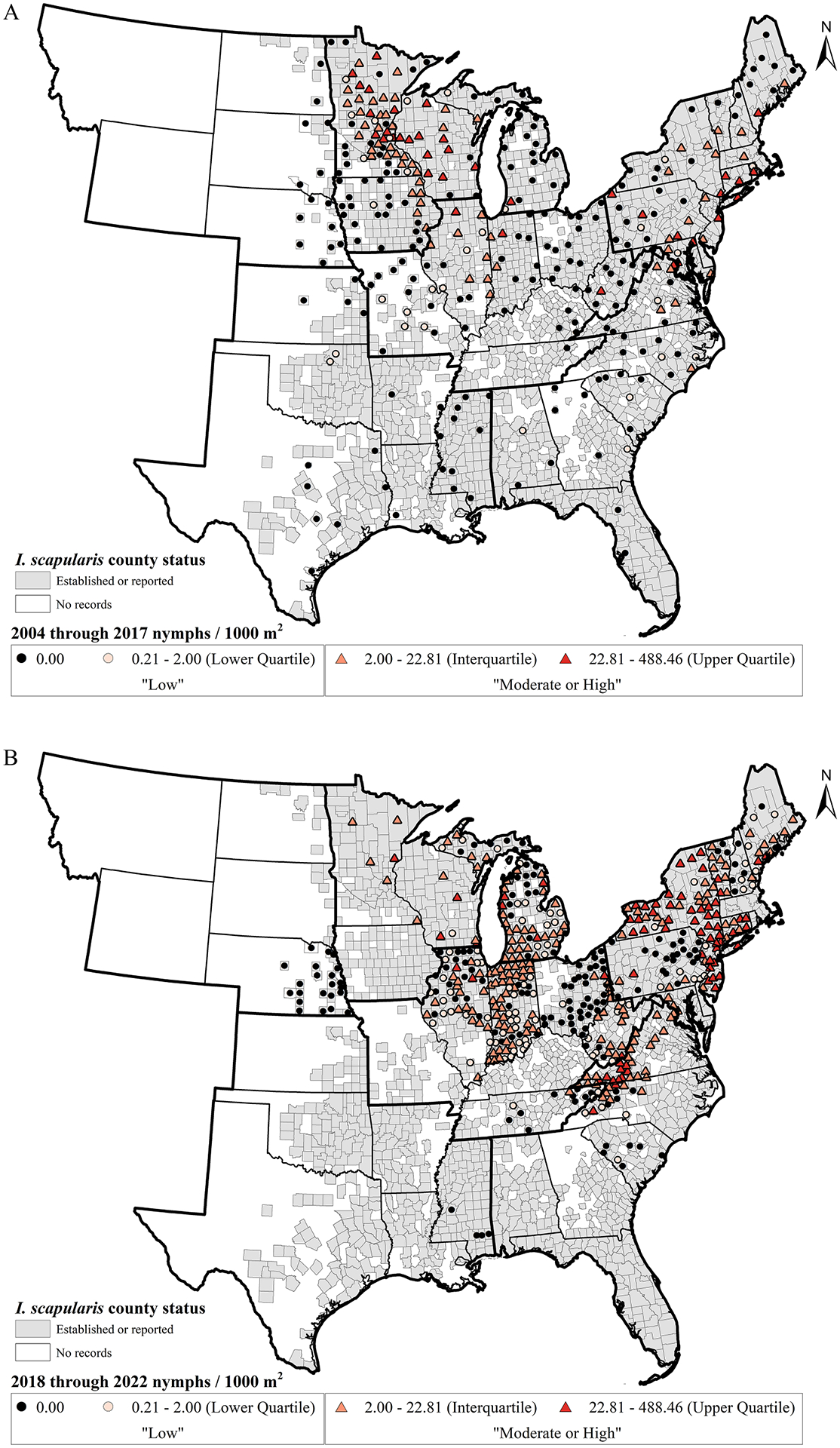
Description:The majority of vector-borne disease cases reported annually in the United States are caused by pathogens spread by the blacklegged tick, Ixodes scapularis. The number and geographic distribution of cases have increased as the geographic range and abundance of the tick have expanded in recent decades. A large proportion of Lyme disease and other I. scapularis-borne diseases are associated with nymphal tick bites; likelihood of such bites generally increases with increasing nymphal densities. National tick surveillance was initiated in 2018 to track changes in the distribution and abundance of medically important ticks at the county spatial scale throughout the United States. Tick surveillance records, including historical data collected prior to the initiation of the national program, are collated in the ArboNET Tick Module database. Through exploration of ArboNET Tick Module data, we found that efforts to quantify the density of host-seeking I. scapularis nymphs (DON) were unevenly distributed among geographic regions with the greatest proportion of counties sampled in the Northeast and Upper Midwest. Submissions covering tick collections from 2004 through 2022 revealed extensive variation in DON estimates at collection site, county, state, and regional spatial scales. Throughout the entire study period, county DON estimates ranged from 0.0 to 488.5 nymphs/1,000 m| . Although substantial variation was recorded within regions, DON estimates were greatest in the Northeast, Upper Midwest, and northern states within the Southeast regions (Virginia and North Carolina); densities were intermediate in the Ohio Valley and very low in the South and Northern Rockies and Plains regions. The proportion of counties classified as moderate or high DON was lower in the Northeast, Ohio Valley, and Southeast regions during the 2004 through 2017 time period (prior to initiation of the national tick surveillance program) compared to 2018 through 2022; DON estimates remained similarly low between these time periods in the South and the Northern Rockies and Plains regions. Despite the limitations described herein, the ArboNET Tick Module provides useful data for tracking changes in acarological risk across multiple geographic scales and long periods of time.
-
Subjects:
-
Keywords:
-
Source:Ticks Tick Borne Dis. 15(3):102316
-
Pubmed ID:38325243
-
Pubmed Central ID:PMC11288111
-
Document Type:
-
Funding:
-
Genre:
-
Volume:15
-
Issue:3
-
Download URL:
-
File Type:
 [PDF - 1.52 MB]
 -
Collection(s):
-
Main Document Checksum:urn:sha-512:9dc82660b7cc3e812391bb234db0111bb180edb7eeb10834ee9414dcaa697cdf08f87d5e993df203aca28ba17e7521c24542431cf52ce2b0f11d8ec1b14541df
Supporting Files


File Language:
English
 Was this page helpful?
 Found an issue?


CDC STACKS serves as an archival repository of CDC-published products including
scientific findings, journal articles, guidelines, recommendations, or other public health information authored or
co-authored by CDC or funded partners.
As a repository, CDC STACKS retains documents in their original published format to ensure public access to scientific information.
As a repository, CDC STACKS retains documents in their original published format to ensure public access to scientific information.
You May Also Like
COLLECTION
CDC Public Access