



Intestinal protozoa in returning travellers: a GeoSentinel analysis from 2007 to 2019
Supporting Files

-
6 03 2024 ; 6-03-
-
Available in CDC Stacks on June 03, 2025, 12:00 AM
File Language:
English
Details
-
Alternative Title:J Travel Med
-
Personal Author:Weitzel, Thomas
 ;
Brown, Ashley
;
Libman, Michael
;
Perret, Cecilia
;
Huits, Ralph
;
Chen, Lin
;
Leung, Daniel T.
;
Leder, Karin
;
Connor, Bradley A.
;
Menéndez, Marta D.
;
Asgeirsson, Hilmir
;
Schwartz, Eli
;
Salvador, Fernando
;
Malvy, Denis
;
Saio, Mauro
;
Norman, Francesca F.
;
Amatya, Bhawana
;
Duvignaud, Alexandre
;
Vaughan, Stephen
;
Glynn, Marielle
;
Angelo, Kristina M.
;
Brown, Ashley
;
Libman, Michael
;
Perret, Cecilia
;
Huits, Ralph
;
Chen, Lin
;
Leung, Daniel T.
;
Leder, Karin
;
Connor, Bradley A.
;
Menéndez, Marta D.
;
Asgeirsson, Hilmir
;
Schwartz, Eli
;
Salvador, Fernando
;
Malvy, Denis
;
Saio, Mauro
;
Norman, Francesca F.
;
Amatya, Bhawana
;
Duvignaud, Alexandre
;
Vaughan, Stephen
;
Glynn, Marielle
;
Angelo, Kristina M.
-
Corporate Authors:
-
Description:Background:
Prolonged diarrhoea is common amongst returning travellers and is often caused by intestinal protozoa. However, the epidemiology of travel-associated illness caused by protozoal pathogens is not well described.
Methods:
We analysed records of returning international travellers with illness caused by Giardia duodenalis, Cryptosporidium spp., Cyclospora cayetanensis or Cystoisospora belli, reported to the GeoSentinel Network during January 2007–December 2019. We excluded records of travellers migrating, with an unascertainable exposure country, or from GeoSentinel sites that were not located in high-income countries.
Results:
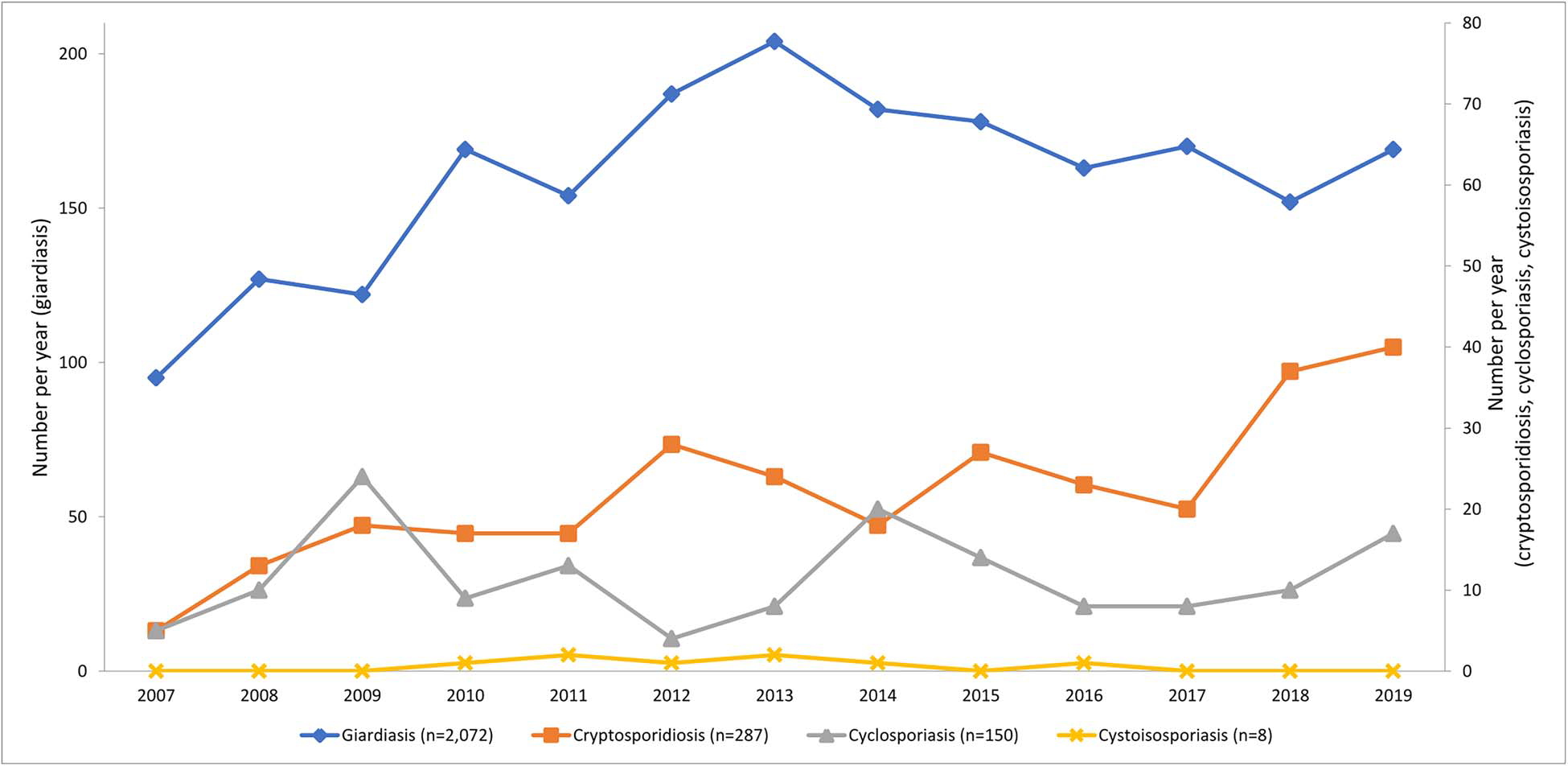
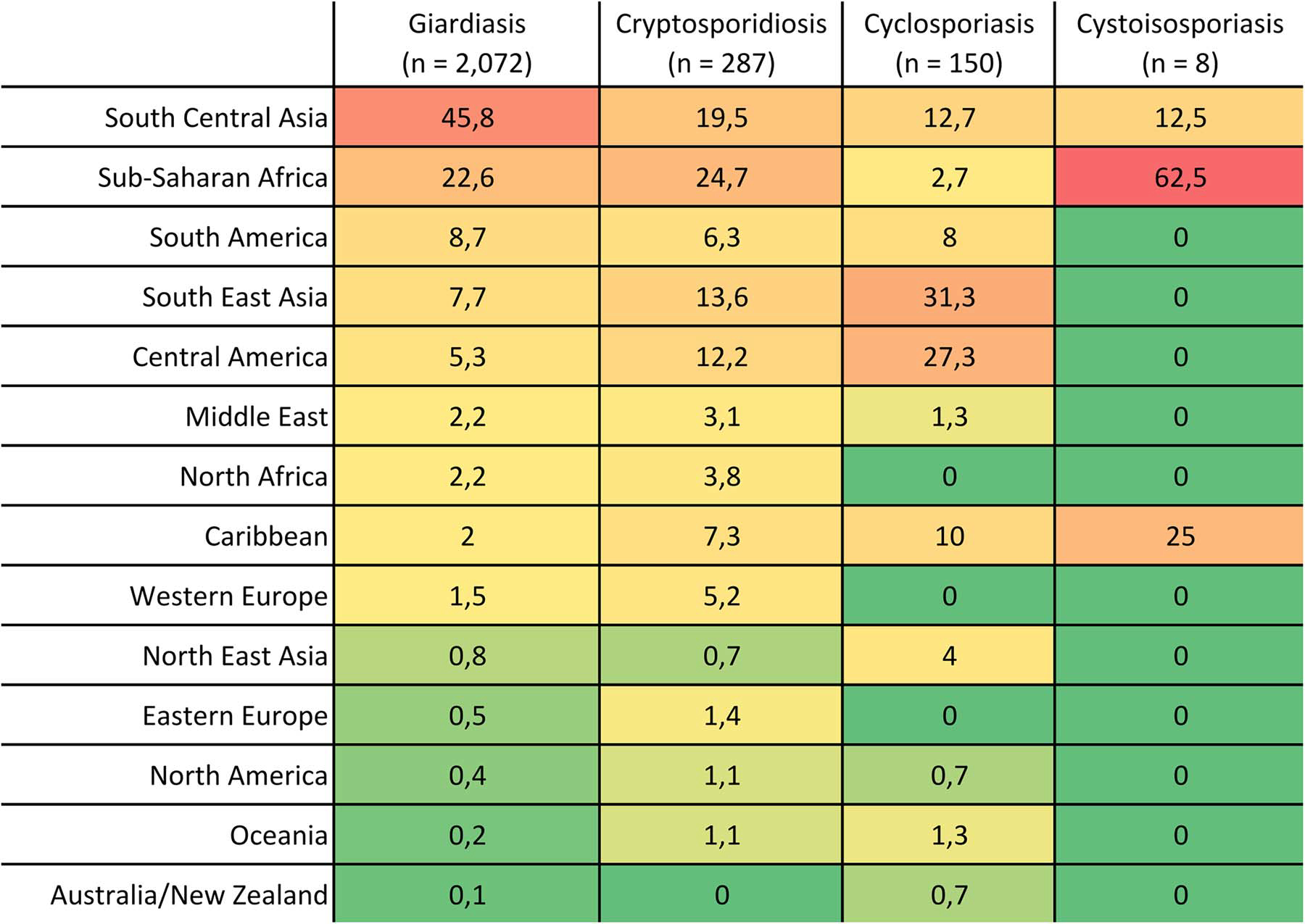
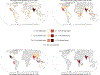
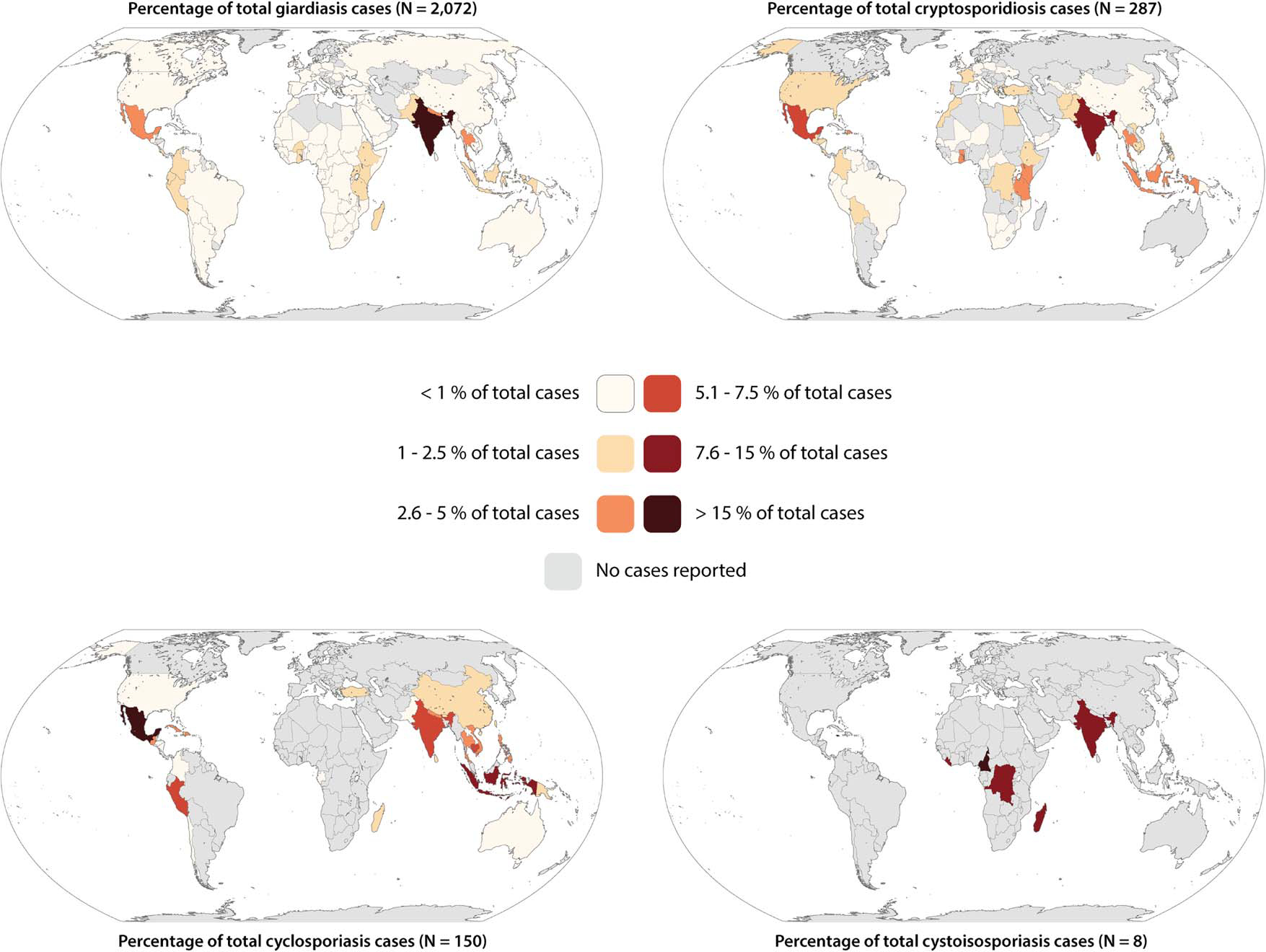
There were 2517 cases, 82.3% giardiasis (n = 2072), 11.4% cryptosporidiosis (n = 287), 6.0% cyclosporiasis (n = 150) and 0.3% cystoisosporiasis (n = 8). Overall, most travellers were tourists (64.4%) on long trips (median durations: 18–30 days). Cryptosporidiosis more frequently affected people < 18 years (13.9%) and cyclosporiasis affected people ≥ 40 years (59.4%). Giardiasis was most frequently acquired in South Central Asia (45.8%) and sub-Saharan Africa (22.6%), cryptosporidiosis in sub-Saharan Africa (24.7%) and South-Central Asia (19.5%), cyclosporiasis in South East Asia (31.3%) and Central America (27.3%), and cystoisosporiasis in sub-Saharan Africa (62.5%). Cyclosporiasis cases were reported from countries of uncertain endemicity (e.g. Cambodia) or in countries with no previous evidence of this parasite (e.g. French Guiana). The time from symptom onset to presentation at a GeoSentinel site was the longest amongst travellers with giardiasis (median: 30 days). Over 14% of travellers with cryptosporidiosis were hospitalized.
Conclusions:
This analysis provides new insights into the epidemiology and clinical significance of four intestinal protozoa that can cause morbidity in international travellers. These data might help optimize pretravel advice and post-travel management of patients with travel-associated prolonged gastrointestinal illnesses. This analysis reinforces the importance of international travel-related surveillance to identify sentinel cases and areas where protozoal infections might be undetected or underreported. -
Subjects:
-
Keywords:
-
Source:J Travel Med. 31(4)
-
Pubmed ID:38245913
-
Pubmed Central ID:PMC11285061
-
Document Type:
-
Funding:Public Health Agency of Canada/ ; U01 CK000632/CK/NCEZID CDC HHSUnited States/ ; US Centers for Disease Control and Prevention/ ; CC999999/ImCDC/Intramural CDC HHSUnited States/ ; APP11550055/Australian National Health and Medical Research Council/ ; 1 U01CK000632-01-00/International Society of Travel Medicine/ ; CC/CDC HHSUnited States/
-
Volume:31
-
Issue:4
-
Download URL:
-
File Type:
 [PDF - 828.55 KB]
 -
Collection(s):
-
Main Document Checksum:urn:sha-512:b1623db43576d92b866e15d723746589e3457460c37aa74fcbccba0de6fa04b25cea495de83c90e7571ac0937fe5e4cba25daf35ff2824f17dfd733bb452feb6
Supporting Files


File Language:
English
 Was this page helpful?
 Found an issue?


CDC STACKS serves as an archival repository of CDC-published products including
scientific findings, journal articles, guidelines, recommendations, or other public health information authored or
co-authored by CDC or funded partners.
As a repository, CDC STACKS retains documents in their original published format to ensure public access to scientific information.
As a repository, CDC STACKS retains documents in their original published format to ensure public access to scientific information.
You May Also Like
COLLECTION
CDC Public Access