


Reported Primary and Secondary Syphilis Cases in the United States: Implications for HIV Infection
Supporting Files

-
9 2018
-
File Language:
English
Details
-
Alternative Title:Sex Transm Dis
-
Personal Author:
-
Description:Background:
Recent increases in syphilis among men who have sex with men (MSM) are especially concerning, given the biologic and epidemiologic associations between syphilis and HIV infection. We sought to better describe the current epidemiology of primary and secondary (P&S) syphilis and the prevalence of HIV infection among reported P&S syphilis cases by demographic group, including sex of sex partner, in the United States in 2016.
Methods:
We reviewed national P&S syphilis case report data from 2016, including available risk factor information such as sex of sex partner and HIV status. Data were extracted from the National Electronic Telecommunications System for Surveillance, the system through which Centers for Disease Control and Prevention receives notifiable sexually transmitted disease data from all 50 states and the District of Columbia. The proportion of cases with HIV coinfection was calculated using cases with known HIV status as the denominator.
Results:
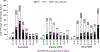
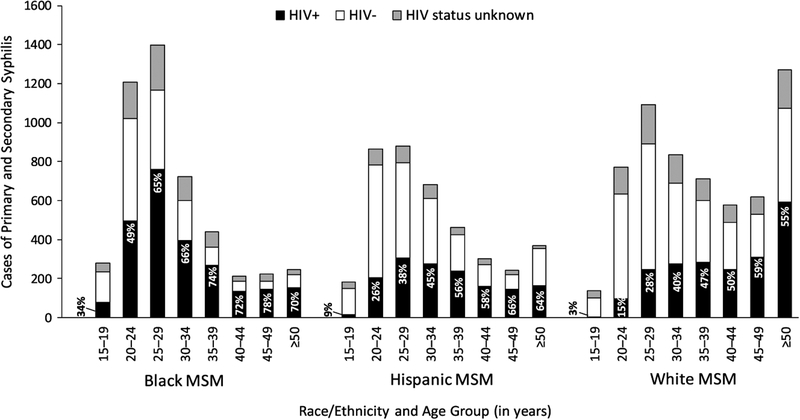
Of 27,814 P&S syphilis cases reported in 2016, 58.1% were among MSM, 13.9% were among men who have sex with women only,11.0% were among women, and 16.9% were among men without data on sex of sex partners. Similar patterns were observed across geographic regions, race/ethnicity groups, and most age groups. Overall, 38.5% of reported P&S syphilis cases with known HIV status were coinfected with HIV. The prevalence of HIV coinfection was highest among MSM (47.0%) compared with men who have sex with women only (10.7%) or women (4.1%). Among MSM with P&S syphilis, the prevalence of HIV coinfection was highest among black MSM, ranging from 33.8% among black MSM aged 15 to 19 years to 77.8% among black MSM aged 45 to 49 years.
Conclusions:
These data underscore the epidemiologic linkages between syphilis and HIV, particularly among MSM. Primary and secondary syphilis may represent an opportunity to prevent HIV infection among persons who are HIV negative and identify and link to care persons living with HIV infection but not currently engaged in care.
-
Subjects:
-
Source:Sex Transm Dis. 45(9 ):S42-S47
-
Pubmed ID:29465633
-
Pubmed Central ID:PMC6745698
-
Document Type:
-
Funding:
-
Volume:45
-
Issue:9
-
Collection(s):
-
Main Document Checksum:urn:sha-512:a93d069f23a484d53641184ce4b27c92b1ff91a37c1826466edee28513fcf8464f9ecf8e8693ab9e0cd684823f5e647114b172290aee0147942c8fc38aebbf98
-
Download URL:
-
File Type:
 [PDF
- 204.09 KB
]
[PDF
- 204.09 KB
]
Supporting Files


File Language:
English
ON THIS PAGE

CDC STACKS serves as an archival repository of CDC-published products including
scientific findings,
journal articles, guidelines, recommendations, or other public health information authored or
co-authored by CDC or funded partners.
As a repository, CDC STACKS retains documents in their original published format to ensure public access to scientific information.
As a repository, CDC STACKS retains documents in their original published format to ensure public access to scientific information.
You May Also Like
COLLECTION
CDC Public Access