



Physical activity, psychological distress, and receiving mental healthcare services among cancer survivors
Supporting Files

-
3 2013 ; 3-2013
-
Available in CDC Stacks on 2024-07-16T00:00:00Z
File Language:
English
Details
-
Alternative Title:J Cancer Surviv
-
Personal Author:
-
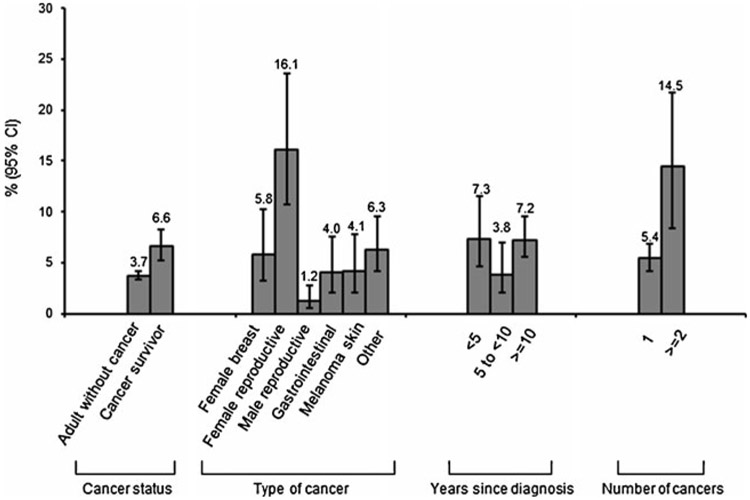
Description:Purpose ; Physical activity confers multiple health benefits in the general population. This study examined the associations of physical activity with serious psychological distress (SPD) and receiving mental healthcare services among U.S. adult cancer survivors. ; Methods ; We analyzed data from 4,797 cancer survivors (aged ≥18 years) and 38,571 adults without cancer who participated in the 2009 Behavioral Risk Factor Surveillance System. SPD was assessed using the Kessler-6 questionnaire. Adjusted prevalence and prevalence ratios were estimated by conducting log-linear regression analysis while controlling for potential confounders. ; Results ; Overall, 6.6 % of cancer survivors (vs. 3.7 % of adults without cancer, P<0.001) reported having SPD, and 14.0 % of cancer survivors (vs. 10.0 % of adults without cancer, P<0.001) reported receiving mental healthcare services; the percentages decreased with increasing physical activity levels. After multivariate adjustment, compared to cancer survivors who were physically inactive, cancer survivors who engaged in physical activity >0 to <150 min/week and ≥150 min/week were 62 % and 61 % (P<0.001 for both) less likely to report SPD, respectively; cancer survivors who engaged in physical activity ≥150 min/week were 33 % (P<0.05) less likely to report receiving mental healthcare services. Additionally, the inverse association between physical activity and receiving mental healthcare services persisted among women with breast or reproductive cancers and among men and women with gastrointestinal cancers. ; Conclusion ; The inverse associations between physical activity and SPD or receiving mental healthcare services suggest that physical activity may play a role in improving mental health among cancer survivors. ; Implications for cancer survivors ; Healthcare clinicians may consider routinely monitoring and assessing the psychological well-being of cancer survivors and educate them about the potential benefits of physical activity in improving their mental health.
-
Subjects:
-
Keywords:
-
Source:J Cancer Surviv. 7(1):131-139
-
Pubmed ID:23184465
-
Pubmed Central ID:PMC11250998
-
Document Type:
-
Funding:
-
Volume:7
-
Issue:1
-
Download URL:
-
File Type:
 [PDF - 383.77 KB]
 -
Collection(s):
-
Main Document Checksum:urn:sha-512:fc1b8bbe913a272498e46389862b0b654bfcd94aa99be5a446eeb95c19169d9de1b9c22305e8a60ad7a056c050f2b2b9fcb7f955645024100f8a53d3389bd96c
Supporting Files


File Language:
English
 Was this page helpful?
 Found an issue?



CDC STACKS serves as an archival repository of CDC-published products including
scientific findings, journal articles, guidelines, recommendations, or other public health information authored or
co-authored by CDC or funded partners.
As a repository, CDC STACKS retains documents in their original published format to ensure public access to scientific information.
As a repository, CDC STACKS retains documents in their original published format to ensure public access to scientific information.
You May Also Like
COLLECTION
CDC Public Access