



Relationships between Cognitive Complaints and Quality of Life in Older Adults with Mild Cognitive Impairment, Mild Alzheimer's Disease Dementia, and Normal Cognition
Supporting Files

-
2018/01/01
-
Available in CDC Stacks on 2019-10-01T00:00:00Z
File Language:
English
Details
-
Alternative Title:Alzheimer Dis Assoc Disord
-
Personal Author:
-
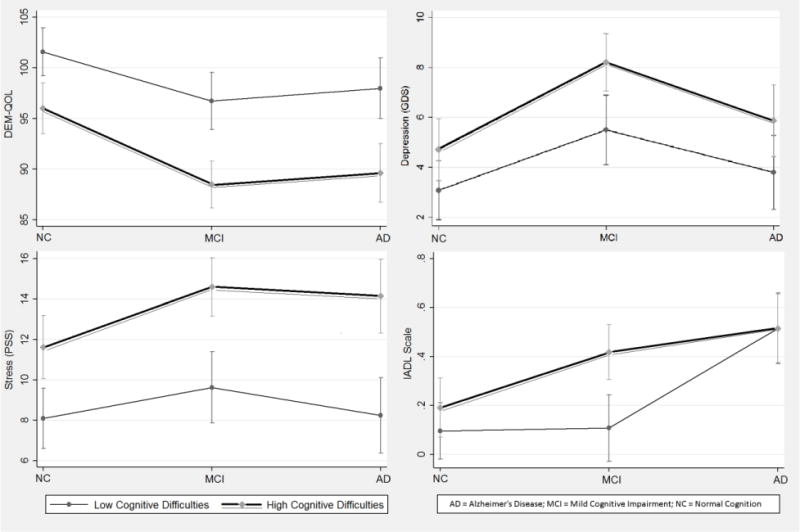
Description:Purpose ; To examine in persons with varying degrees of cognitive impairment the relationship between self-reports of cognitive complaints and quality of life (QOL). ; Method ; Older adults (n=259) with normal cognition, Mild Cognitive Impairment (MCI), and mild stage Alzheimer's disease (AD) dementia completed tests of cognition and self-report questionnaires about QOL and three kinds of cognitive complaints: cognitive difficulties, distress from cognitive difficulties, and believing you had more memory problems than most people. Bivariate, multivariable, and multivariate regression analyses assessed relationships between domains of QOL and each cognitive complaint. ; Results ; Bivariate and multivariable analyses controlling for severity of cognitive and functional impairment found that cognitive complaints were related to relatively lower quality of daily life (QOL-AD, DEM-QOL), greater depression (GDS), more anxiety (BAI), higher perceived stress (PSS), and lower general mental wellbeing (SF-12 MCS). ; Discussion ; Cognitive complaints have robust associations with QOL. These findings have implications for AD prevention trials and management of clinical populations.
-
Subjects:
-
Keywords:
-
Source:Alzheimer Dis Assoc Disord. 32(4):276-283
-
Pubmed ID:29944474
-
Pubmed Central ID:PMC6249095
-
Document Type:
-
Funding:
-
Genre:
-
Volume:32
-
Issue:4
-
Download URL:
-
File Type:
 [PDF - 430.94 KB]
 -
Collection(s):
-
Main Document Checksum:urn:sha-512:fab39436a2625bb36dcce82a6bb28acd24e0a374278db78b4a695b3912f025c340876af83539e7cceea4a2fabfc71a11b85bf06a8419a94bdec419e6900c8d00
Supporting Files


File Language:
English
 Was this page helpful?
 Found an issue?

CDC STACKS serves as an archival repository of CDC-published products including
scientific findings, journal articles, guidelines, recommendations, or other public health information authored or
co-authored by CDC or funded partners.
As a repository, CDC STACKS retains documents in their original published format to ensure public access to scientific information.
As a repository, CDC STACKS retains documents in their original published format to ensure public access to scientific information.
You May Also Like
COLLECTION
CDC Public Access