



Excess deaths associated with COVID-19 by rurality and demographic factors in the United States
Supporting Files

-
6 2024 ; 6-2024
-
Available in CDC Stacks on June 20, 2024, 12:00 AM

File Language:
English
Details
-
Alternative Title:J Rural Health
-
Personal Author:
-
Description:Purpose:
To estimate percent excess deaths during the COVID-19 pandemic by rural-urban residence in the United States and to describe rural-urban disparities by age, sex, and race/ethnicity.
Methods:
Using US mortality data, we used overdispersed Poisson regression models to estimate monthly expected death counts by rurality of residence, age group, sex, and race/ethnicity, and compared expected death counts with observed deaths. We then summarized excess deaths over 6 6-month time periods.
Findings:
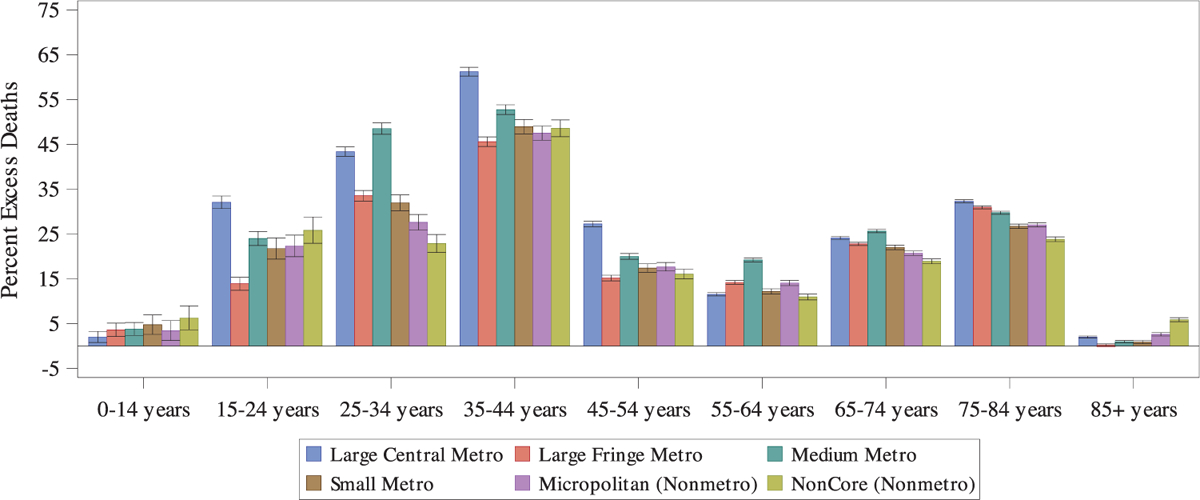
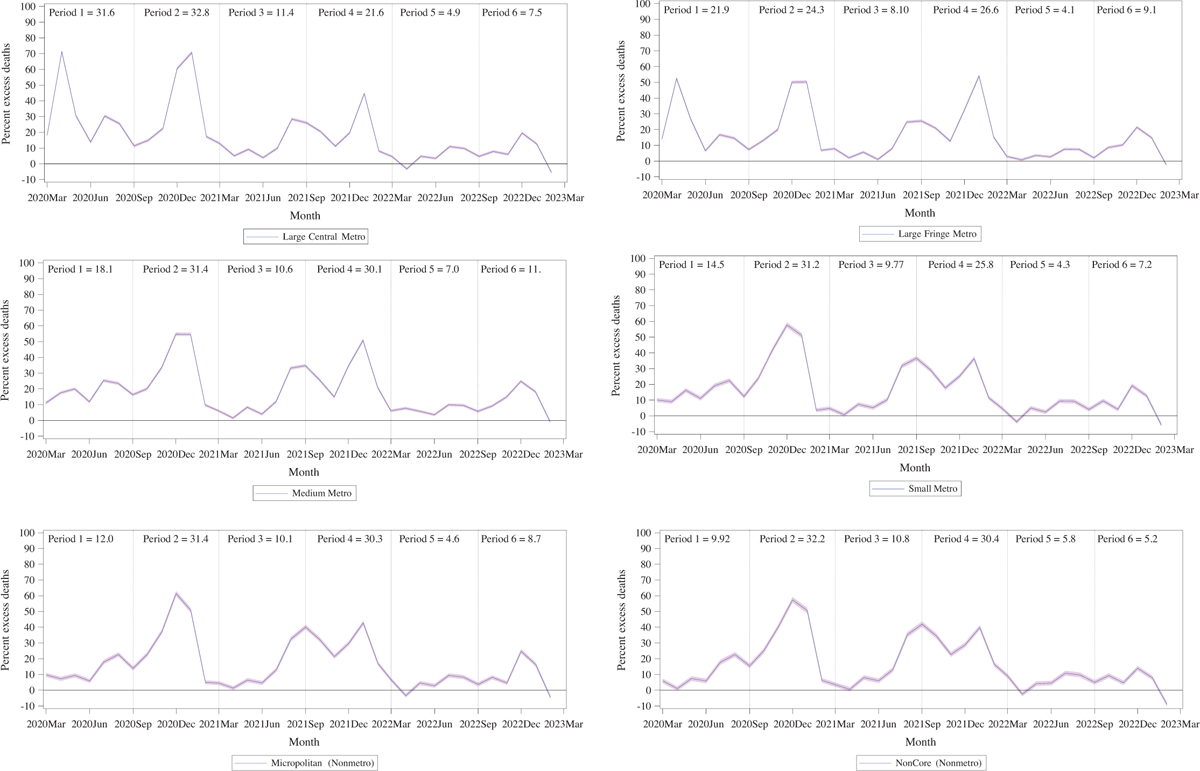
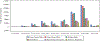
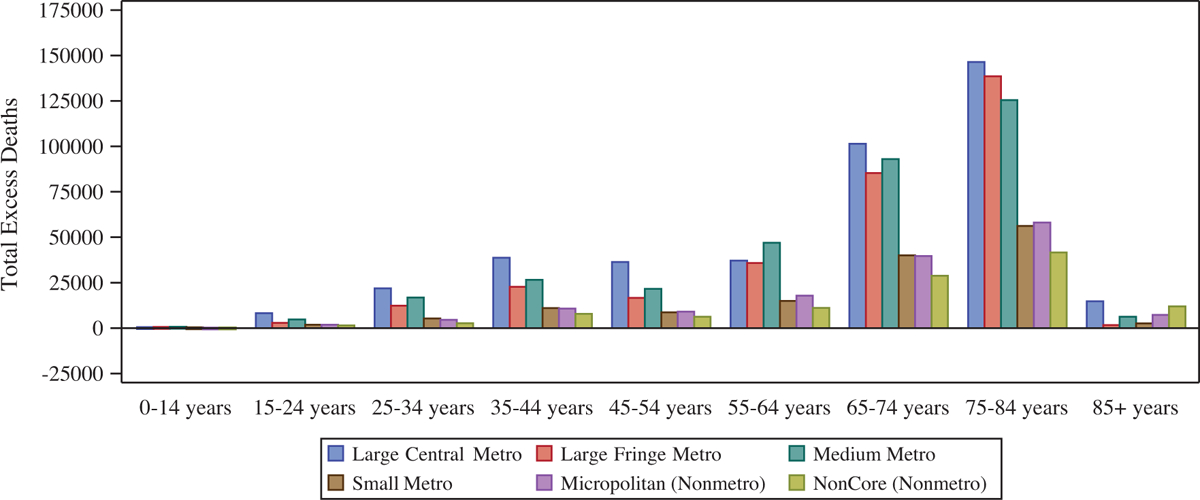
There were 16.9% (95% confidence interval CI: 16.8, 17.0) more deaths than expected between March 2020 and February 2023. The percent excess varied by rurality (large central metro: 18.2% 18.1, 18.4, large fringe metro: 15.6% 15.5, 15.8, medium metro: 18.1% 18.0, 18.3, small metro: 15.5% 15.3, 15.7, micropolitan rural: 16.3% 16.1, 16.5, and noncore rural: 15.8% 15.6, 16.1). The percent excess deaths were 20.2% (20.1, 20.3) for males and 13.6% (13.5, 13.7) for females, and highest for Hispanic persons (49% 49.0, 49.6), followed by non-Hispanic Black persons (28% 27.5, 27.9) and non-Hispanic White persons (12% 11.6, 11.8). The 6-month time periods with the highest percent excess deaths for large central metro areas were March 2020-August 2020 and September 2020-February 2021; for all other areas, these time periods were September 2020-February 2021 and September 2021-February 2022.
Conclusion:
Percent excess deaths varied by rurality, age group, sex, race/ethnicity, and time period. Monitoring excess deaths by rurality may be useful in assessing the impact of the pandemic over time, as rural-urban patterns appear to differ. -
Subjects:
-
Keywords:
-
Source:J Rural Health. 40(3):491-499
-
Pubmed ID:38082546
-
Pubmed Central ID:PMC11164822
-
Document Type:
-
Funding:
-
Volume:40
-
Issue:3
-
Download URL:
-
File Type:
 [PDF - 366.56 KB]
 -
Collection(s):
-
Main Document Checksum:urn:sha256:1cfef32f14f2a07409c0fa5b20e2044e479414fbb2fadcd36434be469ed18300
Supporting Files


File Language:
English
 Was this page helpful?
 Found an issue?

CDC STACKS serves as an archival repository of CDC-published products including
scientific findings, journal articles, guidelines, recommendations, or other public health information authored or
co-authored by CDC or funded partners.
As a repository, CDC STACKS retains documents in their original published format to ensure public access to scientific information.
As a repository, CDC STACKS retains documents in their original published format to ensure public access to scientific information.
You May Also Like
COLLECTION
CDC Public Access