



Tickborne Pathogen Detection, Western Siberia, Russia
Supporting Files
Public Domain

-
Nov 2005
Details
-
Alternative Title:Emerg Infect Dis
-
Personal Author:
-
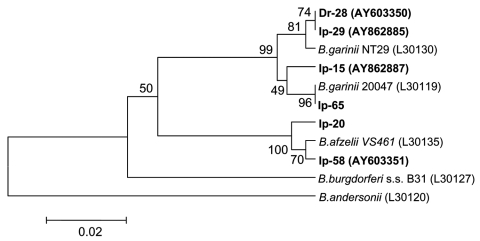
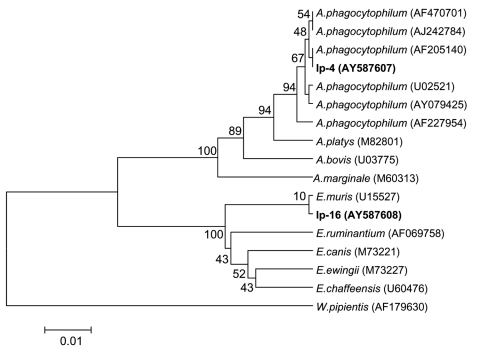
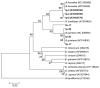
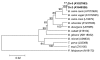
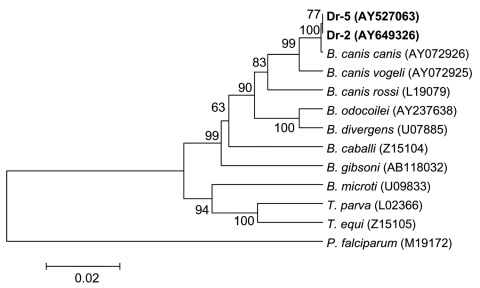
Description:Ixodes persulcatus (n = 125) and Dermacentor reticulatus (n = 84) ticks from Western Siberia, Russia, were tested for infection with Borrelia, Anaplasma/Ehrlichia, Bartonella, and Babesia spp. by using nested polymerase chain reaction assays with subsequent sequencing. I. persulcatus ticks were infected with Borrelia burgdorferi sensu lato (37.6% +/- 4.3% standard deviation), Anaplasma phagocytophilum (2.4% +/- 1.4%), Ehrlichia muris (8.8% +/- 2.5%), and Bartonella spp. (37.6% +/- 4.3%). D. reticulatus ticks contained DNA of B. burgdorferi sensu lato (3.6% +/- 2.0%), Bartonella spp. (21.4% +/- 4.5%), and Babesia canis canis (3.6% +/- 2.0%). Borrelia garinii, Borrelia afzelii, and their mixed infections were observed among I. persulcatus, whereas B. garinii NT29 DNA was seen in samples from D. reticulatus. Among the I. persulcatus ticks studied, no Babesia spp. were observed, whereas B. canis canis was the single subspecies found in D. reticulatus.
-
Subjects:
- Research
- Ixodes persulcatus
- Dermacentor reticulatus
- Borrelia burgdorferi sensu lato
- Anaplasma phagocytophilum
- Ehrlichia muris
- Bartonella
- Babesia canis canis
- nested PCR
- sequencing
- research
- Animals
- Babesia
- Borrelia burgdorferi Group
- DNA, Bacterial
- DNA, Protozoan
- Dermacentor
- Ehrlichia
- Ixodes
- Molecular Sequence Data
- Phylogeny
- Polymerase Chain Reaction
- Prevalence
- Sequence Analysis, DNA
- Siberia
- Tick-Borne Diseases
-
Source:Emerg Infect Dis. 11(11):1708-1715.
-
Document Type:
-
Volume:11
-
Issue:11
-
Download URL:
-
File Type:
 [PDF - 275.20 KB]
 -
Collection(s):
-
Main Document Checksum:urn:sha256:9b65de6e29aef181b74db5509a58d5b3db63ba5f17d95885b79968817e368757
Supporting Files


 Was this page helpful?
 Found an issue?



CDC STACKS serves as an archival repository of CDC-published products including
scientific findings, journal articles, guidelines, recommendations, or other public health information authored or
co-authored by CDC or funded partners.
As a repository, CDC STACKS retains documents in their original published format to ensure public access to scientific information.
As a repository, CDC STACKS retains documents in their original published format to ensure public access to scientific information.
You May Also Like
COLLECTION
Emerging Infectious Diseases