



Novel Flavivirus or New Lineage of West Nile Virus, Central Europe
Supporting Files
Public Domain

-
Feb 2005
Details
-
Alternative Title:Emerg Infect Dis
-
Personal Author:
-
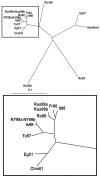
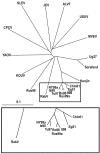
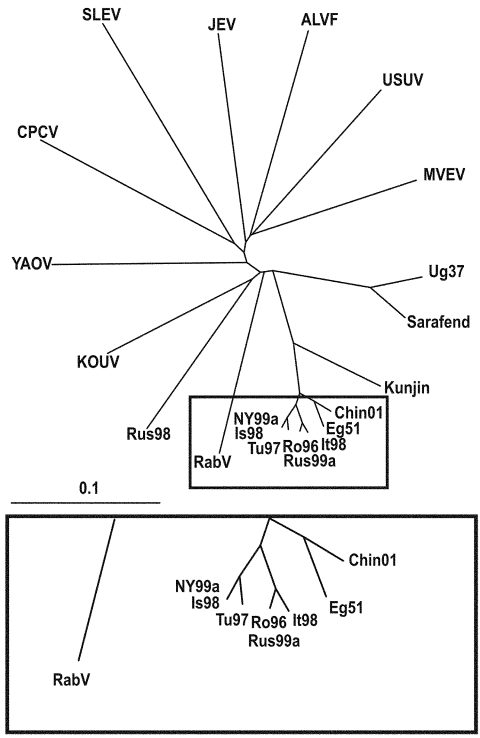
Description:A flavivirus (strain 97-103) was isolated from Culex pipens mosquitoes in 1997 following floods in South Moravia, Czech Republic. The strain exhibited close antigenic relationship to West Nile virus (WNV) prototype strain Eg-101 in a cross-neutralization test. In this study, mouse pathogenicity characteristics and the complete nucleotide and putative amino acid sequences of isolate 97-103, named Rabensburg virus (RabV) after a nearby Austrian city, were determined. RabV shares only 75%-77% nucleotide identity and 89%-90% amino acid identity with representative strains of WNV lineages 1 and 2. Another RabV strain (99-222) was isolated in the same location 2 years later; it showed >99% nucleotide identity to strain 97-103. Phylogenetic analyses of RabV, WNV strains, and other members of the Japanese encephalitis virus (JEV) complex clearly demonstrated that RabV is either a new (third) lineage of WNV or a novel flavivirus of the JEV group.
-
Subjects:
- Research
- Rabensburg virus
- West Nile virus
- Flaviviridae
- complete genome analysis
- phylogenetic analysis
- research
- Amino Acid Sequence
- Animals
- Animals, Suckling
- Base Sequence
- Czech Republic
- Female
- Flavivirus
- Flavivirus Infections
- Mice
- Mice, Inbred ICR
- Molecular Sequence Data
- Phylogeny
- RNA, Viral
- Reverse Transcriptase Polymerase Chain Reaction
- Sequence Alignment
- Specific Pathogen-Free Organisms
- Virulence
-
Source:Emerg Infect Dis. 11(2):225-231.
-
Document Type:
-
Volume:11
-
Issue:2
-
Download URL:
-
File Type:
 [PDF - 292.43 KB]
 -
Collection(s):
-
Main Document Checksum:urn:sha256:02c578bb85f10f34b9ab6e2914d5e1952e72f1031ed1d6230325ba26e2642c14
Supporting Files


 Was this page helpful?
 Found an issue?


CDC STACKS serves as an archival repository of CDC-published products including
scientific findings, journal articles, guidelines, recommendations, or other public health information authored or
co-authored by CDC or funded partners.
As a repository, CDC STACKS retains documents in their original published format to ensure public access to scientific information.
As a repository, CDC STACKS retains documents in their original published format to ensure public access to scientific information.
You May Also Like
COLLECTION
Emerging Infectious Diseases