



Malassezia pachydermatis Carriage in Dog Owners
Supporting Files
Public Domain

-
2005/01/01
Details
-
Alternative Title:Emerg Infect Dis
-
Personal Author:
-
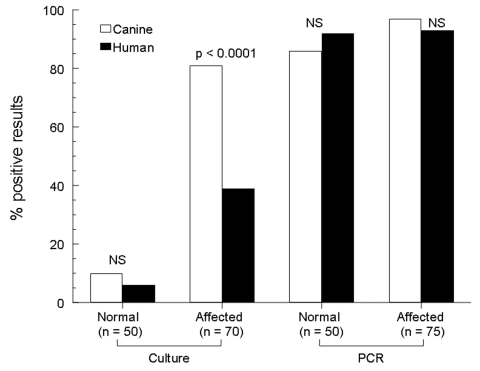
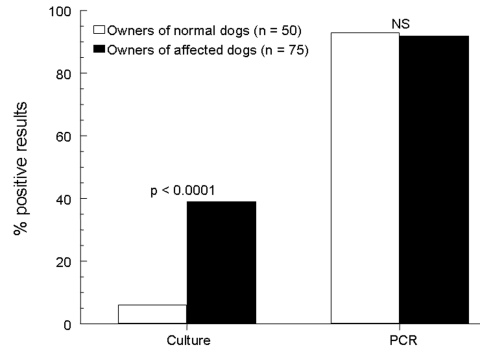
Description:Yeasts of the genus Malassezia serve as both commensal microorganisms and pathogens on the skin of humans and domestic animals. Although rare, cases of life-threatening fungemia in people have been attributed to Malassezia pachydermatis, for which dogs are a natural host. Zoonotic transfer has been documented from dogs to immunocompromised patients by healthcare workers who own dogs. We investigated the role of pet dogs as risk factors for mechanical carriage of M. pachydermatis on human hands. Dogs and their owners were sampled as pairs, by fungal culture and nested polymerase chain reaction (PCR). Although fungal culture was not a reliable means by which to detect carriage of the yeast on human hands, PCR identified M. pachydermatis on most (approximately equal to 93%) human participants. Human carriage of ubiquitous opportunistic pathogens such as M. pachydermatis underscores the importance of good hand hygiene by healthcare professionals.
-
Subjects:
-
Source:Emerg Infect Dis. 11(1):83-88.
-
Document Type:
-
Genre:
-
Volume:11
-
Issue:1
-
Download URL:
-
File Type:
 [PDF - 147.78 KB]
 -
Collection(s):
-
Main Document Checksum:urn:sha-512:126380b7ae819244378a079febc8d63aa75f64c1d0339b948a552ce1990502e71f9050006ece1ace73dd0a041fcd037ddba0819dee4c4fc69660593fa8d75c5c
Supporting Files


 Was this page helpful?
 Found an issue?


CDC STACKS serves as an archival repository of CDC-published products including
scientific findings, journal articles, guidelines, recommendations, or other public health information authored or
co-authored by CDC or funded partners.
As a repository, CDC STACKS retains documents in their original published format to ensure public access to scientific information.
As a repository, CDC STACKS retains documents in their original published format to ensure public access to scientific information.
You May Also Like
COLLECTION
Emerging Infectious Diseases