



Carbapenem-Resistant and Extended-Spectrum β-Lactamase–Producing Enterobacterales in Children, United States, 2016–2020
Supporting Files
Public Domain

-
6 2024
File Language:
English
Details
-
Alternative Title:Emerg Infect Dis
-
Personal Author:Grome, Heather N. ; Grass, Julian E. ; Duffy, Nadezhda ; Bulens, Sandra N. ; Ansari, Uzma ; Campbell, Davina ; Lutgring, Joseph D. ; Gargis, Amy S. ; Masters, Thao ; Kent, Alyssa G. ; McKay, Susannah L. ; Smith, Gillian ; Wilson, Lucy E. ; Vaeth, Elisabeth ; Evenson, Bailey ; Dumyati, Ghinwa ; Tsay, Rebecca ; Phipps, Erin ; Flores, Kristina ; Wilson, Christopher D. ; Czaja, Christopher A. ; Johnston, Helen ; Janelle, Sarah J. ; Lynfield, Ruth ; O’Malley, Sean ; Vagnone, Paula Snippes ; Maloney, Meghan ; Nadle, Joelle ; Guh, Alice Y.
-
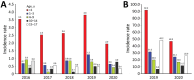
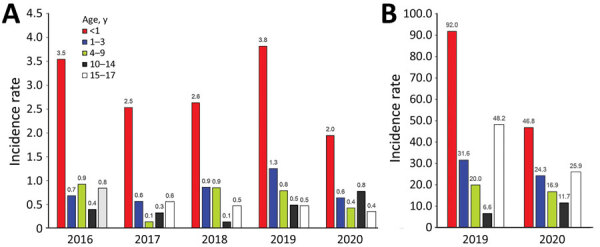
Description:2019–2020 at 6 US sites. Among 159 CRE cases in children (median age 5 years), CRE was isolated from urine for 131 (82.4%) and blood from 20 (12.6%). Annual CRE incidence rate (cases/100,000 population) was 0.47–0.87. Among 207 ESBL-E cases in children (median age 6 years), ESBL-E was isolated from urine of 196 (94.7%) and blood of 8 (3.9%). Annual ESBL-E incidence rate was 26.5 in 2019 and 19.63 in 2020. CRE and ESBL-E rates were >2-fold higher among infants than other age groups. Most CRE and ESBL-E cases were healthcare-associated community-onset (68 43.0% for CRE vs. 40 23.7% for ESBL-E) or community-associated (43 27.2% for CRE vs. 109 64.5% for ESBL-E). Programs to detect, prevent, and treat multidrug-resistant infections must include pediatric populations (particularly the youngest) and outpatient settings.
-
Subjects:
-
Keywords:
-
Source:Emerg Infect Dis. 2024; 30(6):1104-1114
-
Pubmed ID:38781979
-
Pubmed Central ID:PMC11138972
-
Document Type:
-
Place as Subject:
-
Volume:30
-
Issue:6
-
Download URL:
-
File Type:
 [PDF - 866.31 KB]
 -
Collection(s):
-
Main Document Checksum:urn:sha256:4d603f61c01780edf1ec28565118a593c74c3513a38e5a8185951f964fbd2d7b
Supporting Files


File Language:
English
 Was this page helpful?
 Found an issue?

CDC STACKS serves as an archival repository of CDC-published products including
scientific findings, journal articles, guidelines, recommendations, or other public health information authored or
co-authored by CDC or funded partners.
As a repository, CDC STACKS retains documents in their original published format to ensure public access to scientific information.
As a repository, CDC STACKS retains documents in their original published format to ensure public access to scientific information.
You May Also Like
COLLECTION
Emerging Infectious Diseases