



Severe Human Parainfluenza Virus Community- and Healthcare-Acquired Pneumonia in Adults at Tertiary Hospital, Seoul, South Korea, 2010–2019
Supporting Files
Public Domain

-
6 2024
File Language:
English
Details
-
Alternative Title:Emerg Infect Dis
-
Personal Author:Park, Joung Ha ; Hong, Sang-Bum ; Huh, Jin Won ; Jung, Jiwon ; Kim, Min Jae ; Chong, Yong Pil ; Sung, Heungsup ; Do, Kyung Hyun ; Kim, Sung-Han ; Lee, Sang-Oh ; Kim, Yang Soo ; Lim, Chae-Man ; Koh, Younsuck ; Choi, Sang-Ho
-
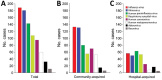
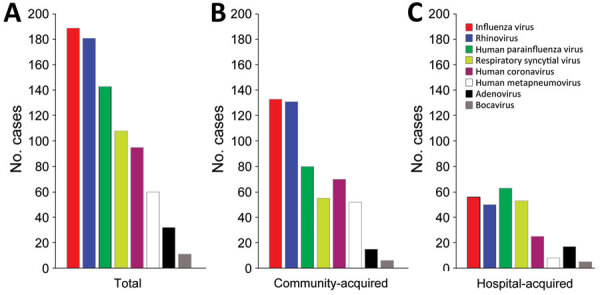
Description:The characteristics of severe human parainfluenza virus (HPIV)-associated pneumonia in adults have not been well evaluated. We investigated epidemiologic and clinical characteristics of 143 patients with severe HPIV-associated pneumonia during 2010-2019. HPIV was the most common cause (25.2%) of severe virus-associated hospital-acquired pneumonia and the third most common cause (15.7%) of severe virus-associated community-acquired pneumonia. Hematologic malignancy (35.0%), diabetes mellitus (23.8%), and structural lung disease (21.0%) were common underlying conditions. Co-infections occurred in 54.5% of patients admitted to an intensive care unit. The 90-day mortality rate for HPIV-associated pneumonia was comparable to that for severe influenza virus-associated pneumonia (55.2% vs. 48.4%; p = 0.22). Ribavirin treatment was not associated with lower mortality rates. Fungal co-infections were associated with 82.4% of deaths. Clinicians should consider the possibility of pathogenic co-infections in patients with HPIV-associated pneumonia. Contact precautions and environmental cleaning are crucial to prevent HPIV transmission in hospital settings.
-
Subjects:
-
Keywords:
-
Source:Emerg Infect Dis. 2024; 30(6):1088-1095
-
Pubmed ID:38781685
-
Pubmed Central ID:PMC11138994
-
Document Type:
-
Genre:
-
Place as Subject:
-
Volume:30
-
Issue:6
-
Download URL:
-
File Type:
 [PDF - 942.34 KB]
 -
Collection(s):
-
Main Document Checksum:urn:sha256:4712192ffe8a04ef8edf5b8c80cb2a3fc146a8c96b17eeb3d533334a4cc8a1ac
Supporting Files


File Language:
English
 Was this page helpful?
 Found an issue?

CDC STACKS serves as an archival repository of CDC-published products including
scientific findings, journal articles, guidelines, recommendations, or other public health information authored or
co-authored by CDC or funded partners.
As a repository, CDC STACKS retains documents in their original published format to ensure public access to scientific information.
As a repository, CDC STACKS retains documents in their original published format to ensure public access to scientific information.
You May Also Like
COLLECTION
Emerging Infectious Diseases