



Cluster Transmission Drives Invasive Group A Streptococcus Disease Within the United States and Is Focused on Communities Experiencing Disadvantage
Supporting Files

-
2022/08/26
-
Available in CDC Stacks on 2024-04-30T00:00:00Z

File Language:
English
Details
-
Alternative Title:J Infect Dis
-
Personal Author:
-
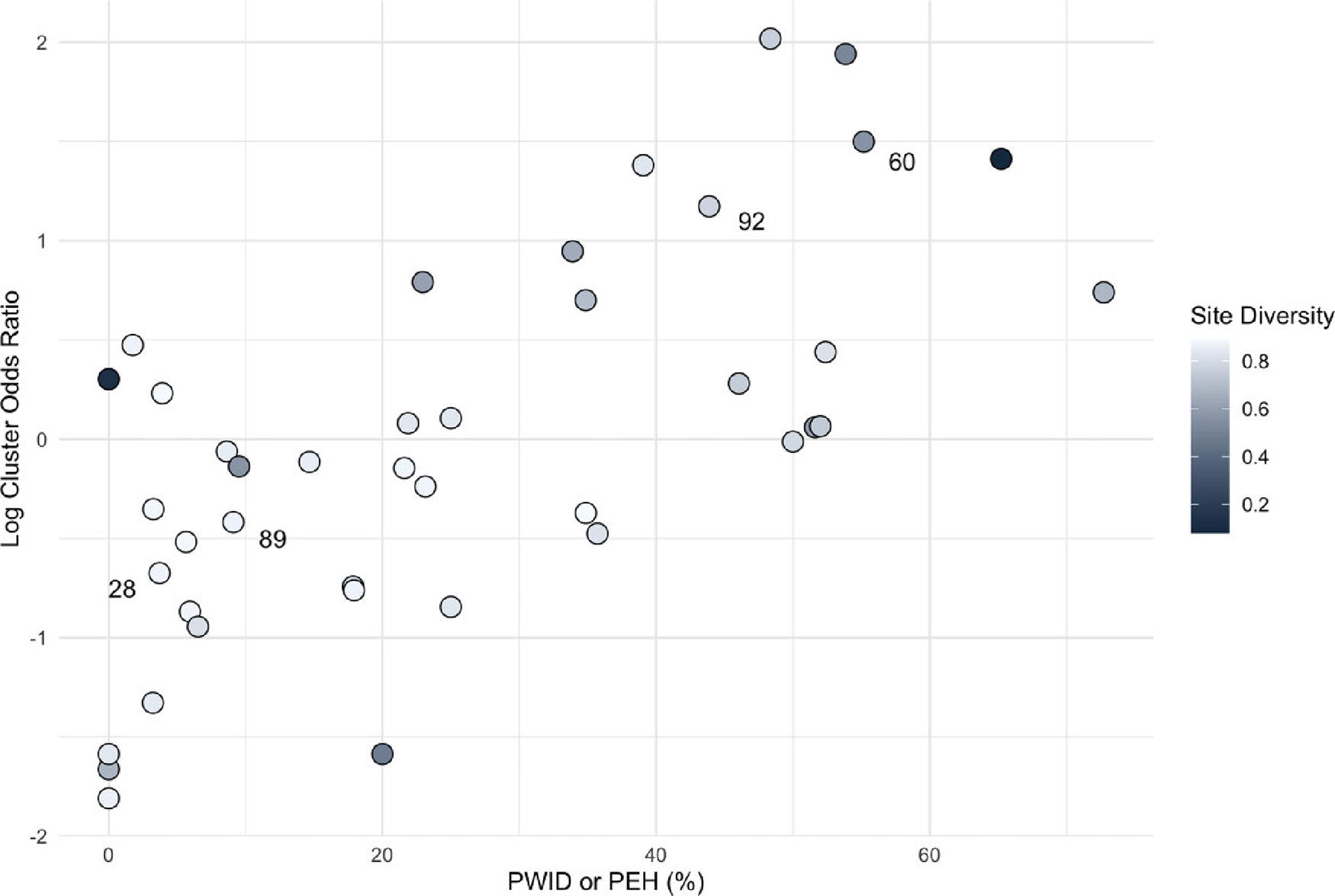
Description:Background. ; Group A streptococci (GAS), although usually responsible for mild infections, can sometimes spread into normally sterile sites and cause invasive GAS disease (iGAS). Because both the risk of iGAS disease and occurrence of outbreaks are elevated within certain communities, such as those comprising people who inject drugs (PWID) and people experiencing homelessness (PEH), understanding the transmission dynamics of GAS is of major relevance to public health. ; Methods. ; We used a cluster detection tool to scan genomes of 7552 Streptococcus pyogenes isolates acquired through the population-based Active Bacterial Core surveillance (ABCs) during 2015-2018 to identify genomically related clusters representing previously unidentified iGAS outbreaks. ; Results. ; We found that 64.6% of invasive isolates were included within clusters of at least 4 temporally related isolates. Calculating a cluster odds ratio (COR) for each emm type revealed that types vary widely in their propensity to form transmission clusters. By incorporating additional epidemiological metadata for each isolate, we found that emm types with a higher proportion of cases occurring among PEH and PWID were associated with higher CORs. Higher CORs were also correlated with emm types that are less geographically dispersed. ; Conclusions. ; Early identification of clusters with implementation of outbreak control measures could result in significant reduction of iGAS.
-
Subjects:
-
Keywords:
-
Source:J Infect Dis. 226(3):546-553
-
Pubmed ID:35511035
-
Pubmed Central ID:PMC11058745
-
Document Type:
-
Funding:
-
Genre:
-
Volume:226
-
Issue:3
-
Download URL:
-
File Type:
 [PDF - 645.84 KB]
 -
Collection(s):
-
Main Document Checksum:urn:sha-512:f55249409c69b7afa8ea9082e34cd50cefbb87e29b3cad4f468439cb5b5cc1944bb592b1078f924b66d50e26b7f806fa921beef8bc995ab7617bf7fbfef9bea5
Supporting Files


File Language:
English
 Was this page helpful?
 Found an issue?



CDC STACKS serves as an archival repository of CDC-published products including
scientific findings, journal articles, guidelines, recommendations, or other public health information authored or
co-authored by CDC or funded partners.
As a repository, CDC STACKS retains documents in their original published format to ensure public access to scientific information.
As a repository, CDC STACKS retains documents in their original published format to ensure public access to scientific information.
You May Also Like
COLLECTION
CDC Public Access