


Antenatal Hospitalizations Among Pregnancies Conceived With and Without Assisted Reproductive Technology
Supporting Files

-
05/01/2016
-
File Language:
English
Details
-
Alternative Title:Obstet Gynecol
-
Personal Author:
-
Corporate Authors:
-
Description:OBJECTIVE:
To describe the prevalence of antenatal hospitalizations, compare characteristics of women with and without antenatal hospitalizations, and compare timing, length of stay, and reason for hospitalization among pregnancies conceived with and without assisted reproductive technology (ART).
METHODS:
We performed a retrospective cohort analysis using linked ART surveillance, vital records, and hospital discharge data from Michigan to calculate the hospitalization ratio as the number of antenatal admissions per 100 live birth deliveries for ART and non-ART deliveries during 2004–2012 and compare trends by ART status. We then restricted analysis to 2008–2012 and used logistic, multinomial, and Poisson regression analysis to model antenatal admissions, trimester of admission, and length of stay, respectively, for ART compared with non-ART deliveries. We examined reason for hospitalization by ART status.
RESULTS:
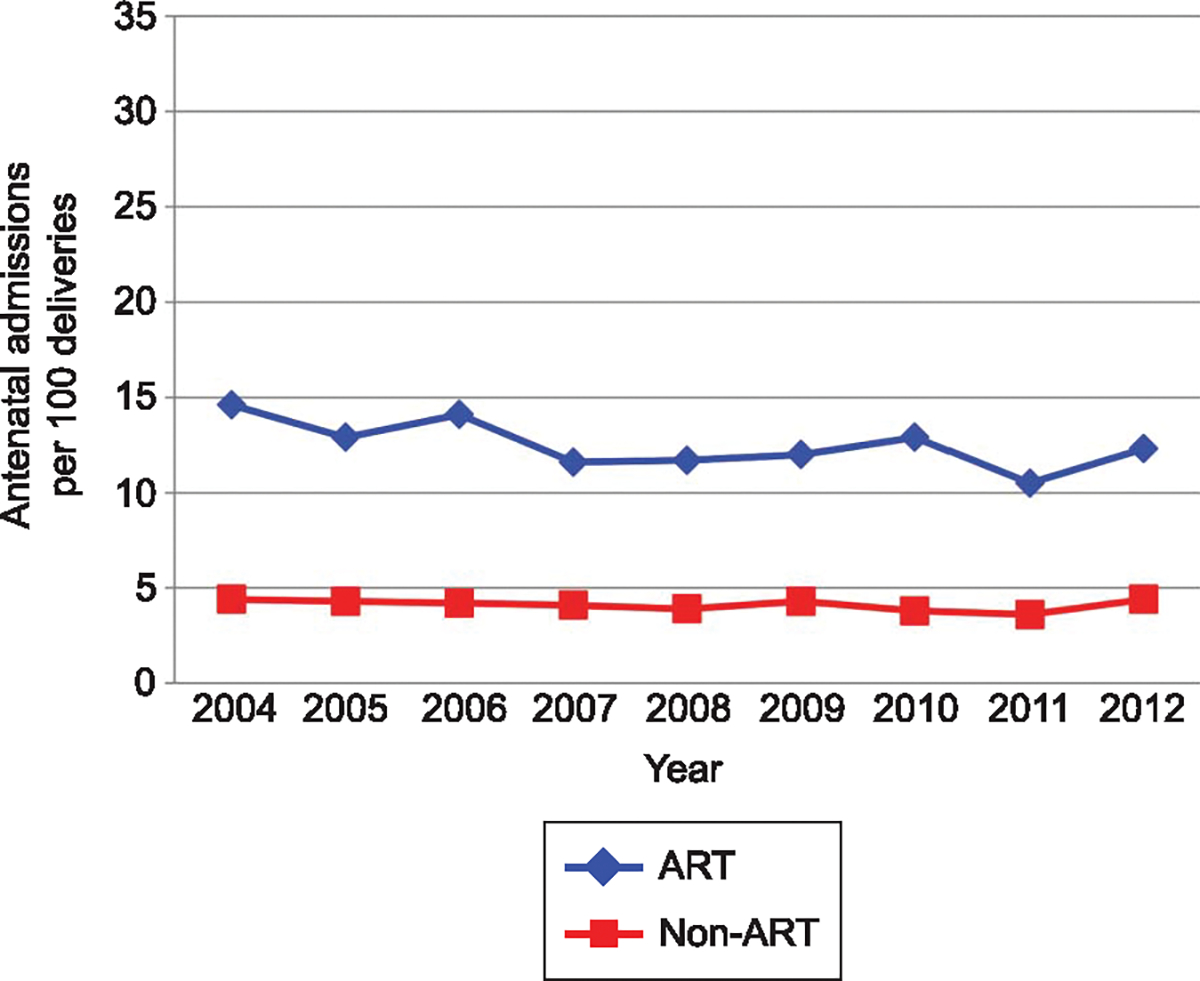
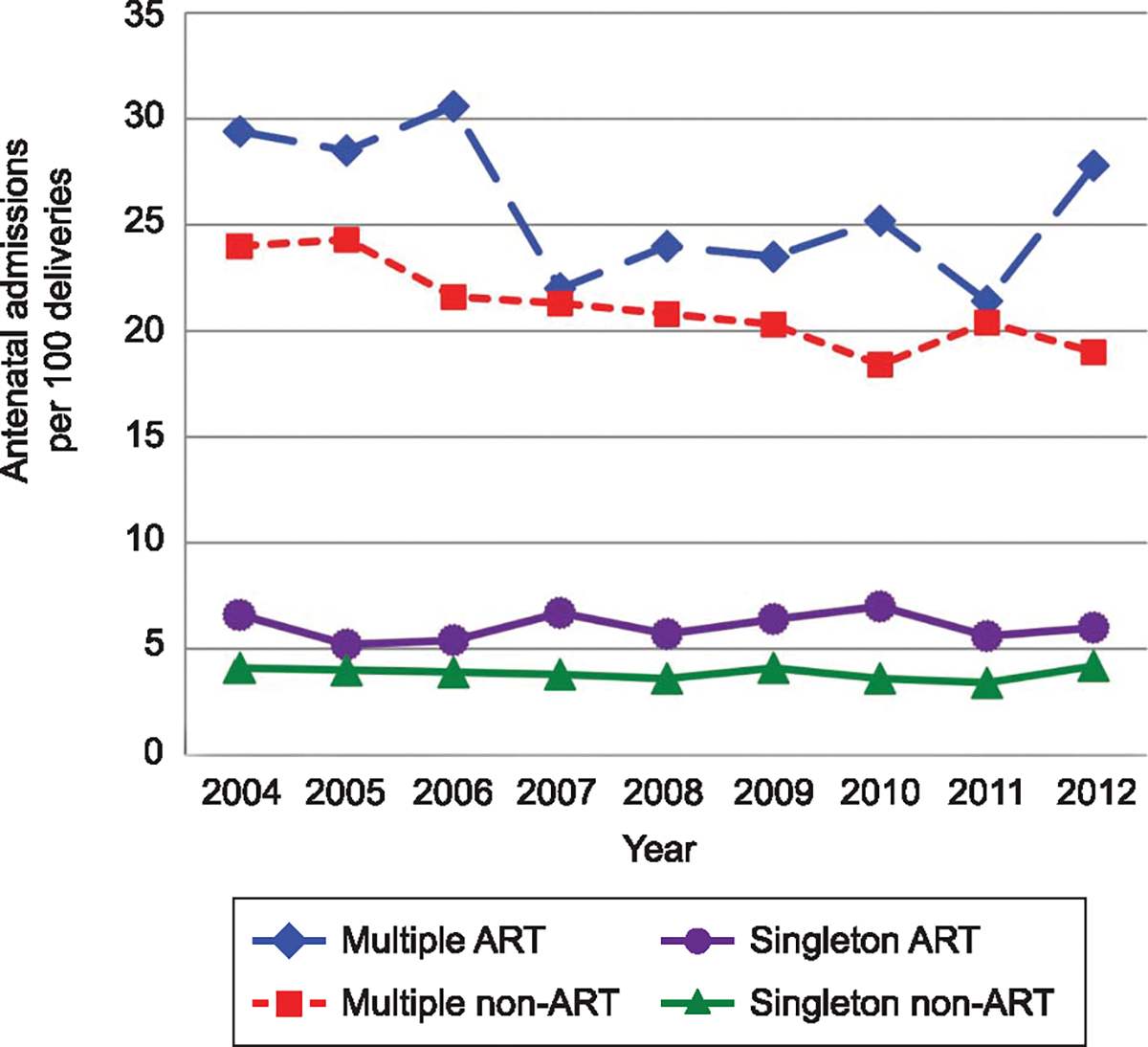
Between 2004 and 2012, the hospitalization ratio for ART deliveries decreased from 14.6 to 12.3 per 100 deliveries (P<.001). Of 557,708 live deliveries during 2008–2012, 22,763 (4.1%) had an antenatal hospitalization. Assisted reproductive technology was a risk factor for having any antenatal admission (singletons adjusted risk ratio [RR] 1.63, 95% confidence interval [CI] 1.43–1.83; multiples adjusted RR 1.24, 95% CI 1.12–1.38) and two or more admissions (singletons adjusted RR 1.86, 95% CI 1.25–2.75; multiples adjusted RR 1.33, 95% CI 1.14–1.54). The percent of time (days) hospitalized during the antenatal period was greater for ART deliveries than non-ART deliveries (singleton adjusted RR 1.28, 95% CI 1.09–1.51; multiples adjusted RR 1.14, 95% CI 1.01–1.29). The most common reason for antenatal admission was preterm labor among all non-ART and multiple gestation deliveries and vaginal bleeding among ART singleton gestations.
CONCLUSION:
Deliveries after ART were associated with increased risk of antenatal admissions and longer hospitalizations compared with non-ART deliveries.
-
Subjects:
-
Source:Obstet Gynecol. 127(5):941-950
-
Series:
-
Subseries:
-
DOI:
-
Pubmed ID:27054936
-
Pubmed Central ID:PMC11046442
-
Document Type:
-
Funding:
-
Genre:
-
Place as Subject:
-
CIO:
-
Division:
-
Topic:
-
Location:
-
Volume:127
-
Issue:5
-
Collection(s):
-
Main Document Checksum:urn:sha-512:85701be8090c86dc199b4972a929815612c7f3086113ed12d6c7dd3bfb38fda81fc248a032ff2fc1f26b636384a7710983a9ea5b95aaeb7bd77e80b6640aa78c
-
Download URL:
-
File Type:
 [PDF
- 609.24 KB
]
[PDF
- 609.24 KB
]
Supporting Files


File Language:
English
ON THIS PAGE

CDC STACKS serves as an archival repository of CDC-published products including
scientific findings,
journal articles, guidelines, recommendations, or other public health information authored or
co-authored by CDC or funded partners.
As a repository, CDC STACKS retains documents in their original published format to ensure public access to scientific information.
As a repository, CDC STACKS retains documents in their original published format to ensure public access to scientific information.
You May Also Like
COLLECTION
CDC Public Access