


Lifetime risk, life expectancy, and years of life lost to type 2 diabetes in 23 high-income jurisdictions: a multinational, population-based study
Supporting Files

-
11 2022
-
File Language:
English
Details
-
Alternative Title:Lancet Diabetes Endocrinol
-
Personal Author:Tomic, Dunya ; Morton, Jedidiah I ; Chen, Lei ; Salim, Agus ; Gregg, Edward W ; Pavkov, Meda E ; Arffman, Martti ; Balicer, Ran ; Baviera, Marta ; Boersma-van Dam, Elise ; Brinks, Ralph ; Carstensen, Bendix ; Chan, Juliana C N ; Cheng, Yiling J ; Fosse-Edorh, Sandrine ; Fuentes, Sonsoles ; Gardiner, Hélène ; Gulseth, Hanne L ; Gurevicius, Romualdas ; Ha, Kyoung Hwa ; Hoyer, Annika ; Jermendy, György ; Kautzky-Willer, Alexandra ; Keskimäki, Ilmo ; Kim, Dae Jung ; Kiss, Zoltán ; Klimek, Peter ; Leventer-Roberts, Maya ; Lin, Chun-Yi ; Lopez-Doriga Ruiz, Paz ; Luk, Andrea O Y ; Ma, Stefan ; Mata-Cases, Manel ; Mauricio, Dídac ; McGurnaghan, Stuart ; Imamura, Tomoaki ; Paul, Sanjoy K ; Peeters, Anna ; Pildava, Santa ; Porath, Avi ; Robitaille, Cynthia ; Roncaglioni, Maria Carla ; Sugiyama, Takehiro ; Wang, Kang-Ling ; Wild, Sarah H ; Yekutiel, Naama ; Shaw, Jonathan E ; Magliano, Dianna J
-
Description:Background
Diabetes is a major public health issue. Because lifetime risk, life expectancy, and years of life lost are meaningful metrics for clinical decision making, we aimed to estimate these measures for type 2 diabetes in the high-income setting.
Methods
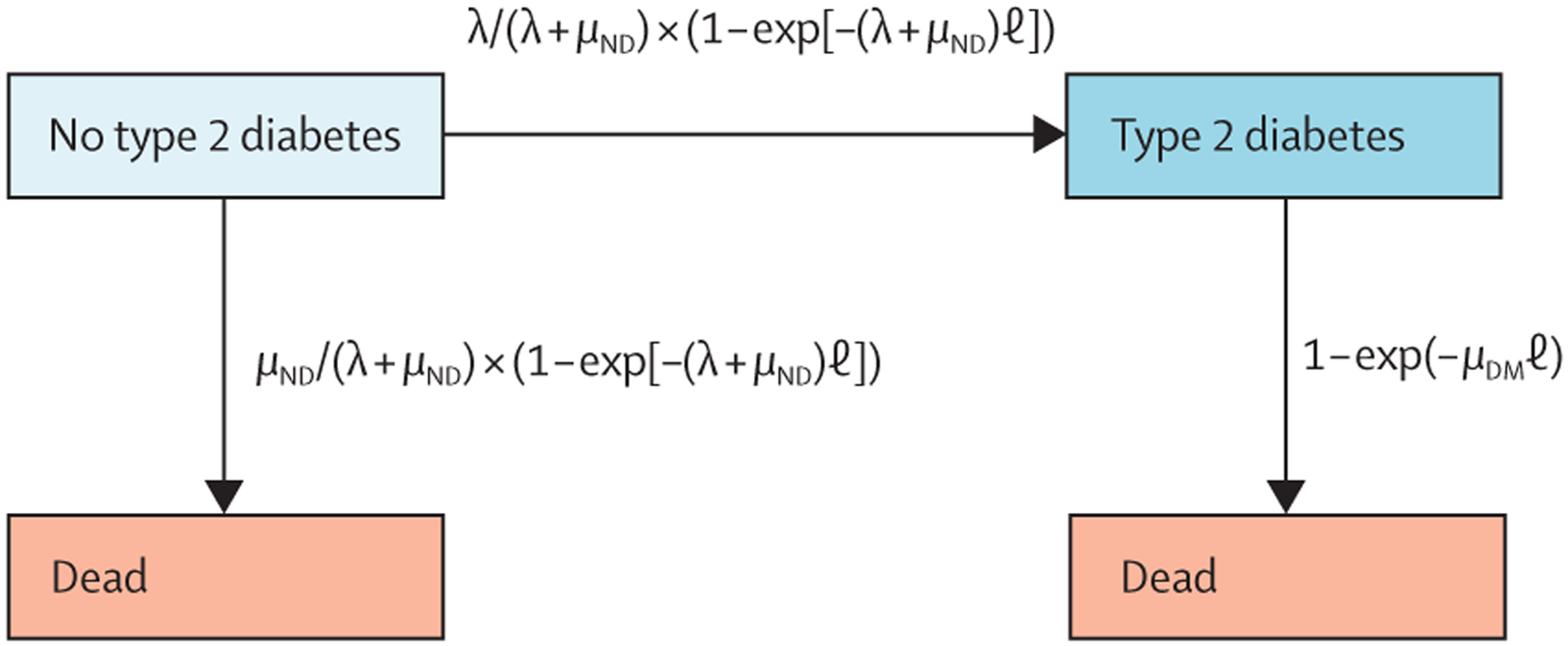
For this multinational, population-based study, we sourced data from 24 databases for 23 jurisdictions (either whole countries or regions of a country): Australia; Austria; Canada; Denmark; Finland; France; Germany; Hong Kong; Hungary; Israel; Italy; Japan; Latvia; Lithuania; the Netherlands; Norway; Scotland; Singapore; South Korea; Spain; Taiwan; the UK; and the USA. Our main outcomes were lifetime risk of type 2 diabetes, life expectancy in people with and without type 2 diabetes, and years of life lost to type 2 diabetes. We modelled the incidence and mortality of type 2 diabetes in people with and without type 2 diabetes in sex-stratified, age-adjusted, and calendar year-adjusted Poisson models for each jurisdiction. Using incidence and mortality, we constructed life tables for people of both sexes aged 20–100 years for each jurisdiction and at two timepoints 5 years apart in the period 2005–19 where possible. Life expectancy from a given age was computed as the area under the survival curves and lifetime lost was calculated as the difference between the expected lifetime of people with versus without type 2 diabetes at a given age. Lifetime risk was calculated as the proportion of each cohort who developed type 2 diabetes between the ages of 20 years and 100 years. We estimated 95% CIs using parametric bootstrapping.
Findings
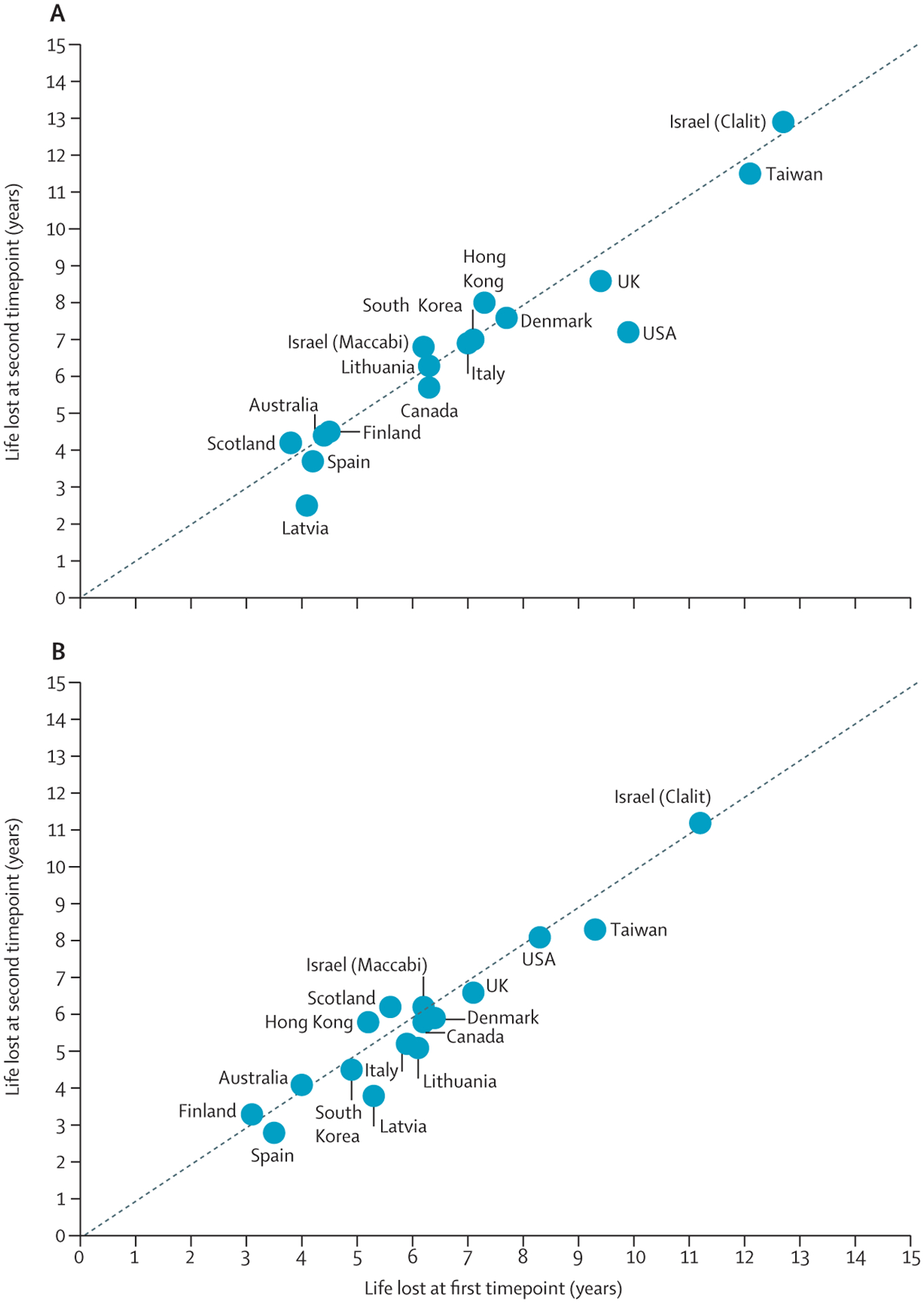
Across all study cohorts from the 23 jurisdictions (total person-years 1 577 234 194), there were 5 119 585 incident cases of type 2 diabetes, 4 007 064 deaths in those with type 2 diabetes, and 11 854 043 deaths in those without type 2 diabetes. The lifetime risk of type 2 diabetes ranged from 16·3% (95% CI 15·6–17·0) for Scottish women to 59·6% (58·5–60·8) for Singaporean men. Lifetime risk declined with time in 11 of the 15 jurisdictions for which two timepoints were studied. Among people with type 2 diabetes, the highest life expectancies were found for both sexes in Japan in 2017–18, where life expectancy at age 20 years was 59·2 years (95% CI 59·2–59·3) for men and 64·1 years (64·0–64·2) for women. The lowest life expectancy at age 20 years with type 2 diabetes was observed in 2013–14 in Lithuania (43·7 years [42·7–44·6]) for men and in 2010–11 in Latvia (54·2 years [53·4–54·9]) for women. Life expectancy in people with type 2 diabetes increased with time for both sexes in all jurisdictions, except for Spain and Scotland. The life expectancy gap between those with and without type 2 diabetes declined substantially in Latvia from 2010–11 to 2015–16 and in the USA from 2009–10 to 2014–15. Years of life lost to type 2 diabetes ranged from 2·5 years (Latvia; 2015–16) to 12·9 years (Israel Clalit Health Services; 2015–16) for 20-year-old men and from 3·1 years (Finland; 2011–12) to 11·2 years (Israel Clalit Health Services; 2010–11 and 2015–16) for 20-year-old women. With time, the expected number of years of life lost to type 2 diabetes decreased in some jurisdictions and increased in others. The greatest decrease in years of life lost to type 2 diabetes occurred in the USA between 2009–10 and 2014–15 for 20-year-old men (a decrease of 2·7 years).
Interpretation
Despite declining lifetime risk and improvements in life expectancy for those with type 2 diabetes in many high-income jurisdictions, the burden of type 2 diabetes remains substantial. Public health strategies might benefit from tailored approaches to continue to improve health outcomes for people with diabetes.
-
Subjects:
-
Source:Lancet Diabetes Endocrinol. 10(11):795-803
-
Pubmed ID:36183736
-
Pubmed Central ID:PMC10988609
-
Document Type:
-
Funding:
-
Volume:10
-
Issue:11
-
Collection(s):
-
Main Document Checksum:urn:sha256:3ac3b8d8c087830ba5f94849d21f54cf32b63b84dc302c7b023b62492b6919da
-
Download URL:
-
File Type:
 [PDF
- 638.99 KB
]
[PDF
- 638.99 KB
]
Supporting Files


File Language:
English
ON THIS PAGE


CDC STACKS serves as an archival repository of CDC-published products including
scientific findings,
journal articles, guidelines, recommendations, or other public health information authored or
co-authored by CDC or funded partners.
As a repository, CDC STACKS retains documents in their original published format to ensure public access to scientific information.
As a repository, CDC STACKS retains documents in their original published format to ensure public access to scientific information.
You May Also Like
COLLECTION
CDC Public Access