



Establishing a Public Health Emergency Operations Center in an Outbreak-Prone Country: Lessons Learned in Uganda, January 2014 to December 2021
Supporting Files

-
2022 ; Sep-Oct 2022
-
Available in CDC Stacks on April 02, 2024, 12:00 AM
File Language:
English
Details
-
Alternative Title:Health Secur
-
Personal Author:Kayiwa, Joshua ; Homsy, Jaco ; Nelson, Lisa J. ; Ocom, Felix ; Kasule, Juliet N. ; Wetaka, Milton M. ; Kyazze, Simon ; Mwanje, Wilbrod ; Kisakye, Anita ; Nabunya, Dorothy ; Nyirabakunzi, Margaret ; Aliddeki, Dativa Maria ; Ojwang, Joseph ; Boore, Amy ; Kasozi, Sam ; Borchert, Jeff ; Shoemaker, Trevor ; Nabatanzi, Sandra ; Dahlke, Melissa ; Brown, Vance ; Downing, Robert ; Makumbi, Issa
-
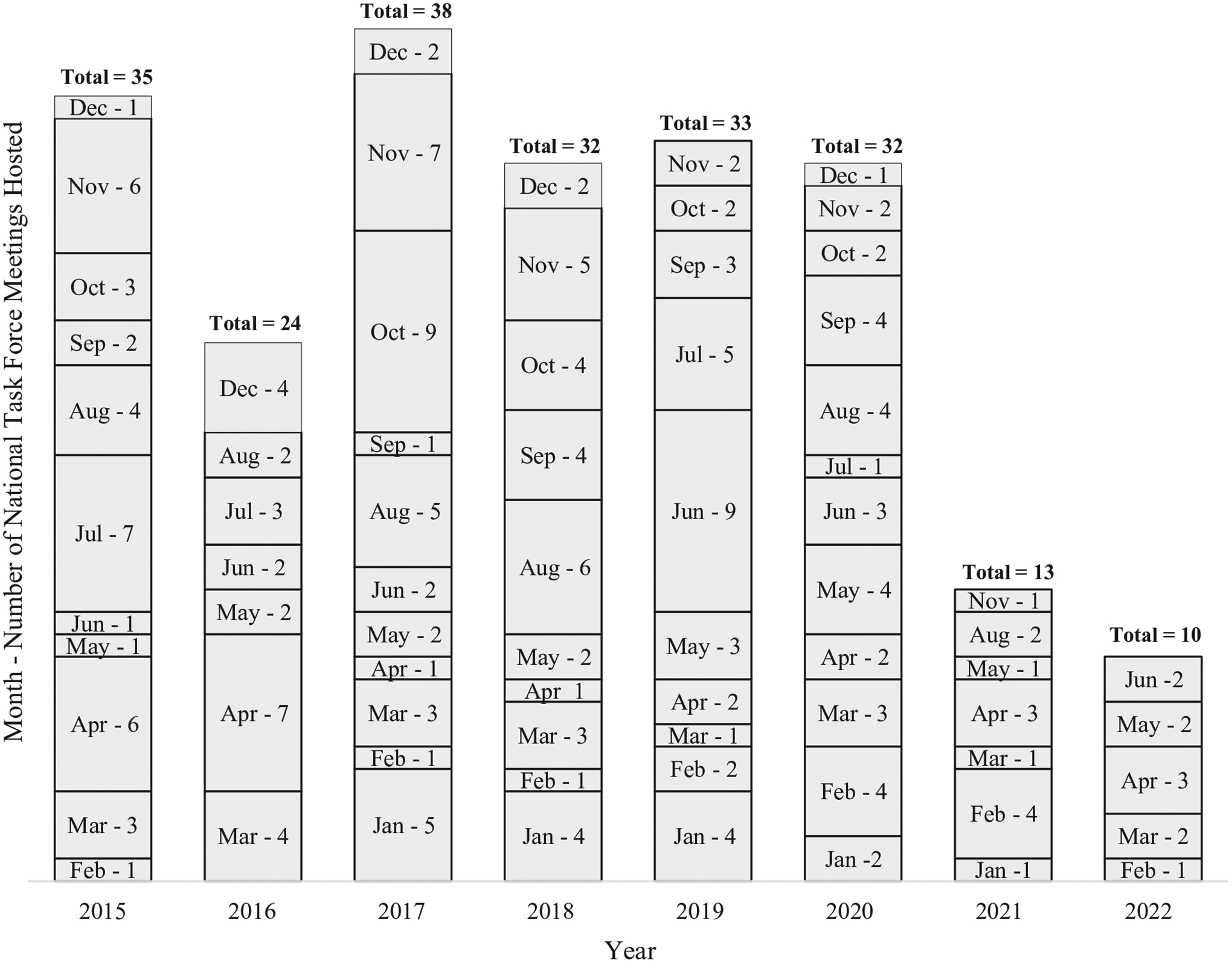
Description:Uganda is highly vulnerable to public health emergencies (PHEs) due to its geographic location next to the Congo Basin epidemic hot spot, placement within multiple epidemic belts, high population growth rates, and refugee influx. In view of this, Uganda's Ministry of Health established the Public Health Emergency Operations Center (PHEOC) in September 2013, as a central coordination unit for all PHEs in the country. Uganda followed the World Health Organization's framework to establish the PHEOC, including establishing a steering committee, acquiring legal authority, developing emergency response plans, and developing a concept of operations. The same framework governs the PHEOC's daily activities. Between January 2014 and December 2021, Uganda's PHEOC coordinated response to 271 PHEs, hosted 207 emergency coordination meetings, trained all core staff in public health emergency management principles, participated in 21 simulation exercises, coordinated Uganda's Global Health Security Agenda activities, established 6 subnational PHEOCs, and strengthened the capacity of 7 countries in public health emergency management. In this article, we discuss the following lessons learned: PHEOCs are key in PHE coordination and thus mitigate the associated adverse impacts; although the functions of a PHEOC may be legalized by the existence of a National Institute of Public Health, their establishment may precede formally securing the legal framework; staff may learn public health emergency management principles on the job; involvement of leaders and health partners is crucial to the success of a public health emergency management program; subnational PHEOCs are resourceful in mounting regional responses to PHEs; and service on the PHE Strategic Committee may be voluntary.
-
Subjects:
-
Keywords:
-
Source:Health Secur. 20(5):394-407
-
Pubmed ID:35984936
-
Pubmed Central ID:PMC10985018
-
Document Type:
-
Funding:
-
Volume:20
-
Issue:5
-
Download URL:
-
File Type:
 [PDF - 778.22 KB]
 -
Collection(s):
-
Main Document Checksum:urn:sha256:39b7f260257d747b78075218bd744a8c497c0cd78c653ad4fad1e9478c41134d
Supporting Files


File Language:
English
 Was this page helpful?
 Found an issue?


CDC STACKS serves as an archival repository of CDC-published products including
scientific findings, journal articles, guidelines, recommendations, or other public health information authored or
co-authored by CDC or funded partners.
As a repository, CDC STACKS retains documents in their original published format to ensure public access to scientific information.
As a repository, CDC STACKS retains documents in their original published format to ensure public access to scientific information.
You May Also Like
COLLECTION
CDC Public Access