



Multinational Outbreak of Listeria monocytogenes Infections Linked to Enoki Mushrooms Imported from the Republic of Korea 2016–2020
Supporting Files

-
7 2023 ; 7-2023
-
Available in CDC Stacks on March 18, 2024, 12:00 AM
File Language:
English
Details
-
Alternative Title:J Food Prot
-
Personal Author:Pereira, Evelyn ; Conrad, Amanda ; Tesfai, Adiam ; Palacios, Alexandra ; Kandar, Rima ; Kearney, Ashley ; Locas, Annie ; Jamieson, Fred ; Elliot, Elisa ; Otto, Mark ; Kurdilla, Kerry ; Tijerina, Mary ; Son, Insook ; Pettengill, James B. ; Chen, Yi ; Fox, Teresa ; Lane, Chris ; Aguillon, Ryan ; Huffman, Jasmine ; Low, Mabel Sheau Fong ; Wise, Matthew ; Edwards, Lauren ; Bidol, Sally ; Blankenship, Heather M. ; Rosen, Hilary E. ; Leclercq, Alexandre ; Lecuit, Marc ; Tourdjman, Mathieu ; Herber, Hubert ; Singleton, Lauren S. ; Viazis, Stelios ; Bazaco, Michael C.
-
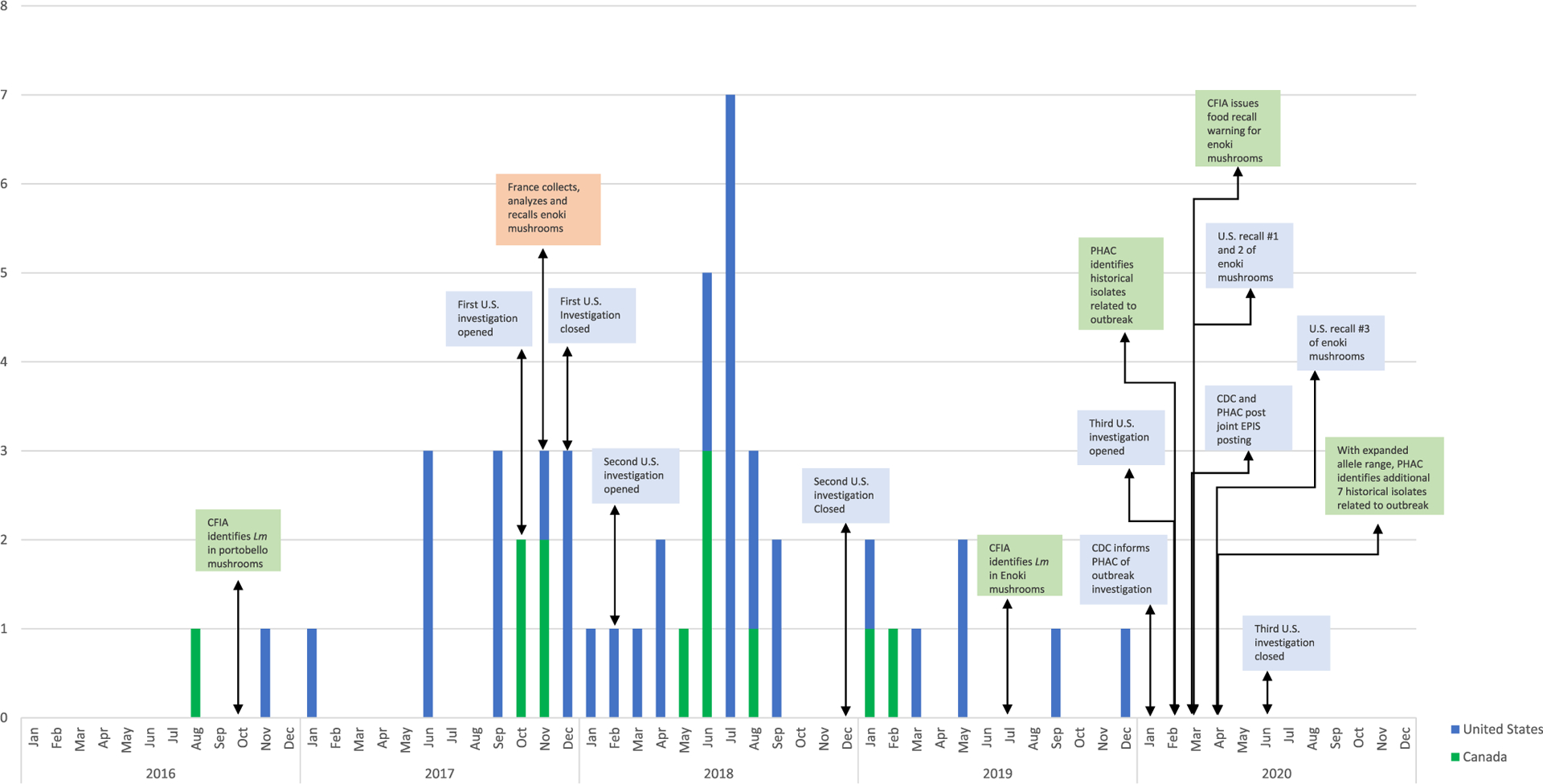
Description:Keeping the global food supply safe necessitates international collaborations between countries. Health and regulatory agencies routinely communicate during foodborne illness outbreaks, allowing partners to share investigational evidence. A 2016-2020 outbreak of Listeria monocytogenes infections linked to imported enoki mushrooms required a multinational collaborative investigation among the United States, Canada, Australia, and France. Ultimately, this outbreak included 48 ill people, 36 in the United States and 12 in Canada, and was linked to enoki mushrooms sourced from one manufacturer located in the Republic of Korea. Epidemiologic, laboratory, and traceback evidence led to multiple regulatory actions, including extensive voluntary recalls by three firms in the United States and one firm in Canada. In the United States and Canada, the Korean manufacturer was placed on import alert while other international partners provided information about their respective investigations and advised the public not to eat the recalled enoki mushrooms. The breadth of the geographic distribution of this outbreak emphasizes the global reach of the food industry. This investigation provides a powerful example of the impact of national and international coordination of efforts to respond to foodborne illness outbreaks and protect consumers. It also demonstrates the importance of fast international data sharing and collaboration in identifying and stopping foodborne outbreaks in the global community. Additionally, it is a meaningful example of the importance of food sampling, testing, and integration of sequencing results into surveillance databases.
-
Subjects:
-
Keywords:
-
Source:J Food Prot. 86(7):100101
-
Pubmed ID:37169291
-
Pubmed Central ID:PMC10947956
-
Document Type:
-
Funding:
-
Volume:86
-
Issue:7
-
Download URL:
-
File Type:
 [PDF - 1.37 MB]
 -
Collection(s):
-
Main Document Checksum:urn:sha256:acf0ac81ef426daeab351006ee4d04ba1ae379ab07181e40bc2f6c29bce25340
Supporting Files


File Language:
English
 Was this page helpful?
 Found an issue?




CDC STACKS serves as an archival repository of CDC-published products including
scientific findings, journal articles, guidelines, recommendations, or other public health information authored or
co-authored by CDC or funded partners.
As a repository, CDC STACKS retains documents in their original published format to ensure public access to scientific information.
As a repository, CDC STACKS retains documents in their original published format to ensure public access to scientific information.
You May Also Like
COLLECTION
CDC Public Access