



Cross-Sectional Association Between Physical Activity Level and Subjective Cognitive Decline Among US Adults Aged ≥45 Years, 2015
Supporting Files

-
12 2020 ; 12-2020
-
Available in CDC Stacks on March 15, 2024, 12:00 AM
File Language:
English
Details
-
Alternative Title:Prev Med
-
Personal Author:
-
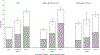
Description:Subjective cognitive decline (SCD) is the self-reported experience of worsening or more frequent confusion or memory loss within the previous 12 months and can be one of the earliest symptoms of Alzheimer's disease. Regular physical activity can contribute to the primary, secondary, and tertiary prevention of cognitive decline. At the national level, prevalence estimates of SCD by physical activity level in the United States are currently unknown. The purpose of this study is to examine the prevalence of SCD and resulting functional limitations by physical activity level among US adults aged ≥45 years. Data from 33 states and the District of Columbia participating in the 2015 Behavioral Risk Factor Surveillance System (N = 128,925) were analyzed. We estimated the prevalence of SCD (a positive response to a question about worsening or more frequent confusion or memory loss within the previous 12 months) and resulting functional limitations overall and by self-reported physical activity level based on current guidelines (i.e., active, insufficiently active, and inactive). Odds ratios were estimated using logistic regression models adjusting for respondent characteristics. Overall, 11.3% of US adults aged ≥45 years reported SCD. Prevalence of SCD increased as physical activity level decreased (active: 8.8%; insufficiently active: 11.4%; inactive: 15.7%). Among those with SCD, the prevalence of functional limitations also increased as physical activity level decreased (active: 40.5%; insufficiently active: 50.0%; inactive: 57.4%). These differences largely remained after adjusting for respondent characteristics. Findings highlight the potential public health impact nationally of efforts to promote physical activity for cognitive health.
-
Subjects:
-
Keywords:
-
Source:Prev Med. 141:106279
-
Pubmed ID:33035548
-
Pubmed Central ID:PMC10941305
-
Document Type:
-
Funding:
-
Volume:141
-
Download URL:
-
File Type:
 [PDF - 161.99 KB]
 -
Collection(s):
-
Main Document Checksum:urn:sha-512:75aa6d3801348e15707108b193e0fcd7c3ac0c66c82566f862fbc157caa54672a82f98b22f0543fb081ef78b9fde1a2617669762bc2dde36ec8d3a4fb4e97640
Supporting Files


File Language:
English
 Was this page helpful?
 Found an issue?


CDC STACKS serves as an archival repository of CDC-published products including
scientific findings, journal articles, guidelines, recommendations, or other public health information authored or
co-authored by CDC or funded partners.
As a repository, CDC STACKS retains documents in their original published format to ensure public access to scientific information.
As a repository, CDC STACKS retains documents in their original published format to ensure public access to scientific information.
You May Also Like
COLLECTION
CDC Public Access