



A Communitywide Collaboration to Increase Enrollment, Retention, and Success in Evidence-Based Lifestyle-Change Programs in Racial and Ethnic Minority Populations
Supporting Files

-
8 03 2023
File Language:
English
Details
-
Journal Article:Preventing Chronic Disease (PCD)
-
Personal Author:Kepper, Maura ; Stamatakis, Katherine A. ; Mudd, Natalie ; Deitch, Ariel ; Terhaar, Ally ; Liu, Julia ; Gates, Emerald ; Williams, Bobie ; Cole, Gabrielle ; French, Carolyn S. ; Hampton, Amy ; Eyler, Amy
-
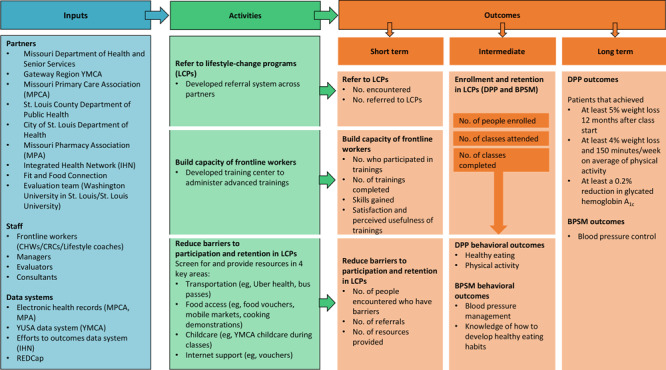
Description:Purpose and Objectives ; Chronic diseases (eg, diabetes, hypertension) are the leading causes of death in the US and disproportionally affect racial and ethnic minority populations. This disparity is partially due to the unequal burden of unmet social needs that stem from several factors, including racism. ; Intervention Approach ; The Alliance is a collaboration among health care, public health, and community organizations formed to improve referral, enrollment, and successful completion of evidence-based lifestyle-change programs, particularly among Black people. The Alliance built 1) a system to assess and address social barriers through the screening and referral process and 2) a training center for frontline staff (eg, community health workers). ; Evaluation Methods ; From January 2020 through September 2022, we conducted an evaluation that included both quantitative and qualitative methods. We developed an electronic database to make referrals and track key barriers to participation. Additionally, we conducted a focus group among frontline staff (N = 15) to understand the challenges in making referrals and discussing, documenting, and addressing barriers to participation. We used surveys that collected quantitative and open-ended qualitative responses to evaluate the training center and to understand perceptions of training modules as well as the skills gained. ; Results ; Frontline staff engaged with 6,036 people, of whom 847 (14%) were referred to a lifestyle-change program from January 2020 through September 2022. Of those referred, 257 (30%) were eligible and enrolled in a program. Food access and unreliable internet were the most common barriers to participation. Thirteen of 15 frontline staff participated in trainings, and, on average, trainees completed 4.2 trainings and gained several skills (eg, ability to monitor personal bias, de-escalate a crisis, educate on mental health, understand community and environmental factors). ; Implications for Public Health ; The Alliance is an example of how health care, public health, and community partners can work together to increase enrollment in lifestyle-change programs of residents disproportionately affected by chronic diseases. Lessons learned from implementation and evaluation can inform other complex partnerships to improve public health.
-
Subjects:
-
Source:Prev Chronic Dis. 2023; 20
-
DOI:
-
ISSN:1545-1151
-
Pubmed ID:37535902
-
Pubmed Central ID:PMC10431923
-
Document Type:
-
Funding:
-
Genre:
-
Volume:20
-
Download URL:
-
File Type:
 [PDF - 605.44 KB]
 -
Collection(s):
-
Main Document Checksum:urn:sha-512:ee0743185ae9fc24f1085874b1e2f953dbce8ef1a9fbb69f18d05b202b8caacfabf3b6aae17c042b9a24b5dc19e574e4694e746891df943ccc702e0939099b35
Supporting Files


File Language:
English
 Was this page helpful?
 Found an issue?

CDC STACKS serves as an archival repository of CDC-published products including
scientific findings, journal articles, guidelines, recommendations, or other public health information authored or
co-authored by CDC or funded partners.
As a repository, CDC STACKS retains documents in their original published format to ensure public access to scientific information.
As a repository, CDC STACKS retains documents in their original published format to ensure public access to scientific information.
You May Also Like
COLLECTION
Preventing Chronic Disease