



Food Insecurity Trajectories in the US During the First Year of the COVID-19 Pandemic
Supporting Files

-
1 19 2023
File Language:
English
Details
-
Journal Article:Preventing Chronic Disease (PCD)
-
Personal Author:
-
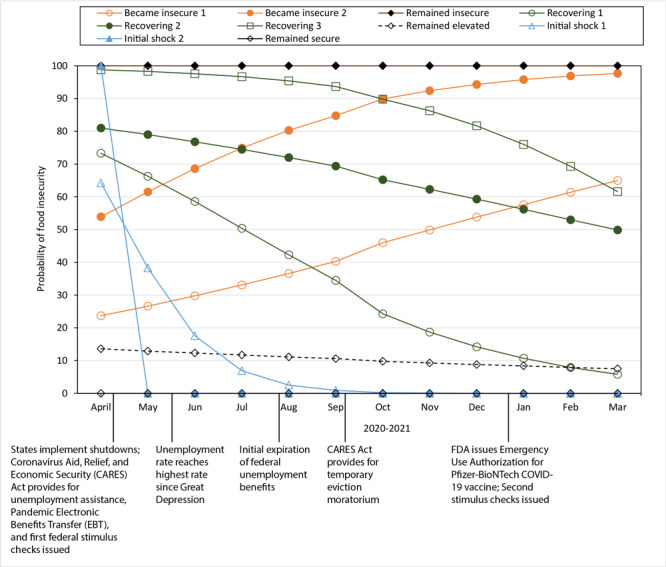
Description:Introduction ; The objective of this study was to characterize population-level trajectories in the probability of food insecurity in the US during the first year of the COVID-19 pandemic and to examine sociodemographic correlates associated with identified trajectories. ; Methods ; We analyzed data from the Understanding America Study survey, a nationally representative panel (N = 7,944) that assessed food insecurity every 2 weeks from April 1, 2020, through March 16, 2021. We used latent class growth analysis to determine patterns (or classes) of pandemic-related food insecurity during a 1-year period. ; Results ; We found 10 classes of trajectories of food insecurity, including 1 class of consistent food security (64.7%), 1 class of consistent food insecurity (3.4%), 5 classes of decreasing food insecurity (15.8%), 2 classes of increasing food insecurity (4.6%), and 1 class of stable but elevated food insecurity (11.6%). Relative to the class that remained food secure, other classes were younger, had a greater proportion of women, and tended to identify with a racial or ethnic minority group. ; Conclusion ; We found heterogeneous longitudinal patterns in the development, resolution, or persistence of food insecurity during the first year of the COVID-19 pandemic. Experiences of food insecurity were highly variable across the US population, with one-third experiencing some form of food insecurity risk. Findings have implications for identifying population groups who are at increased risk of food insecurity and related health disparities beyond the first year of the pandemic.
-
Subjects:
-
Source:Prev Chronic Dis. 2023; 20
-
DOI:
-
ISSN:1545-1151
-
Pubmed ID:36657063
-
Pubmed Central ID:PMC9856052
-
Document Type:
-
Funding:
-
Volume:20
-
Download URL:
-
File Type:
 [PDF - 621.87 KB]
 -
Collection(s):
-
Main Document Checksum:urn:sha-512:9935f65bd2b0cb66e00fbd00e44b2f6d132fe4e7b130fa83b29892826cf78aeb89c499880e0a184dd33993a71838f0287a3506c815c1aaa36d54c77bd89138a7
Supporting Files


File Language:
English
 Was this page helpful?
 Found an issue?

CDC STACKS serves as an archival repository of CDC-published products including
scientific findings, journal articles, guidelines, recommendations, or other public health information authored or
co-authored by CDC or funded partners.
As a repository, CDC STACKS retains documents in their original published format to ensure public access to scientific information.
As a repository, CDC STACKS retains documents in their original published format to ensure public access to scientific information.
You May Also Like
COLLECTION
Preventing Chronic Disease