


Added Sugar Intake and Cardiovascular Diseases Mortality Among US Adults
Supporting Files

-
4 2014
-
File Language:
English
Details
-
Alternative Title:JAMA Intern Med
-
Personal Author:
-
Description:IMPORTANCE
Epidemiologic studies have suggested that higher intake of added sugar is associated with cardiovascular disease (CVD) risk factors. Few prospective studies have examined the association of added sugar intake with CVD mortality.
OBJECTIVE
To examine time trends of added sugar consumption as percentage of daily calories in the United States and investigate the association of this consumption with CVD mortality.
DESIGN, SETTING, AND PARTICIPANTS
National Health and Nutrition Examination Survey (NHANES, 1988-1994 [III], 1999-2004, and 2005-2010 [n = 31 147]) for the time trend analysis and NHANES III Linked Mortality cohort (1988-2006 [n = 11 733]), a prospective cohort of a nationally representative sample of US adults for the association study.
MAIN OUTCOMES AND MEASURES
Cardiovascular disease mortality.
RESULTS
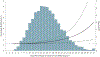
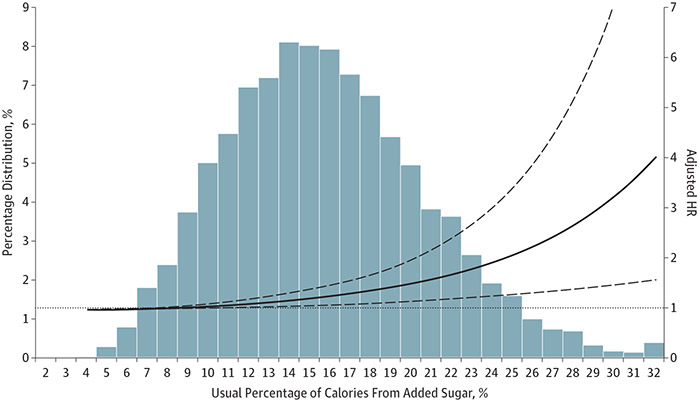
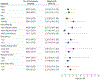
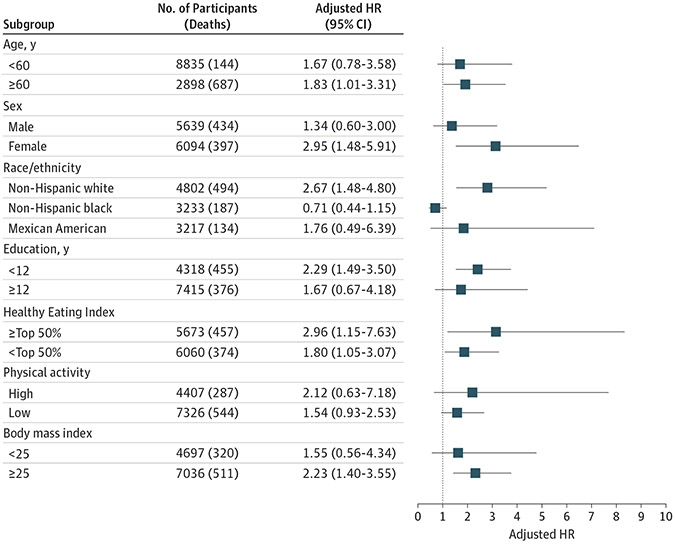
Among US adults, the adjusted mean percentage of daily calories from added sugar increased from 15.7% (95% CI, 15.0%-16.4%) in 1988-1994 to 16.8% (16.0%-17.7%; P = .02) in 1999-2004 and decreased to 14.9% (14.2%-15.5%; P < .001) in 2005-2010. Most adults consumed 10% or more of calories from added sugar (71.4%) and approximately 10% consumed 25% or more in 2005-2010. During a median follow-up period of 14.6 years, we documented 831 CVD deaths during 163 039 person-years. Age-, sex-, and race/ethnicity-adjusted hazard ratios (HRs) of CVD mortality across quintiles of the percentage of daily calories consumed from added sugar were 1.00 (reference), 1.09 (95% CI, 1.05-1.13), 1.23 (1.12-1.34), 1.49 (1.24-1.78), and 2.43 (1.63-3.62; P < .001), respectively. After additional adjustment for sociodemographic, behavioral, and clinical characteristics, HRs were 1.00 (reference), 1.07 (1.02-1.12), 1.18 (1.06-1.31), 1.38 (1.11-1.70), and 2.03 (1.26-3.27; P = .004), respectively. Adjusted HRs were 1.30 (95% CI, 1.09-1.55) and 2.75 (1.40-5.42; P = .004), respectively, comparing participants who consumed 10.0% to 24.9% or 25.0% or more calories from added sugar with those who consumed less than 10.0% of calories from added sugar. These findings were largely consistent across age group, sex, race/ethnicity (except among non-Hispanic blacks), educational attainment, physical activity, health eating index, and body mass index.
CONCLUSIONS AND RELEVANCE
Most US adults consume more added sugar than is recommended for a healthy diet. We observed a significant relationship between added sugar consumption and increased risk for CVD mortality.
-
Subjects:
-
Source:JAMA Intern Med. 174(4):516-524
-
Pubmed ID:24493081
-
Pubmed Central ID:PMC10910551
-
Document Type:
-
Funding:
-
Volume:174
-
Issue:4
-
Collection(s):
-
Main Document Checksum:urn:sha256:e3978aea45358aeb84981644fae9aacbd7e2560efdffa1f7658609a00891123f
-
Download URL:
-
File Type:
 [PDF
- 642.95 KB
]
[PDF
- 642.95 KB
]
Supporting Files


File Language:
English
ON THIS PAGE

CDC STACKS serves as an archival repository of CDC-published products including
scientific findings,
journal articles, guidelines, recommendations, or other public health information authored or
co-authored by CDC or funded partners.
As a repository, CDC STACKS retains documents in their original published format to ensure public access to scientific information.
As a repository, CDC STACKS retains documents in their original published format to ensure public access to scientific information.
You May Also Like
COLLECTION
CDC Public Access