



Flea Presence and Abundance Are Not Predictors of Bartonella tribocorum Carriage in Norway Rats (Rattus norvegicus) from an Underserved Neighborhood of Vancouver, Canada
Supporting Files

-
2 2021 ; 2-2021
-
Available in CDC Stacks on 2024-02-26T00:00:00Z
File Language:
English
Details
-
Alternative Title:Vector Borne Zoonotic Dis
-
Personal Author:
-
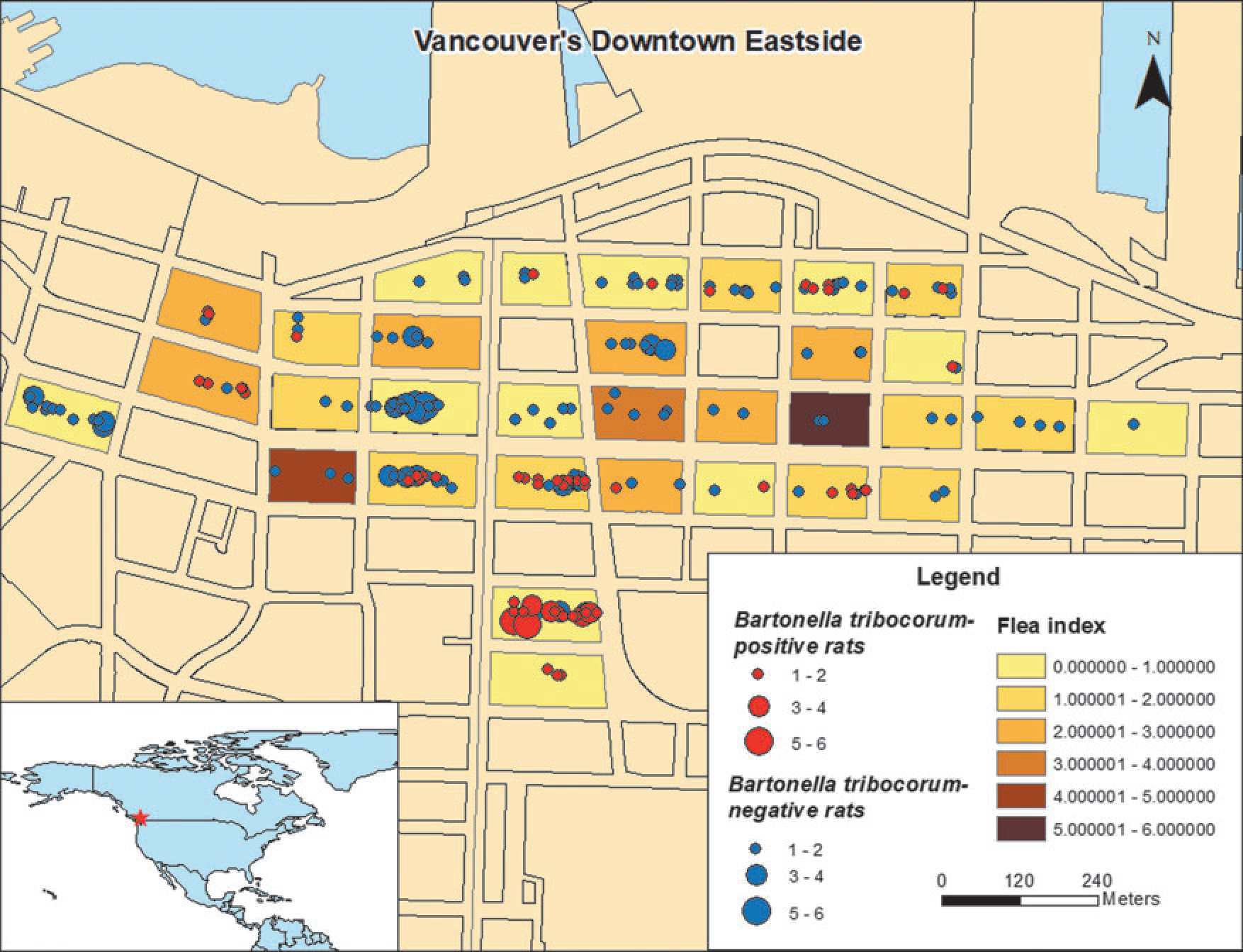
Description:Urban Norway rats (|) carry pathogenic | spp. that are transmitted among rats and from rats to people through arthropod vectors, particularly fleas. There is marked temporospatial variation in | spp. carriage among Norway rats in Vancouver, Canada, and we investigated whether this variation is associated with flea presence or abundance. | was isolated from 96/370 (35%) rats and 211 (57%) rats had fleas with an average of one flea per rat. All fleas were identified as |. There was no significant relationship between | carriage and flea presence or abundance, suggesting that, in contrast to other rat-associated zoonoses transmitted by fleas (|, |) flea indices may not be informative for understanding the ecology of | spp. in rats, particularly for |.
-
Keywords:
-
Source:Vector Borne Zoonotic Dis. 21(2):121-124
-
Pubmed ID:33226890
-
Pubmed Central ID:PMC10895708
-
Document Type:
-
Funding:
-
Volume:21
-
Issue:2
-
Download URL:
-
File Type:
 [PDF - 435.45 KB]
 -
Collection(s):
-
Main Document Checksum:urn:sha256:059cf9c3a9622cb629df9cc99537dd7de48346fb1da1ea5a8289269a3b683c0d
Supporting Files


File Language:
English
 Was this page helpful?
 Found an issue?


CDC STACKS serves as an archival repository of CDC-published products including
scientific findings, journal articles, guidelines, recommendations, or other public health information authored or
co-authored by CDC or funded partners.
As a repository, CDC STACKS retains documents in their original published format to ensure public access to scientific information.
As a repository, CDC STACKS retains documents in their original published format to ensure public access to scientific information.
You May Also Like
COLLECTION
CDC Public Access