


Very Low Driving-Pressure Ventilation in Patients With COVID-19 Acute Respiratory Distress Syndrome on Extracorporeal Membrane Oxygenation: A Physiologic Study
Supporting Files

-
3 2023
-
File Language:
English
Details
-
Alternative Title:J Cardiothorac Vasc Anesth
-
Personal Author:
-
Description:Objectives:
To determine in patients with acute respiratory distress syndrome (ARDS) on venovenous extracorporeal membrane oxygenation (VV ECMO) whether reducing driving pressure (ΔP) would decrease plasma biomarkers of inflammation and lung injury (interleukin-6 [IL-6], IL-8, and the soluble receptor for advanced glycation end-products sRAGE).
Design:
A single-center prospective physiologic study.
Setting:
At a single university medical center.
Participants:
Adult patients with severe COVID-19 ARDS on VV ECMO.
Interventions:
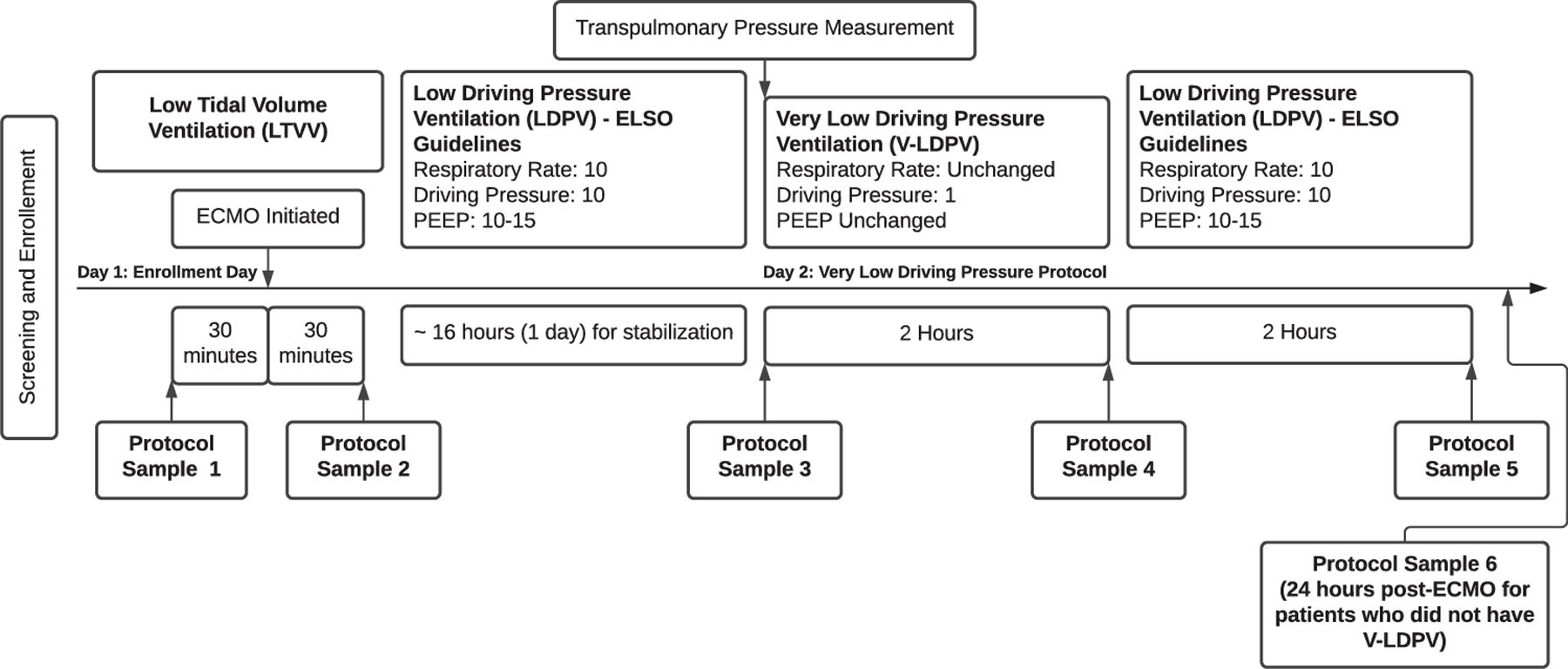
Participants on VV ECMO had the following biomarkers measured: (1) pre-ECMO with low-tidal-volume ventilation (LTVV), (2) post-ECMO with LTVV, (3) during low-driving-pressure ventilation (LDPV), (4) after 2 hours of very low driving-pressure ventilation (V-LDPV, main intervention ΔP = 1 cmH2O), and (5) 2 hours after returning to LDPV.
Main Measurements and Results:
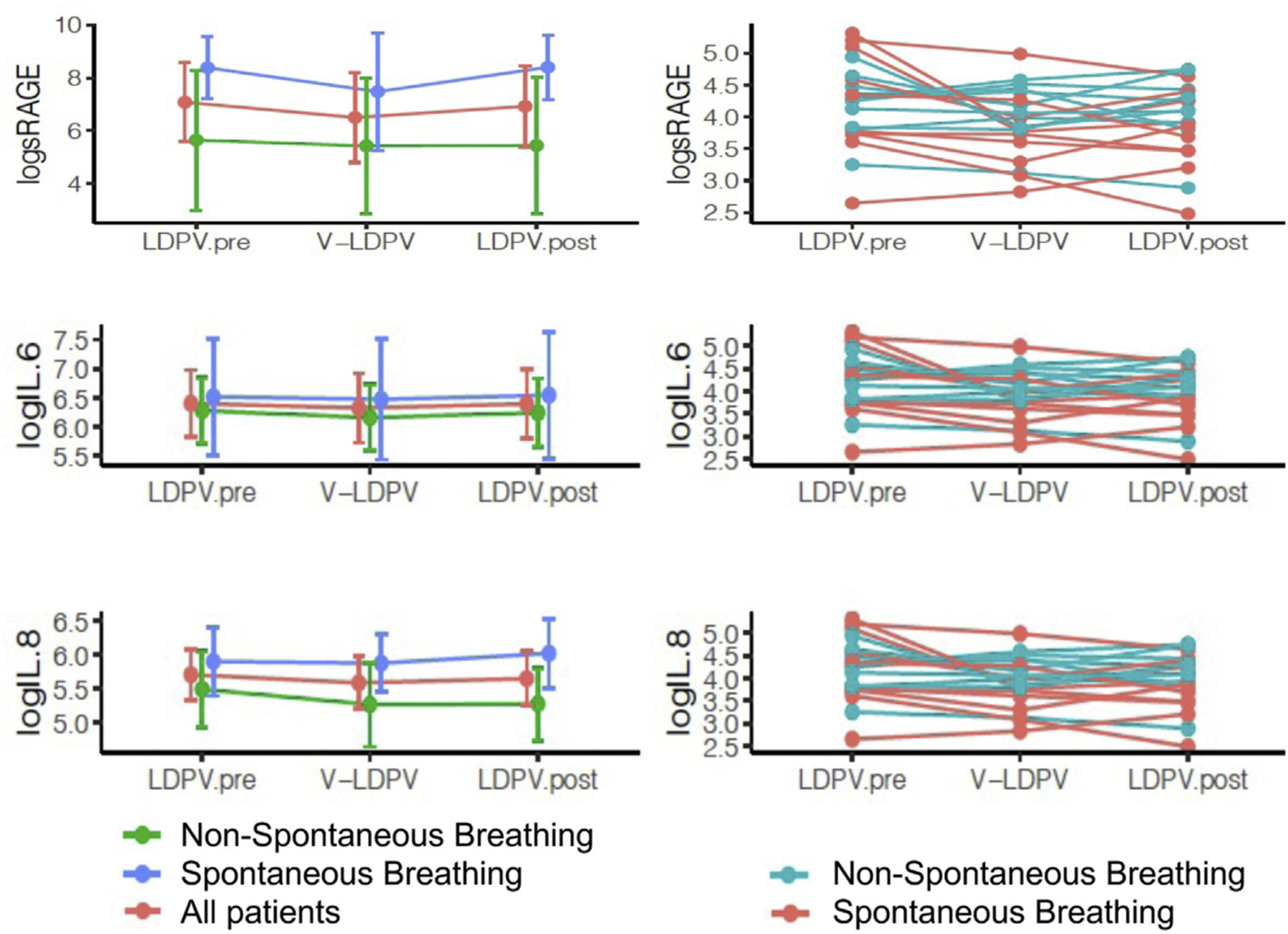
Twenty-six participants were enrolled; 21 underwent V-LDPV. There was no significant change in IL-6, IL-8, and sRAGE from LDPV to V-LDPV and from V-LDPV to LDPV. Only participants (9 of 21) with nonspontaneous breaths had significant change (p < 0.001) in their tidal volumes (Vt) (mean ± SD), 1.9 ± 0.5, 0.1 ± 0.2, and 2.0 ± 0.7 mL/kg predicted body weight (PBW). Participants with spontaneous breathing, Vt were unchanged—4.5 ± 3.1, 4.7 ± 3.1, and 5.6 ± 2.9 mL/kg PBW (p = 0.481 and p = 0.065, respectively). There was no relationship found when accounting for Vt changes and biomarkers.
Conclusions:
Biomarkers did not significantly change with decreased ΔPs or Vt changes during the first 24 hours post-ECMO. Despite deep sedation, reductions in Vt during V-LDPV were not reliably achieved due to spontaneous breaths. Thus, patients on VV ECMO for ARDS may have higher Vt (ie, transpulmonary pressure) than desired despite low ΔPs or Vt.
-
Subjects:
-
Keywords:
-
Source:J Cardiothorac Vasc Anesth. 37(3):423-431
-
Pubmed ID:36567221
-
Pubmed Central ID:PMC9701579
-
Document Type:
-
Funding:R01 HL145470/HL/NHLBI NIH HHSUnited States/ ; R01 HL157985/HL/NHLBI NIH HHSUnited States/ ; I01 BX004767/BX/BLRD VAUnited States/ ; R01 HL133847/HL/NHLBI NIH HHSUnited States/ ; UL1 TR001442/TR/NCATS NIH HHSUnited States/ ; K24 HL132105/HL/NHLBI NIH HHSUnited States/ ; R01 HL142114/HL/NHLBI NIH HHSUnited States/ ; R01 HL119201/HL/NHLBI NIH HHSUnited States/ ; IK2 BX004338/BX/BLRD VAUnited States/ ; K99 AI145762/AI/NIAID NIH HHSUnited States/ ; R01 AG063925/AG/NIA NIH HHSUnited States/ ; R21 HL154026/HL/NHLBI NIH HHSUnited States/ ; U19 AI142742/AI/NIAID NIH HHSUnited States/ ; T32 HL134632/HL/NHLBI NIH HHSUnited States/ ; R01 HL081823/HL/NHLBI NIH HHSUnited States/ ; T32 GM121318/GM/NIGMS NIH HHSUnited States/ ; U01 IP000965/IP/NCIRD CDC HHSUnited States/ ; R01 CA215405/CA/NCI NIH HHSUnited States/ ; R01 HL085188/HL/NHLBI NIH HHSUnited States/ ; KL2 TR001444/TR/NCATS NIH HHSUnited States/ ; R01 HL154926/HL/NHLBI NIH HHSUnited States/ ; R01 HL148436/HL/NHLBI NIH HHSUnited States/ ; UG1 HL139117/HL/NHLBI NIH HHSUnited States/ ; R01 HL137052/HL/NHLBI NIH HHSUnited States/
-
Volume:37
-
Issue:3
-
Collection(s):
-
Main Document Checksum:urn:sha-512:afe5128a80ddc09cf7010618dc00f92fdefb7738ad2238c4e6d3bad2db4cbd69a7ea3b1d5646f595375f85f28034aa6a0ed17df5bbacf6ba1ce80bfbe2d3b97c
-
Download URL:
-
File Type:
 [PDF
- 891.85 KB
]
[PDF
- 891.85 KB
]
Supporting Files


File Language:
English
ON THIS PAGE


CDC STACKS serves as an archival repository of CDC-published products including
scientific findings,
journal articles, guidelines, recommendations, or other public health information authored or
co-authored by CDC or funded partners.
As a repository, CDC STACKS retains documents in their original published format to ensure public access to scientific information.
As a repository, CDC STACKS retains documents in their original published format to ensure public access to scientific information.
You May Also Like
COLLECTION
CDC Public Access